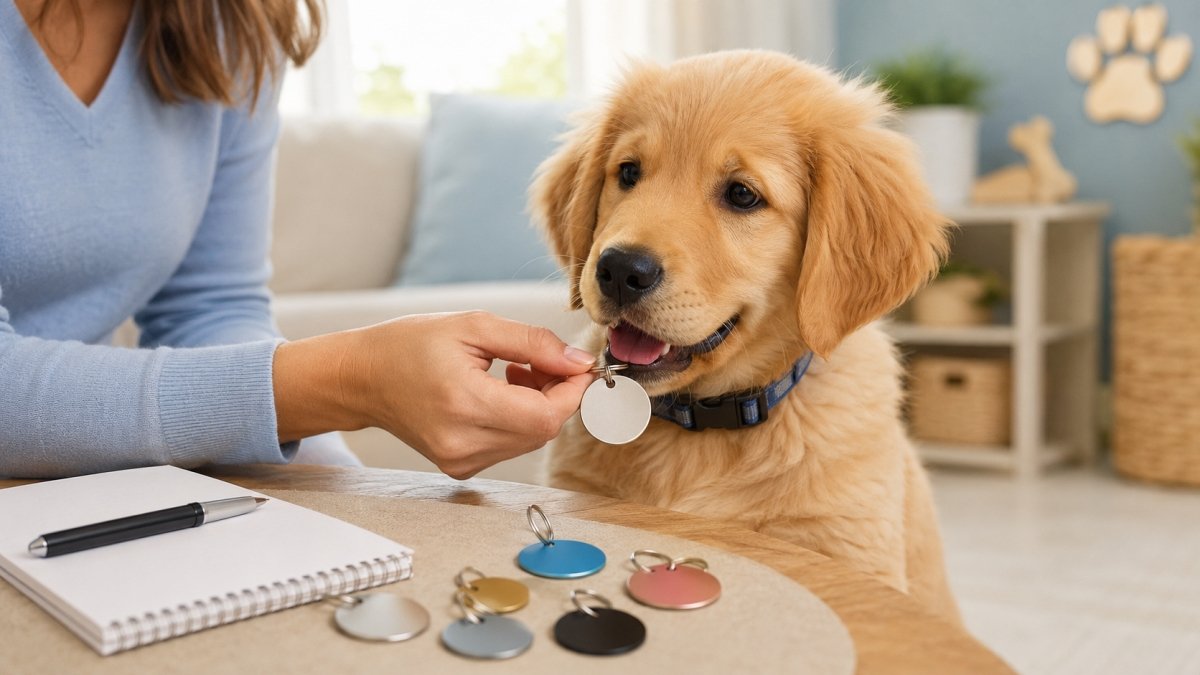
Picking a name feels like it should be the fun part of bringing home a dog, and it is, but it’s also the first decision you’ll live with for the next 10 to 15 years, said out loud in the vet’s waiting room, at the dog park, and a hundred times a day in your own kitchen. Whether you’re staring at a brand-new puppy who hasn’t earned a name yet, or you’ve just adopted a rescue dog who came with one that doesn’t feel right, the pressure to get it “right” is real.
The good news: there’s more to work with here than gut feeling. Dogs actually process names in a specific, well-studied way, and that science can save you from picking a name that’s cute on paper but hard for your dog to learn. This guide walks through what makes a name land, how dogs learn names in the first place, the most popular names right now, how to teach a name (new or replacement) so it actually sticks, and what to do if your dog is ignoring theirs.
What Makes a Good Dog Name?
Before you fall in love with a name, it helps to run it through a few practical filters. None of these are hard rules; a name you adore is worth some flexibility, but they explain why some names are easier to live with than others.
- Sound: Names with one or two syllables that end in a vowel sound — think Bella, Rocky, Milo — tend to be easier for dogs to pick out from a sentence and easier for you to say quickly in a recall situation. Longer names usually get shortened anyway, so you might as well start there.
- Distinctiveness from commands: Avoid names that rhyme with or closely resemble common cues. “Kit” sounds a lot like “sit,” and “Beau” can blur into “no” in a noisy environment. A dog that’s not sure whether you’re calling her or correcting her will hesitate on both.
- Distinctiveness from household names: If a family member is named something close to the name you’re considering, expect some confused head-turns from both of them.
- How it feels to say in public: You’ll be calling this name across a dog park, down a hallway at the vet, and out your front door. Picking something you’re comfortable saying loudly and often matters more than it sounds like it would.
- Longevity: A name tied to a meme, a show, or an inside joke can feel dated in a couple of years, while you’ll be using it for over a decade. That doesn’t mean avoid humor entirely; just picture yourself saying it in ten years, not ten days.
- Popularity trade-offs: A trendy name isn’t wrong, but at a crowded dog park or in a group training class, three dogs turning around at once is a minor headache you can sidestep.
How Do Dogs Actually Learn Their Name?

This is the part most naming guides skip, and it’s worth understanding because it changes how you should think about the name itself.
Dogs don’t understand names the way people understand vocabulary; there’s no dictionary definition in a dog’s head for “Bella.” Instead, a name becomes meaningful through repeated pairing: the sound of the name predicts something relevant happens next: you make eye contact, a treat appears, a walk starts. Over time, the sound itself becomes a cue worth paying attention to, a process rooted in classical conditioning, the same basic learning mechanism behind Pavlov’s famous dogs and their bell.
Research summarized by the American Psychological Association suggests the average dog can learn upwards of 150 words, with especially quick learners recognizing 250 or more — and most dogs pick up a new name within about a week of consistent use, according to PetMD. Those figures vary by dog, training consistency, and breed, so treat them as a general range rather than a guarantee for any individual dog.
One popular naming myth is worth retiring: the old advice to favor hard consonant sounds like “K” or “D” because dogs supposedly hear them more clearly. Current research suggests dogs don’t reliably distinguish between similar-sounding speech sounds the way that theory assumes — what dogs actually lean on is a mix of the sound pattern, your tone of voice, and context, according to the American Kennel Club. In practice, that means a name’s “consonant hardness” matters a lot less than how consistently and warmly you use it.
There’s also a genuinely surprising layer to how far this learning can go. A study covered by NPR found that a small subset of exceptionally quick-learning dogs — nicknamed “genius dogs,” mostly working breeds like Border Collies capable of learning five or more object names — can pick up new words simply by overhearing them in conversation, without anyone deliberately teaching them, much like a toddler absorbing language in the background. Most dogs won’t be genius-dog fast, but it’s a good reminder that dogs are listening — and learning from — far more of your household conversation than they get credit for.
7 Tips for Choosing a Name Your Dog Will Actually Learn Quickly

1. Keep It Short and Sweet
One or two syllables is the sweet spot. Shorter names are quicker for your dog to isolate from the rest of a sentence, and quicker for you to say sharply if you need their attention fast.
2. End on a Vowel Sound
Names like Luna, Cooper, or Daisy carry an open, drawn-out sound that’s easy to say with real emphasis, useful when you’re calling your dog back from across a field.
3. Say It Out Loud, a Lot, Before You Commit
Don’t just read the name — shout it across a room the way you would to call your dog in from the yard. Some names look great on paper and feel awkward the fiftieth time you say them that day.
4. Avoid Command Look-Alikes
Run the shortlist against your basic commands (sit, stay, no, down, come) and rule out anything that sounds too close.
5. Consider How Often You’ll Hear It Back
If you go with a name in this year’s top 10 (see below), it’s not a problem; plenty of dogs share names, but be ready for extra confirmation at the vet, the groomer, and group training classes.
6. Let the Dog’s Personality Weigh In — But Don’t Wait Too Long
Watching a puppy or newly adopted dog for a few days before naming them can genuinely help a name feel right. Just don’t let “getting to know them” turn into weeks without a name; dogs settle in faster once they have a consistent word tied to them.
7. Test-Drive It for a Few Days
The AKC’s advice holds up well here: live with a shortlist for several days before you register it anywhere or tell the whole family it’s final. A name that feels perfect on day one sometimes doesn’t survive day three.
What Are the Most Popular Dog Names Right Now?

If you’d rather start from a proven shortlist than a blank page, here’s what other dog owners are actually naming their dogs. Pet insurer Trupanion analyzed more than 130,000 puppies and kittens enrolled over the past year and published its 2026 rankings in December 2025. Worth noting: this reflects Trupanion’s own enrolled pet base rather than a full national census, but at that sample size it’s a solid read on current trends.
| Rank | Name |
|---|---|
| 1 | Luna |
| 2 | Daisy |
| 3 | Teddy |
| 4 | Charlie |
| 5 | Lucie |
| 6 | Bella |
| 7 | Milo |
| 8 | Cooper |
| 9 | Winnie |
| 10 | Rosie |
“L” names had a moment in this data set — Luna topped every regional breakdown Trupanion looked at, while Leo and Loki, both popular picks among the best male dog names, also ranked highly alongside Lola, per Trupanion. Regional variation was real too: Cooper led in Arizona, Daisy topped Georgia’s list, and Teddy was Texas’s favorite. Across the full data set, owners submitted more than 12,000 different names, so “popular” still leaves an enormous amount of room to be original.
How Do I Teach My Dog Their New Name?
Once you’ve picked a name, the name itself is only half the job; the other half is making it mean something to your dog. The AKC recommends a simple, reward-based approach often called the “name game”:
- Pick a quiet space. Start somewhere low-distraction, like your living room, so your dog can actually focus.
- Wait for a moment of inattention. Say the name only when your dog isn’t already looking at you — you’re rewarding the turn, not confirming they were already watching.
- Say the name once, in a warm, upbeat tone. No repeating it three times in a row — see the section below on why that backfires.
- Mark the response immediately. The instant your dog turns toward you, say “yes” or click a clicker, then follow with a treat.
- Repeat in short bursts throughout the day, rather than one long session. A few minutes, several times a day, beats one 20-minute drill.
- Raise the difficulty gradually. Once your dog reliably turns for the name up close, add distance, then add distractions like another person in the room, then try it outdoors.
Most dogs start responding reliably within a few days to a week of this kind of consistent practice — faster for food-motivated dogs, a bit slower for dogs who are still settling into a new home.
What Should I Do If My Dog Doesn’t Respond to Their Name?
If your dog seems to be ignoring their name — especially a name they used to respond to — the most common cause isn’t stubbornness or hearing. It’s a phenomenon trainers call learned irrelevance: a dog learns that a particular sound has no meaningful consequence, good or bad, and simply stops paying attention to it.
Here’s how that happens in an ordinary household without anyone meaning for it to: you call your dog’s name while they’re absorbed in something else, nothing happens, so you call it again, and again, and eventually you give up or just walk over and get them yourself. Repeat that pattern enough times, and your dog learns their name is background noise — a sound with no real information attached, much like how you tune out a ticking clock. The name hasn’t lost its sound; it’s lost its meaning.
The fix is the same rebuilding process as teaching the name for the first time, just more deliberate about consistency:
- Say the name once, not on repeat. If your dog doesn’t respond, go get their attention another way (a clap, a toy) rather than repeating the name into irrelevance.
- Never use the name as a warning or a scold. If the name predicts something unpleasant even occasionally, your dog will start hedging on whether it’s safe to respond.
- Pair it with something good every single time, for a while. Treats, praise, a favorite toy — rebuild the association deliberately before you start relying on it for anything important, like recall near traffic.
This is worth taking seriously beyond convenience — a dog that’s learned to tune out their name is also a dog that’s harder to call back in a genuinely unsafe moment, so it’s a training gap worth closing early rather than working around.
Is It OK to Rename an Adopted or Rescue Dog?
Short answer: yes. Dogs don’t have any attachment to the specific sound of their name the way people do — what they’re attached to is you being a reliable source of good things. A dog doesn’t mind being renamed; they mind inconsistency.
That said, there are a few honest considerations depending on your dog’s situation.
- History and background: If your dog came from a neglectful or abusive situation, giving them a new name can genuinely feel like a fresh start for you, even if the dog isn’t processing it symbolically the way a person would. There’s no downside to this choice.
- Age and existing training: An older dog who reliably responds to their current name and has real command training built around it has more to “lose” in the transition than a dog who barely knows their old name yet. It’s still doable — it just takes a bit more patience.
- Shelter names that don’t fit: Shelters and rescues often assign temporary names, sometimes theme-based (litters of “Spice Girls” or “superheroes” aren’t unusual), and there’s generally no reason to feel obligated to keep one.
If you do decide to rename, the transition tends to go faster with a bridge strategy: for the first week or two, say both names together as one sound — “SallyMaddie” — before gradually dropping the old name entirely. Reward every response to the new name from day one, the same way you would when teaching a puppy’s first name, and most rescue dogs pick up a new name within a few days to a couple of weeks of consistent, reward-based use, according to Orvis. Avoid choosing a new name that sounds close to the old one if the old name carries negative associations — the goal is a clean, positive new sound, not a variation on something your dog may already associate with a hard past.
Getting It Right
There’s no single “correct” name for a dog; the best name is the one you’ll happily say a hundred times a day for the next decade, that your dog can pick out clearly, and that doesn’t get confused with “sit” at the worst possible moment. Whether you’re naming a brand-new puppy from scratch or giving a rescue dog a fresh start, the same principles hold: keep it short, say it often, pair it with something good, and give it a few consistent days to take root.
The name is really just the first word in a much longer conversation you’re about to have with your dog. Get it close to right, use it consistently and kindly, and your dog will do the rest. Most are turning their head at the sound of it within a week, whether that name is Luna, Rocky, or something nobody else at the dog park has ever heard before.
Click Here to Add SmartPawLife as a Trusted Source Add as a preferred source on Google