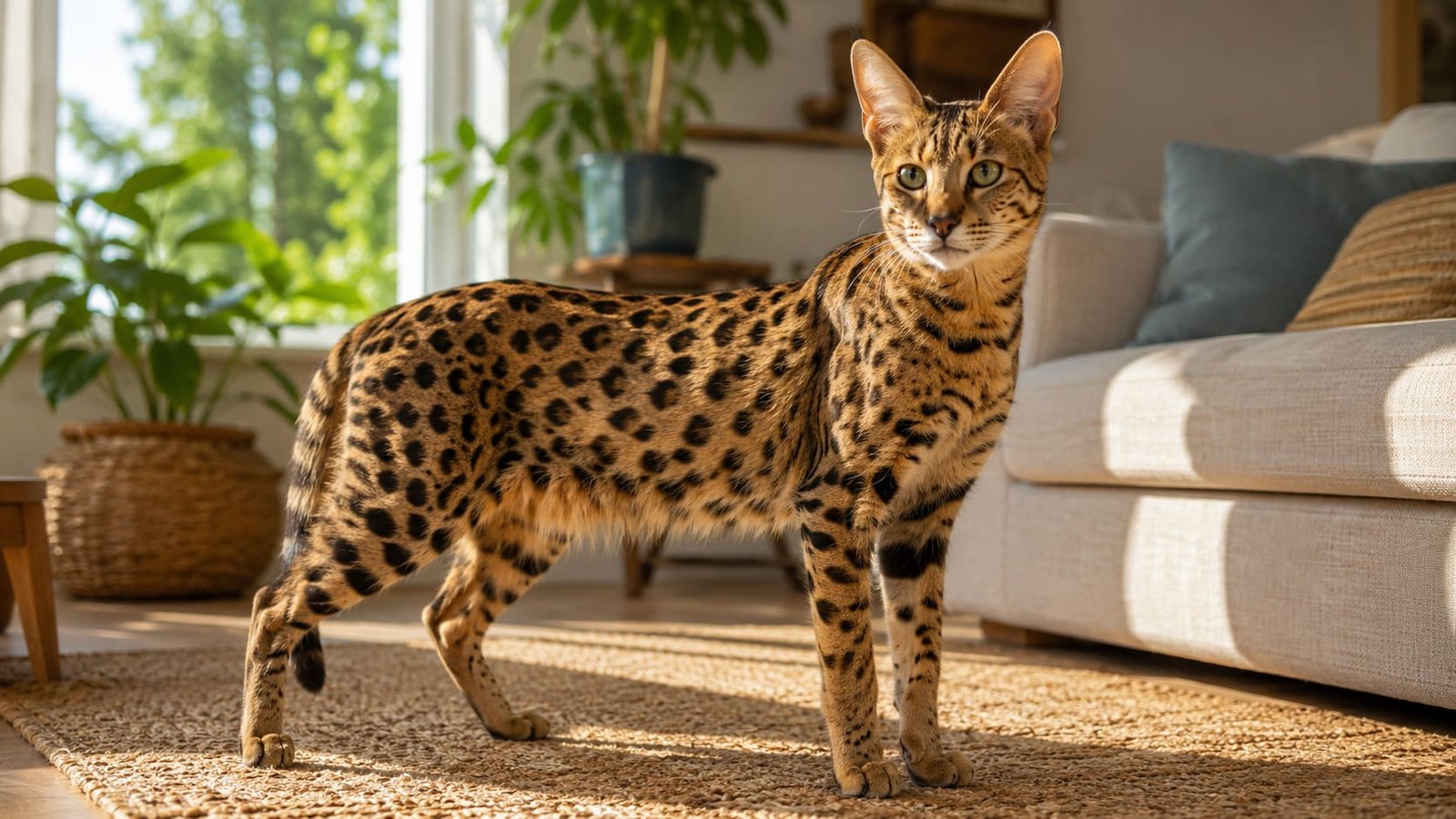
A Savannah cat is a domestic breed developed from crosses between an African serval and domestic cats. Size, temperament, cost, and legality all depend on generation (F1 to F5 and SBT). This guide covers care needs, health screening, state laws, and the rabies rule owners rarely hear.
Most people meet a Savannah cat in a video before they meet one in person. The cat is standing on its hind legs, opening a door, or leaping onto a fridge from a standstill. It looks like a small cheetah decided to move in.
Then comes the search: how big do they get, what do they cost, are they even legal here.
Those questions share one answer, and it is not the one most breed pages lead with. Everything about a Savannah depends on how many generations separate it from its wild ancestor.
That single number changes the cat’s size, its price, its temperament, whether your state allows it, and what happens at the vet’s office. This guide covers all of it, including the legal and medical details that rarely make it onto a breed profile.
Savannah cat at a glance
- A Savannah cat is a domestic breed developed from crosses between the African serval and domestic cats. TICA registered it in 2001 and granted championship status in 2012.
- Generation drives everything. An F1 has a serval parent and is roughly half serval; an F5 or SBT is four or more generations removed and behaves like a large, athletic house cat.
- Savannahs are tall rather than heavy. Most weigh 10 to 17 pounds depending on generation, though early generation males can reach the mid twenties.
- Savannah cat price tracks generation, from roughly $1,000 for a later generation kitten to well above $15,000 for an F1.
- Legality is set state by state and sometimes city by city. Several states ban the breed entirely, and others allow only F4 or F5 and later.
- No rabies vaccine is licensed for wild hybrids in the U.S., which can affect what happens legally if your cat ever bites someone.
What is a Savannah cat?
A Savannah cat is the descendant of a serval, a tall wild African cat, crossed with a domestic cat. It is a recognized domestic breed, not an exotic pet, though several states disagree with that description in their statutes.
Where the breed came from
The first Savannah was born on April 7, 1986, when breeder Judee Frank paired a male serval with a Siamese. The kitten was named Savannah, and she gave the breed its name.
She produced viable kittens of her own in 1989, bred to a Turkish Angora. Breeders wrote the first Savannah breed standard in 1996 and submitted it to The International Cat Association.
TICA accepted the Savannah as a registered breed in 2001 and moved it to championship status in 2012.
What a Savannah cat looks like
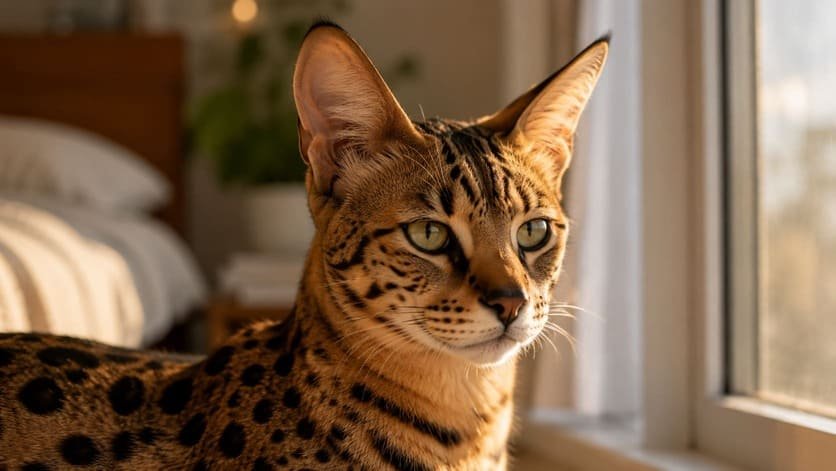
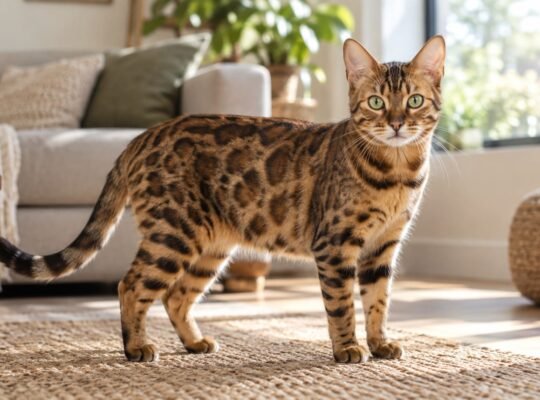
What you get visually is a cat built on serval proportions. Long legs, a long neck, a small triangular head, and large ears set high on the skull. The hind legs sit slightly higher than the front, which produces that distinctive prowling stance.
The coat is short and dense with bold dark spots. TICA recognizes brown spotted tabby, silver spotted tabby, black, and black smoke.
Dark tear duct lines run from the inner corner of each eye. The backs of the ears often carry ocelli, pale thumbprint marks ringed in darker fur.
Savannah cat generations: F1 to F5 and SBT explained
Generation is the first thing to settle, because it decides size, price, temperament, and whether you can legally own the cat at all.
What the F number means
The letter F stands for filial, meaning how many generations removed the cat is from its serval ancestor. Breeders use it as shorthand, and so do state legislatures.
- F1. One serval parent. Roughly 50 percent serval. Largest, most restricted, most expensive.
- F2. A serval grandparent, around 25 percent. Still very large and still restricted in many places.
- F3. A serval great-grandparent, around 12.5 percent. The point where most families find the temperament manageable.
- F4. Four generations out. Legally treated as domestic in most U.S. states.
- F5 and beyond. Functionally a spotted, long-legged house cat with high energy.
Serval percentage is a rough guide rather than a guarantee. A well bred F4 can look more serval-like than a poorly bred F2, because breeders select for type as well as ancestry.
What SBT means
You will also see the letters A, B, and C after the generation number, plus SBT. SBT stands for Stud Book Tradition, meaning at least four generations removed with Savannah to Savannah breeding behind it.
SBT cats are the ones eligible for TICA championship competition, and they are the generation most U.S. families end up buying.
Why early generation males are sterile
One quirk matters if you are shopping. Early generation males are usually sterile, while females are fertile from F1 onward, so breeders keep the females for their programs.
If you want an F1, F2, or F3, you will almost certainly be offered a male. Male fertility typically returns around F4 or F5. Sterility has no effect on the cat as a companion.
How big do Savannah cats get?
Savannah cat size depends almost entirely on generation, and the honest answer is smaller than the internet suggests.
Savannah cat size by generation
- F1 and F2: commonly 15 to 25 pounds, standing roughly 14 to 17 inches at the shoulder
- F3: typically 10 to 17 pounds
- F4, F5, and SBT: usually 10 to 15 pounds, comparable to a large domestic cat
- Height across generations: most Savannahs measure 14 to 17 inches tall regardless of weight
The tallest domestic cat on record
The breed holds the Guinness World Records title for tallest living domestic cat. Fenrir, an F2 living in Michigan, measured 18.83 inches in January 2021.
Records like that shape expectations unhelpfully. Fenrir stands about an inch above a typical Savannah, and he is an F2, the second largest generation there is.
Why Savannahs look heavier than they weigh
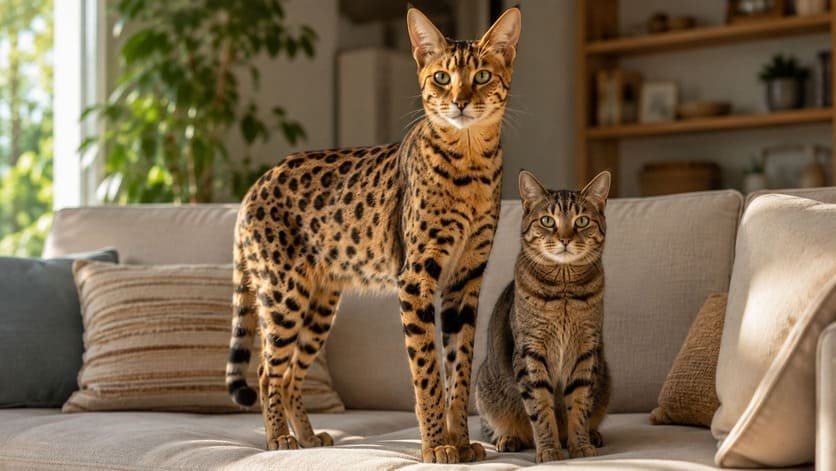
Here is the correction almost nobody makes clearly. TICA’s own breed description notes that the long body and legs create a false impression of a very large or heavy cat, when in reality most Savannahs weigh less than another cat of similar apparent size.
This matters practically. People pick up a tall F3 and guess 20 pounds when the cat weighs 14. If you are budgeting for food, medication doses, or a carrier, use the scale, not your eyes.
Growth also runs long. Savannahs fill out slowly and often keep developing width through their second and into their third year. A lanky, awkward yearling is normal, not a sign that something went wrong.
Savannah cat personality and temperament
Breed pages will tell you Savannahs are active, intelligent, and doglike. True, and useless. Here is what actually shows up in a new home, roughly in the order it shows up.
Days one to three
Most Savannah kittens hide, and the hiding place will be higher or tighter than you expect. Behind a washing machine, on top of a wardrobe, inside a box spring. Do not chase. Put food, water, and a litter box in the same room and let the cat come out on its own schedule, usually after dark.
Week one
The vocalizing starts. Savannahs chirp and trill more than they meow, and many produce a sharp hiss that sounds startlingly like a snake. It is a communication sound, not aggression. New owners panic about it constantly.
Weeks two and three
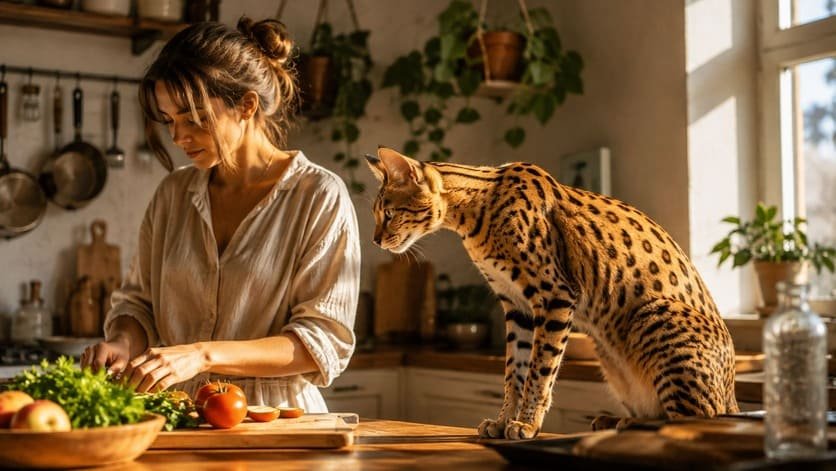
Shadowing begins. The cat follows you room to room, sits on the bathroom counter while you brush your teeth, and supervises cooking from the edge of the counter. This is the trait people either love or find exhausting, and it does not fade with age.
Weeks three to five
The problem solving arrives. Cabinet doors, lever handles, faucet taps, and the lid of the treat container all become projects. Water play starts here too. Many Savannahs will paw a full water bowl until it tips, purely to watch it happen.
Week four onward
The predictable evening burst arrives on a schedule. Most Savannahs run a hard activity window in the late afternoon and again after dark. Twenty minutes of interactive play with a wand toy before that window, rather than during it, takes most of the edge off.
Reading the overstimulation cue
Watch the ears and the tail base rather than the body. A Savannah that is overstimulated during play flattens its ears sideways and twitches at the base of the tail a few seconds before it grabs.
That gap is your cue to stop the game. Learning to read it prevents most of the scratched forearms new owners complain about.
The affection is real, but it is conditional on inclusion. Savannahs bond hard with the people who interact with them and stay reserved with visitors, sometimes permanently. A Savannah that hides from your guests is not poorly socialized. It is being a Savannah.
Are Savannah cats legal in the United States?
It depends on your state, your county, and sometimes your city. This is the section most breed profiles compress into one sentence, and it is where people get hurt.
States that ban Savannah cats
Savannah legality is written around the generation ladder. As of mid 2026, the states most commonly cited as banning the breed outright, regardless of generation, are Georgia, Hawaii, Nebraska, and Rhode Island.
City bans exist independently of state law. New York City and Denver prohibit all generations inside city limits even though both states permit some.
States that allow only F4 or F5 and later
Several states permit only later generations. Alaska, Colorado, Iowa, Massachusetts, New Hampshire, and Vermont generally allow F4 and later. New York allows F5 and later. Texas handles it county by county.
These rules change, and county ordinances can be stricter than state law. Call your state wildlife or agriculture agency and your local animal control before you send a deposit, not after. A cat that arrives in a jurisdiction that prohibits it can be confiscated.
The rabies vaccine problem no one mentions
This is the detail that almost never appears on a breed page, and it deserves your attention.
No rabies vaccine currently carries U.S. licensing for wild hybrids. Veterinary and public health guidance treats vaccination of a hybrid as off label. Some states restrict it, others permit it, and no state treats it as reliably protective.
The practical consequence: if a Savannah bites a person or is exposed to a potentially rabid animal, some jurisdictions will treat the cat as unvaccinated no matter what is on its certificate.
In parts of the country that means extended quarantine at your expense. In some cases it means euthanasia, because rabies testing requires examining brain tissue.
The AVMA model rabies control document sets out the framework states adapt. Ask your local health department how it classifies hybrid cats before you buy.
Later generation SBT cats are usually treated as ordinary domestic cats. That word “usually” is doing real work in the sentence.
Finding a vet who will treat a Savannah
Call clinics before the kitten comes home, not after. Some practices decline early generation hybrids entirely. Ask three questions: do you see Savannah cats, do you treat them as domestic cats for vaccine protocols, and are you comfortable anesthetizing one.
Breeder communities widely repeat that Savannahs react badly to certain anesthetics and to modified live vaccines. Published veterinary evidence for a breed specific effect is thin.
Many exotic practices still default to killed vaccines and careful anesthetic protocols out of general caution with hybrids. Raise it with your vet and let them make the call rather than arriving with instructions.
Insurance and rental restrictions
Some insurers and landlords classify hybrid animals separately from domestic pets. Check your policy language and your lease before purchase.
This is a five minute phone call that occasionally saves people an impossible choice later.
Savannah cat care and home setup
Grooming is the easy part. Everything else is energy management.
Grooming and coat care
A short weekly brushing handles the coat, with a little more during seasonal shedding. The short dense coat sheds year round, and it does not mat the way a longhaired breed does.
Trim claws every two to three weeks. Brush the teeth as often as your cat tolerates, ideally several times a week, since dental disease is one of the most common chronic problems in cats.
Vertical space and climbing
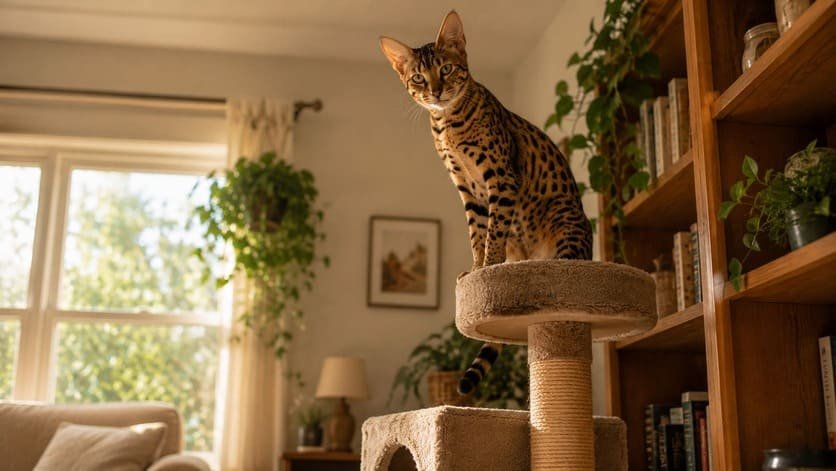
Savannahs jump extremely well and will find the highest point in your home whether or not you provide one. Give them a legitimate perch that reaches six feet or more, positioned near a window.
Height is the cheapest enrichment available to you. A cat that has a sanctioned high spot spends less time auditing your bookshelves.
Litter box setup for a tall cat
Buy litter boxes bigger than you think you need. Plenty of owners end up using a large storage tote with a cut entry instead of a commercial box, because a tall cat needs room to turn around.
Scoop daily, and consider high sides. Long legged cats sometimes spray over a standard rim by accident rather than by intent.
Escape proofing your home
Escape prevention deserves a weekend before the cat arrives. This breed opens doors, works lever handles, and pushes through unsecured window screens.
Add childproof latches to cabinets holding food or cleaning products. Check every screen frame while you can still do it calmly.
Play, enrichment, and water
Two focused fifteen minute wand sessions a day beat an all day pile of toys. Schedule one before the late afternoon activity window and one in the evening, and rotate toys weekly so novelty holds.
Expect interest in water. A pet fountain redirects some of the bowl tipping, and a closed toilet lid saves you a discovery you would rather not make.
How to leash train a Savannah cat
Many Savannahs walk well outdoors. Build up over two to four weeks rather than rushing the harness:
- Leave the harness on the floor near the food bowl for two or three days.
- Put it on just before meals and take it off after, daily for five to seven days.
- Clip on the leash and let it drag indoors under supervision, then follow the cat rather than steering.
- Carry the cat outside instead of letting it walk through the door, and start in an enclosed yard for five to ten minutes.
- Extend sessions only once the cat is exploring rather than crouching.
Stop any session before the cat gets overwhelmed. A single bad outing sets the process back further than a slow week does.
What to feed a Savannah cat
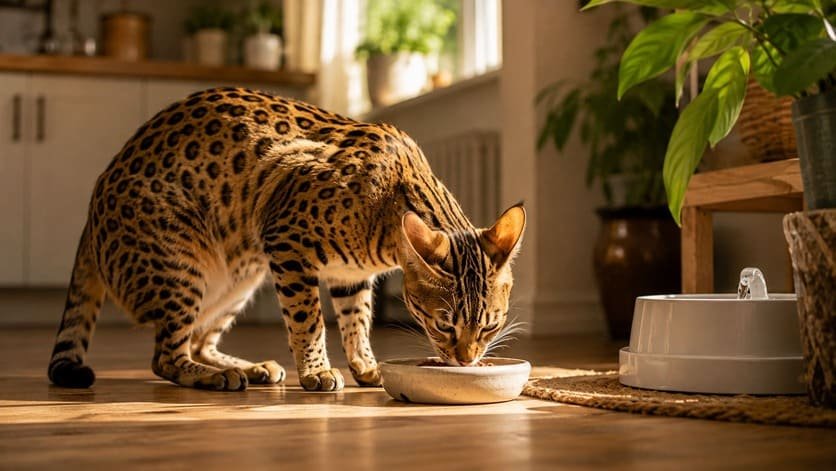
Savannahs do not need an exotic diet. A complete commercial cat food formulated for the cat’s life stage meets their nutritional needs, the same as it would for any domestic cat.
Do Savannah cats need raw food?
Raw feeding comes up constantly in breeder groups, and some breeders send kittens home on raw. Raw diets carry documented handling and pathogen risks for both cats and households, and major veterinary organizations do not recommend them.
If your breeder feeds raw, talk to your vet about how to do it more safely, or how to move off it.
Portioning and weight management
A few practical points that come up more with this breed than most:
- Keep them lean. Growth continues into the second or third year, so a rangy adolescent that eats constantly is usually normal. An adult that is filling out around the ribs is not.
- Feed measured meals rather than free feeding. These cats are food motivated and will eat as a form of entertainment.
- Use puzzle feeders for part of the daily ration. It gives the problem solving instinct somewhere useful to go.
- Watch counter surfing. A cat that can reach a five foot shelf can reach your dinner, and cooked bones and onion based sauces are genuine hazards.
If your cat develops loose stool on a new food, slow the transition down and give it ten to fourteen days rather than swapping abruptly.
Savannah cat health problems and lifespan
Savannahs are generally hardy. The conditions worth knowing about are inherited, which means the breeder you choose matters more than anything you will do at home.
How long do Savannah cats live?
Many Savannahs live into their early or mid teens. Lifespan depends mostly on indoor living, a lean body condition, dental care, and routine veterinary attention.
Genetics set the ceiling. Whether inherited conditions were screened out of the breeding lines has more influence on the number than any supplement or specialty diet will.
Inherited conditions with DNA tests
TICA recommends screening for two inherited conditions, and both have DNA tests available:
- Pyruvate kinase deficiency (PKdef). An inherited enzyme deficiency that causes red blood cells to break down early, leading to intermittent anemia. Signs can include lethargy, weakness, pale gums, and weight loss.
- Progressive retinal atrophy (PRA). Gradual degeneration of the retina that can lead to blindness. Early signs are subtle, often reluctance to move in dim light or bumping into objects that were recently moved.
Both tests are inexpensive and permanent. A breeder should be able to hand you the results without going to look for them.
Hypertrophic cardiomyopathy in Savannah cats
Hypertrophic cardiomyopathy is the third concern, and it works differently. HCM is the most common heart disease in cats generally, and it has been reported in Savannahs.
There is no Savannah specific DNA test for it, so screening depends on echocardiograms of the breeding parents.
Cornell’s Feline Health Center has a clear overview of hypertrophic cardiomyopathy in cats worth reading before you talk to a breeder.
The sign to watch for at home is a resting respiratory rate above about 35 breaths per minute in a sleeping cat, along with lethargy or open mouth breathing. Any of those warrants a same day vet call.
Four questions to ask a Savannah breeder
Ask these and expect documentation, not reassurance:
- Have both parents been DNA tested for PKdef and PRA, and can I see the results?
- When were the parents last screened by echocardiogram, and by which cardiologist?
- What vaccine protocol did the kitten receive, and on what dates?
- What is your written health guarantee, and what happens if the kitten is found to have an inherited condition?
A breeder who becomes vague at question two is telling you something.
How much does a Savannah cat cost?
Savannah cat price tracks generation almost perfectly, and the purchase price is only the opening figure.
Savannah cat price by generation
U.S. breeders in 2026 generally list F5 and SBT kittens starting somewhere around $1,000 to $3,000, with F4 and F3 cats in the low to mid thousands.
F1 kittens are usually listed well above $15,000, and the highest percentage cats go higher still. Early generation breeding is difficult and litters are small, which is what the price reflects.
Ongoing monthly costs
Food, litter, insurance, and routine care for a large active cat add up every month before anything goes wrong.
This breed also generates its own category of costs: replaced screens, replaced blinds, and the occasional emergency visit after something got swallowed. Budget for a contingency rather than a flat monthly figure.
Savannah cat rescue and adoption
Breed rescue is a genuine option, and an underused one. Savannahs are rehomed as adults more often than most breeds, usually because someone underestimated the energy or moved somewhere the cat is not legal.
Adoption fees run a fraction of breeder prices. You also get an adult whose temperament is already visible instead of a coin flip.
Is a Savannah cat right for you?
Some honest sorting.
A Savannah tends to work well if you are home a reasonable amount, you actively want an animal that involves itself in everything you do, you have vertical space, and you have confirmed that your generation of interest is legal where you live.
It tends to go badly in a few specific situations. Households with small caged pets, because the prey drive is not something you train out. Homes where the cat will be alone ten hours a day with no companion animal.
Renters on short leases in states with patchwork rules also struggle. So does anyone hoping for a lap cat that mostly sleeps, which is a reasonable thing to want and not what this breed is.
If you land in the second group, a Bengal, an Abyssinian, or a well matched adult domestic shorthair from a shelter will give you a lot of the same energy without the legal complications.
Savannah cat FAQs
No more than any large, strong domestic cat, and later generations behave like ordinary house cats. The realistic risks are scratches during overstimulated play and injury to small pets. Early generation cats need experienced handling, and any cat showing genuine aggression should be assessed by a certified animal behaviorist.
Often yes, particularly with calm dogs and when introductions are gradual. Start with scent swapping and a closed door for several days, then supervised meetings through a baby gate, then short shared sessions. Never leave them alone together until you have seen weeks of relaxed coexistence.
No. No cat breed is. The main allergen is a protein in saliva and skin secretions, and Savannahs produce it like any other cat.
Many do better with one, especially in homes where people are gone during the day. Another active cat of similar size and play style usually works better than a sedentary older cat.
Plan on at least 30 to 45 minutes of interactive play daily, split into sessions, plus climbing structures and puzzle feeders for the hours in between.
Occasionally, yes. As a daily routine, it tends to produce destructive behavior and vocalizing. If your household is out for full workdays, a companion animal and substantial enrichment are close to mandatory.
The Savannah hiss is loud, sharp, and often mistaken for aggression. It is frequently just startle or communication. Look at the whole body: flattened ears, a lashing tail, and a crouched posture mean something different from a hiss delivered with a relaxed body.
Moderately. The short dense coat sheds year round with seasonal increases, and weekly brushing keeps it manageable.
Before you commit
The Savannahs that end up in rescue almost never got there because the cat was defective. They got there because someone bought the look without checking the law, the vet situation, or the energy level.
Do the three phone calls first: your state wildlife or agriculture agency, your local animal control, and two veterinary clinics.
If all of them come back clean and you still want the cat after reading what the first six weeks look like, you will probably do well with this breed.
Then start with an F4, F5, or SBT unless you have specific experience with hybrids. And check the breed rescue listings before you check the breeder waitlists.
This article is for informational purposes only and is not a substitute for veterinary advice. Talk to a licensed veterinarian about any health concern, vaccine protocol, anesthesia question, or diet change for your individual cat.
Click Here to Add SmartPawLife as a Trusted Source Add as a preferred source on Google