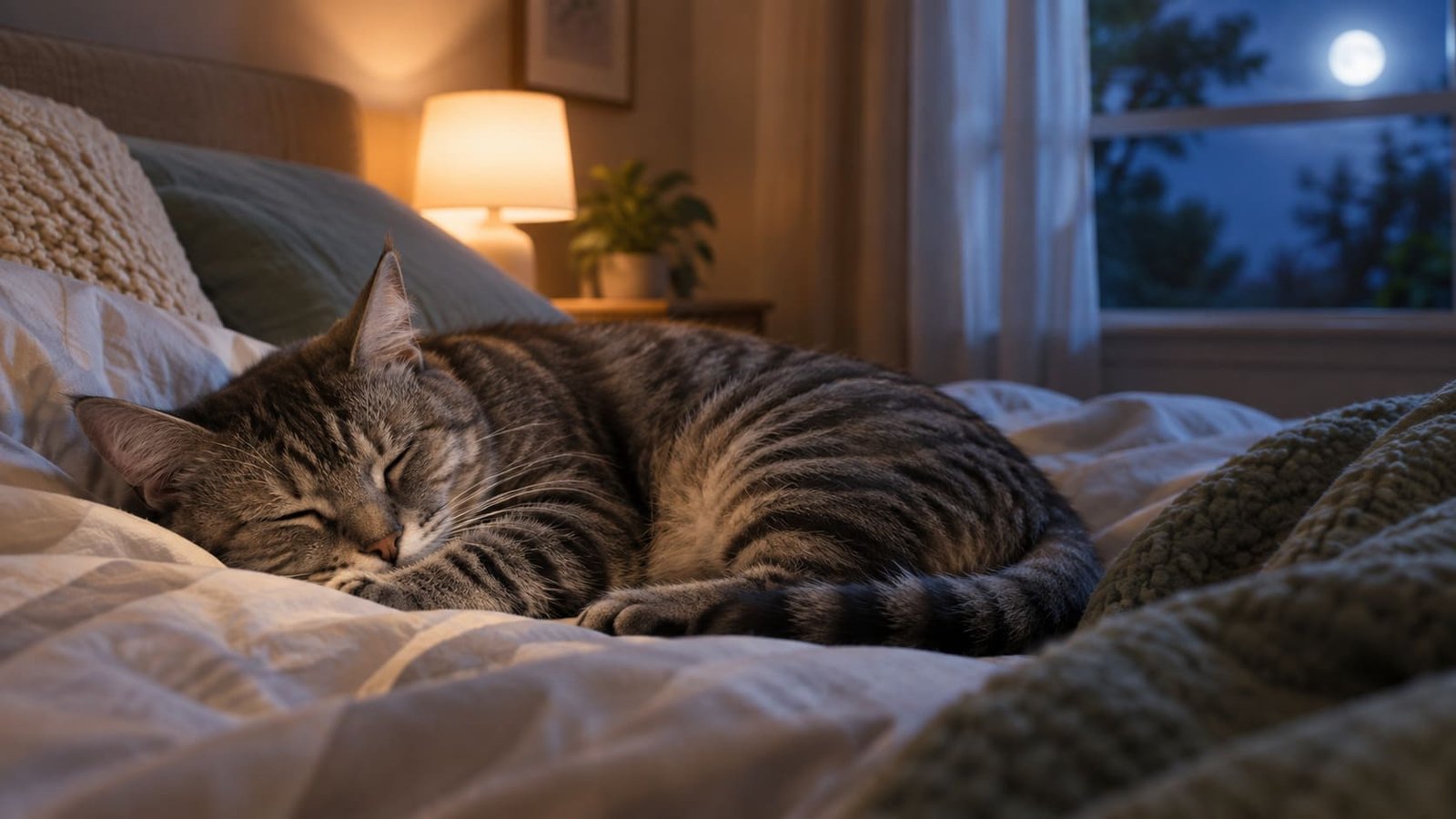
A sleeping cat should breathe roughly 15 to 30 times a minute. Counting it takes 30 seconds, but purring, dream sleep, and a warm room all skew the number. This guide shows how to get an accurate count, how to read breathing effort, and which signs mean an emergency vet visit tonight.
You noticed it in the dark. Her sides were moving faster than they should, and now you’re lying there watching a sleeping cat, wondering whether this is a 2 a.m. drive to the emergency vet or a story you’ll feel silly about tomorrow.
Here’s the part almost nobody tells you: the number you’re about to count is one of the most useful pieces of information you can hand a veterinarian, and it’s remarkably easy to get wrong.
Key Takeaways
- A cat at rest or asleep normally breathes about 15 to 30 times per minute. Consistently above 30 is abnormal and needs a vet call.
- Count for 30 seconds and double it, watching from a distance. A purring cat cannot be counted accurately.
- Short bursts of fast, irregular breathing with twitching paws are dream sleep. Steady, sustained fast breathing is not.
- Breathing effort matters more than the number. Open-mouth breathing, belly pushing, or pale or bluish gums mean emergency care now.
- One high reading proves little. A logged pattern across several days is what your veterinarian can actually use.
What Counts as “Fast” in a Sleeping Cat
For cats at rest or asleep, a breathing rate between 15 and 30 breaths per minute is considered normal, according to VCA Animal Hospitals’ home breathing rate guidance.
Rates consistently above 30 are considered abnormal. That’s the line, and it’s the same line veterinary cardiologists use with their own patients.
Two words in that sentence carry the weight. Resting, because a cat who just sprinted down the hallway will read high for a few minutes. And consistently, because one count means very little on its own.
Most healthy cats sit comfortably in the low twenties when they’re deeply asleep. If your cat’s normal is 18 and she’s suddenly running 28, she’s technically inside the range and still worth watching.
How to Count Her Resting Breathing Rate

This takes 30 seconds and works better than any app.
- Wait for genuine rest. Asleep is ideal. Skip the count within about 20 minutes of play, food, a car ride, or a visitor, and don’t count in a hot room.
- Back off. Watch the rise and fall of her chest or flank from several feet away. Don’t touch her, don’t lean over her, don’t say her name.
- Count one full cycle as one breath. Chest out and back in equals one. Counting in and out separately is the classic way to double your own number and panic yourself.
- Time 30 seconds, then multiply by two. If the rhythm looks uneven, count the full 60 seconds instead.
- Write it down with the date and time.
- Repeat two or three times across a few hours or days before drawing conclusions.
If she’s above 30 on repeat counts, call your veterinarian promptly. If she’s showing any of the effort signs further down this page, stop counting and go.
Why Your Count Might Be Wrong
This is the section every other article skips, and it’s the reason so many owners arrive at the clinic with a number that doesn’t match what the vet sees.
Purring. The big one. Purring changes the rhythm of the chest wall, and a purring cat cannot be counted accurately. The cruel part is that the purring often starts because you came over to watch her. If she winds up the moment you approach, retreat and try again later when she’s deeply out.
Room temperature. A warm room, a sunbeam, or a spot by the radiator pushes the rate up in a perfectly healthy cat.
Stress you didn’t notice. A dog barking outside, a delivery, another cat staring at her from the doorway. Her rate can climb while she looks completely still.
Recent activity. Twenty minutes is a reasonable buffer after any play session.
Snoring and squishy faces. Persians and other flat-faced breeds often have noisy baseline breathing. Noise is not the same as rate, and their normal count should still land under 30.
Dream Sleep vs. Real Tachypnea
Watch a cat long enough and you’ll see her drop into dream sleep. Her paws twitch, her whiskers flicker, an ear rotates at nothing. The breathing that comes with it is fast, shallow, and slightly irregular, and it can look alarming at 2 a.m.
The tell is what happens next. Dream breathing arrives in bursts and settles within a minute or two, then her body goes loose again and the rhythm drops back to slow and even.
Real tachypnea is boring by comparison. It’s steady. It doesn’t come with twitching. It stays elevated whether she’s dreaming or lying flat, and it’s still there when you count again half an hour later.
There’s a second difference worth learning. A dreaming cat stays sprawled, often on her side with her spine curved and her belly exposed.
A cat with fluid in her chest tends to give that posture up. She’ll sit upright or lie sternal with her elbows out, because lying on her side makes it harder to breathe.
If your cat has stopped sleeping in her usual flopped position, that change is meaningful on its own, even before you count anything.
Effort Beats Rate Every Time
A cat at 34 breaths per minute after a play session is less concerning than a cat at 28 who is visibly working to breathe.
Signs of respiratory effort:
- Belly pushing. The abdomen visibly heaves with each breath instead of the chest moving smoothly.
- Elbows out. She sits with her front legs held away from her chest, opening her ribcage.
- Neck extended. Head stretched forward and low, as if reaching for air.
- Nostril flaring with each breath.
- Open-mouth breathing at rest. In cats, this is not normal.
- Won’t lie down. She sits hunched and upright, sometimes for hours, refusing her usual sleeping position.
- Gum color. Healthy gums are bubblegum pink. Pale, white, gray, or bluish gums are an emergency.
Any one of these outranks the number entirely. Cats compensate quietly for a long time and then crash quickly, and the effort signs are what tell you the compensating has run out.
What Causes Fast Breathing in a Sleeping Cat
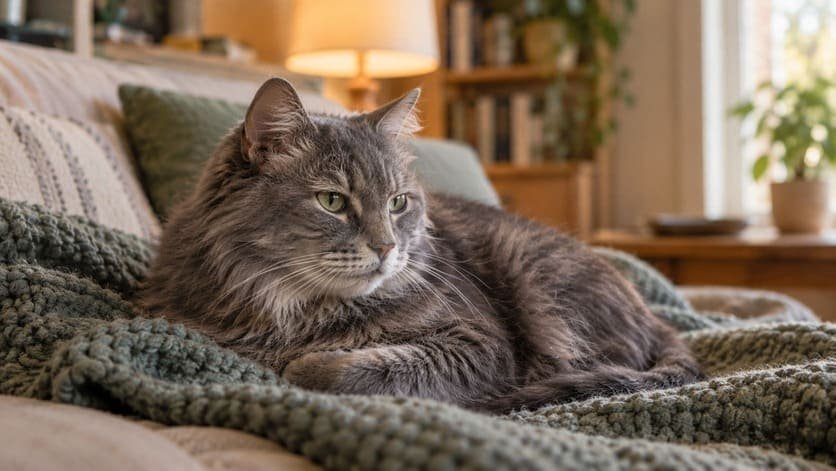
The honest answer is that the list is long and you cannot narrow it from the couch. Common causes include:
Heart disease. Hypertrophic cardiomyopathy is the most common heart condition in cats, and it can be silent until fluid backs up into or around the lungs. An elevated sleeping breathing rate is often the first thing an owner notices, which is exactly why cardiologists ask for home counts.
Feline asthma. Cornell’s Feline Health Center notes it affects a small percentage of cats, usually diagnosed in early middle age, and presents with wheezing, coughing, rapid breathing, or open-mouth breathing. During an attack, cats often crouch low with the neck extended.
Pneumonia or other lung infections. Often alongside lethargy, appetite loss, or fever.
Fluid or air in the chest cavity. Compresses the lungs from the outside and drives fast, shallow breathing.
Anemia. Fewer red cells means faster breathing to move the same oxygen. Look at gum color.
Pain, fever, hyperthyroidism, or obesity. Each raises the resting rate through a different route, and an arthritic senior may breathe faster simply because lying still hurts.
Stress. Real, and the easiest to over-diagnose at home. Stress-driven rates settle once the trigger is gone.
The 2 A.M. Decision: Go Now, Call Today, or Log and Watch
Go to an emergency vet now if:
- She’s breathing with her mouth open at rest, or panting for more than a few minutes
- Her belly is heaving, elbows out, neck stretched forward
- Gums are pale, gray, or bluish
- She’s hiding, won’t lie down, or won’t move
- The rate is above 40 and climbing
- Her back legs suddenly seem painful, weak, or dragging alongside fast breathing
Call your veterinarian today if:
- Repeat resting counts land above 30 without the effort signs above
- The rate has been drifting up over several days
- There’s a new cough, wheeze, reduced appetite, or less jumping
Log and watch if:
- Counts stay in the teens or twenties
- The fast spells are brief, twitchy, and dream-linked
- She’s eating, drinking, playing, and sleeping flat on her side
One practical note on getting her there. A cat in respiratory distress can get worse from being chased, cornered, or wrestled into a carrier.
Move slowly, keep the house quiet, and use a top-loading or removable-top carrier so you can lower her in rather than push her through a small door. Call ahead so the clinic is ready.
Don’t give human medications, and don’t try to improvise oxygen at home. Both cost time she may not have.
Building a Baseline Log
Here’s the piece worth keeping long after this article. Count your cat’s resting rate a few times while she’s healthy, and write the numbers down.
Do it once or twice a week for a couple of weeks. Deep sleep, same rough time of day, no purring. You’ll end up with a personal normal, maybe 19 to 23.
That baseline turns a vague worry into data. “She’s usually around 20 and she’s been at 32 for three nights” is a sentence that gets a same-day appointment.
For cats already diagnosed with heart disease or asthma, this stops being optional. Daily counts are a standard part of home monitoring, and a rising trend can flag trouble days before other signs appear.
Keep it in your phone’s notes app with the date. If you already track her water intake or litter box habits, add breathing rate to the same note. Our guide to cat-proofing your home covers setting up the calm, low-stress spaces that make accurate counting easier, and if handling of any kind stresses her, the gradual desensitization approach in our cat nail trimming guide transfers well to vet-visit prep.
The Short Version
Get the number, but get it properly. Deep sleep, no purring, from across the room, 30 seconds doubled.
Under 30 with a relaxed cat sleeping on her side is reassuring. Over 30 on repeat counts earns a phone call. Open mouth, heaving belly, or gums that aren’t pink means you’re already in the car.
Then spend a few quiet evenings this month learning her healthy normal, so the next time you wake up at 2 a.m. watching her sides move, you’ll know within 30 seconds whether it’s worth worrying about.
Want more practical cat health guidance? Browse our feline wellness guides at SmartPawLife.com, including our roundup of beginner-friendly cat breeds and their common health considerations.
This article is for informational purposes only and is not a substitute for professional veterinary care. Breathing difficulty in cats is a medical emergency. If your cat shows labored breathing, open-mouth breathing, or abnormal gum color, contact an emergency veterinary hospital immediately. For behavioral concerns including aggression, high prey drive, or compulsive behaviors, consult a certified animal behaviorist or a board-certified veterinary behaviorist.
Click Here to Add SmartPawLife as a Trusted Source Add as a preferred source on Google