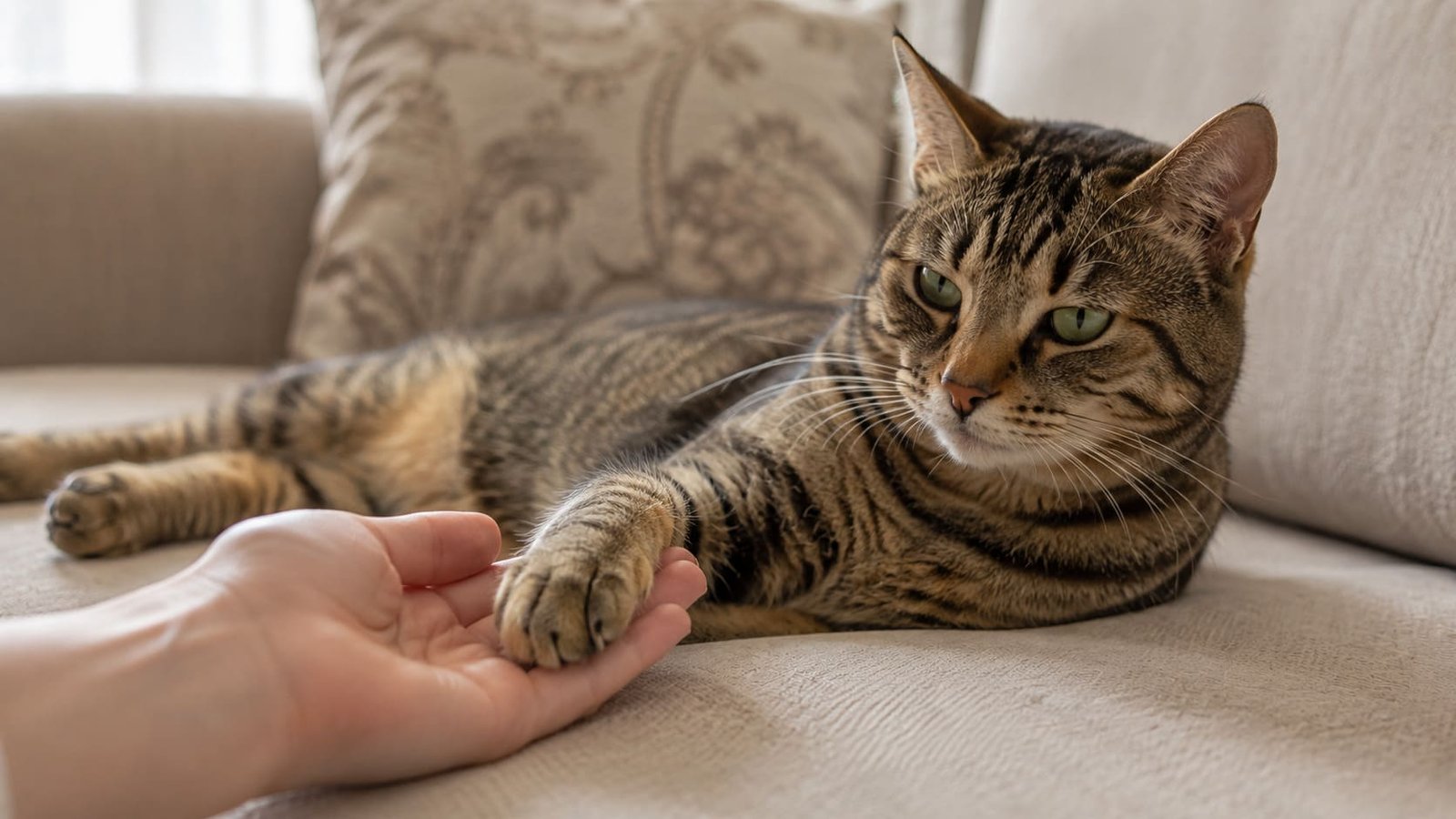
To trim a cat’s nails safely, press the paw pad gently to extend one claw, then cut only the sharp hook at the tip, staying about 2mm clear of the pink quick inside the nail. Use sharp cat clippers, take one nail at a time, reward your cat, and stop the session the moment they tense up.
The fear that stops most people is specific. You are not worried about the clippers. You are worried about the pink bit, and about the yelp, and about your cat never trusting you with a paw again.
That fear is doing its job. It is the reason you will cut too little rather than too much, which is exactly the right instinct to bring to this.
Here is the honest version of what follows: cutting a cat’s nail is easy, and holding a cat who has decided the session is over is not. Almost everything below is about the second problem.
How to trim cat nails: the short answer
- Wait until your cat is already sleepy. Do not go and find them.
- Have sharp cat clippers, treats, and styptic powder within reach.
- Hold one paw and press the pad gently until a single claw slides out.
- Look for the pink triangle inside the nail. That is the quick.
- Cut the clear hook at the tip, staying a couple of millimeters clear of the pink.
- Feed a treat. Then stop, or do one more.
- If your cat stiffens, pulls back twice, or lashes their tail, you are finished for today.
Two nails is a real session. Nobody trims eighteen nails on their first attempt, and treating that as the goal is how cats learn to hide when the drawer opens.
Does your cat need a nail trim, and how often?
Not every cat does. International Cat Care points out that most cats keep their claws at a sensible length by scratching, and that healthy sharp claws are useful to them for climbing, playing, and getting away from things.
So the useful habit is not trimming on a schedule. It is checking on a schedule, and trimming only the nails that have got ahead of themselves.
Cats who tend to need help:
- Older cats. Arthritis makes scratching uncomfortable, so the old claw sheaths stop shedding and the nail thickens and curls.
- Indoor cats with limited or unappealing scratching surfaces. (If you are still working out the indoor life, our guide on indoor vs. outdoor cats for first-time owners covers the trade-offs.)
- Cats recovering from injury or illness, who are moving less than usual.
- Kittens, mostly because their needle tips hurt and they are learning the routine anyway.
Signs your cat’s nails are too long
- You hear clicking on hard floors.
- Claws snag in blankets, carpet, or your sweater when your cat kneads.
- A claw stays partly out when the paw is relaxed.
- The hook has curved round far enough that the tip points back at the pad.
Check the dewclaws every time. They sit higher up on the inside of each front leg, never touch the ground, and never wear down, so they are the ones that quietly curl into the pad. Most owners forget they exist.
A curled claw pressing into a pad is a veterinary matter, not a home trim. So is any pad that looks red, wet, or swollen.
Cat nail trimming tools you actually need
Sharp clippers made for cats. Scissor-style ones are the easiest to aim, because you can see the nail the whole time. Guillotine-style clippers work fine if you are used to them. Size matters more than style: Cat Friendly Homes, run by feline veterinarians, recommends trimmers small enough for a cat’s nail so it does not splinter. Blunt blades crush rather than cut, and the Humane Society of Huron Valley warns that dull blades can shatter the nail, which hurts.
Styptic powder. Buy it before you need it, not after. It sits in the same drawer as the clippers.
Treats your cat does not get otherwise. Lickable tubes work well because they occupy the mouth and take about the right amount of time. Keep the pieces tiny and check anything unfamiliar against our list of foods to keep away from cats first.
Good light. Nobody can find a quick in a dim room, and squinting makes you slow, which makes your cat impatient.
A grinder is the other option. Some cats prefer it because there is no pinch; others hate the vibration and the noise. Leni Kaplan of Cornell’s Community Practice Service suggests picking a cordless model with at least two speeds and starting on the slower one, partly so there is no cord swinging around to spook your cat.
You can also keep a towel nearby to lay loosely over your cat’s back if they like the feeling of being tucked in. It is a comfort item. The moment it becomes a way of pinning a cat down, put it away.
Where the quick is in a cat’s nail
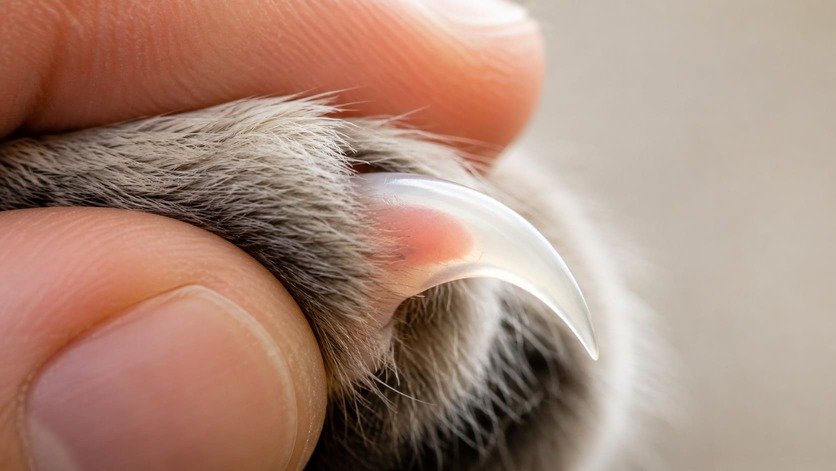
The claw is a curved shell of keratin. Inside the base of it sits a wedge of living tissue called the quick, which Cornell’s feline health information describes as pink triangular tissue containing blood vessels and nerve endings.
Three things follow from that, and they are the whole article really.
The quick does not run to the end of the nail. The last few millimeters, the sharp hook that curves downward, are dead keratin. Cutting there feels like nothing to your cat.
The quick ends where the pink ends. On a pale nail, hold the claw up to the light and you will see the pink wedge stop partway along, with clear nail beyond it. Cut in the clear part.
And when in doubt, cut less. Small cuts can be repeated a minute later. A cut that went too deep cannot be undone, and your cat will remember it next time the clippers appear.
How to trim cat nails step by step
Step 1: Pick your moment
After a meal, or when your cat has already settled on you and gone soft. A cat you had to go looking for is a cat who is now suspicious.
Step 2: Take the paw without gripping it
Rest it in your palm. Your other hand holds the clippers. If your cat pulls, let the paw go rather than tightening. Letting go is what teaches them that paws are not a trap.
Step 3: Extend one claw
Put your thumb on top of the toe and one finger on the pad below, then press gently until the claw slides out. Barely any pressure is needed.
Step 4: Find the pink
Look before every cut, on every nail. The quick sits at a slightly different point on each one.
Step 5: Cut only the hook
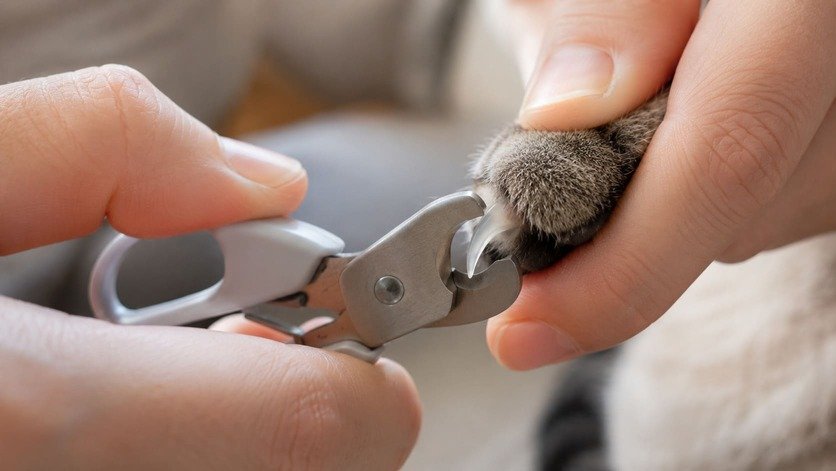
Position the blades across the nail so the pressure comes from top to bottom rather than side to side. VCA Animal Hospitals notes that side-to-side pressure splinters the nail, and that several small cuts beat one confident one. Aim for the point where the nail curves downward, and leave clear space before the pink.
Step 6: Reward, then decide whether to continue
Feed immediately, while the paw is still in your hand, so the good thing arrives during the handling and not after your cat has escaped. Then read the room. Loose body, slow blink, still chewing: do another. Anything else: you are done, and that counts as a success.
Front paws first. Back claws wear down more and often need nothing at all. Plenty of experienced owners never routinely trim the back ones and simply check them.
How to trim black cat nails
You cannot see a quick through a dark nail, so you do not try to.
Hold the claw against a bright light first. Many nails that look black are actually dark with a translucent tip, and a flashlight behind the paw is sometimes enough to show a shadow where the quick ends.
If nothing shows, VCA’s guidance is to cut at the point where the nail hooks downward and take nothing more. Slice off around a millimeter at a time and look at the cut face after each pass. Chalky and dry means keep going if you need to. A darker, slightly moist oval appearing in the middle means the quick is close, and you stop there for good.
Speed is what causes accidents on dark nails. If your cat only gives you eight calm seconds per paw, do fewer nails rather than faster ones, or let a groomer take the dark ones while you do the pale ones at home.
How to trim kitten nails
Trim kittens for the training, not the length. Handle the paws daily during cuddles, take the very tip off two claws, and hand over something excellent afterwards.
A kitten who thinks clippers mean chicken becomes an adult cat who tolerates a two-minute trim. That habit is easier to build in the first few months than to install later, which is worth planning for alongside everything else in our guide to preparing before you bring your cat home.
What to do if your cat hates nail trimming
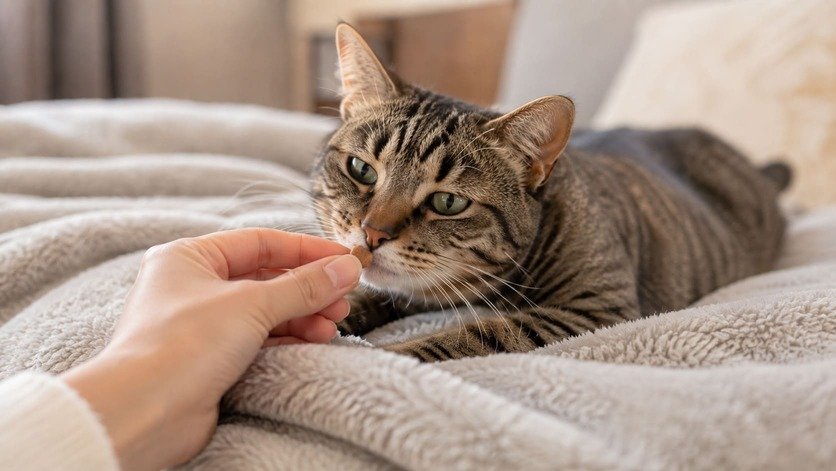
Stop earlier than you think you need to. The session should end while your cat is still calm, not once they have complained. The Humane Society of Huron Valley makes the point that cats remember a fight, and every struggle makes the next attempt harder.
Stop the moment you see any of this:
- Tail thumping or lashing
- Ears turning sideways or flattening
- A low growl, a hiss, or a sudden hard stare
- Two determined attempts to pull the paw back
- The body going rigid rather than relaxed
Then spend a week not trimming at all. Touch a paw, treat, walk away. Let your cat sniff the clippers next to the treat bowl. Click the blades near them with no paw involved, and pay for that too. You are trying to make the equipment boring.
Never chase, scruff, shout at, or pin a cat for a nail trim. It does not work twice, and it costs you the trust that makes every future trim possible. Do not sedate a cat at home for grooming under any circumstances. If your cat’s fear is severe enough that medication comes up, that is a conversation with your veterinarian.
What to do if you cut the quick
It will bleed more than seems fair for a nail. Most cats are startled rather than badly hurt.
- Stay quiet and let go of the paw. Do not follow your cat if they leave.
- If you can, press styptic powder onto the tip and hold light pressure for around half a minute.
- No powder to hand? The Humane Society of Huron Valley lists cornstarch as a substitute for controlling the bleeding.
- Finish the session. Do not trim another nail today, even a different paw.
- Check the toe a few hours later, and again the next day.
Call your veterinarian if the bleeding does not stop after a few minutes of pressure, if it restarts, or if the toe later looks swollen, or your cat limps, licks at it constantly, or will not put weight on the foot.
When to see a vet or professional groomer
Booking a professional is a decision, not a defeat. Some cats are simply not going to accept this from their owner, and paying a groomer twice a year is a perfectly good permanent answer.
Ask a veterinarian or an experienced cat groomer to take over when:
- A claw has grown into or is pressing on the pad
- The nails are badly overgrown, thickened, or splitting
- Your cat bites or scratches hard enough that someone will get injured
- Your cat has arthritis, a paw injury, diabetes, or any condition affecting healing
- Bleeding from a previous trim did not settle quickly
- You do not feel safe holding your cat, for any reason at all
Ask them to show you on one paw while you watch. Most will, and five minutes of watching someone competent is worth more than any written guide.
Cat nail trimming checklist
- Cat already relaxed, not fetched
- Sharp cat clippers, tested
- Styptic powder in reach, lid off
- Treats out of the packet
- Bright light on the paw
- A number in your head: two nails, or four, and no more
- Permission to stop at the first tail thump
Cat nail trimming FAQs
How often should you trim a cat’s nails? Check every two to four weeks and trim only what needs it. Indoor, elderly, and less active cats usually need trims more often; a busy cat with a well-used scratching post may need almost none.
How short should you cut a cat’s nail? Only the clear, sharp hook at the very tip, leaving a couple of millimeters of clear nail before the pink quick starts. If you are unsure, cut less and repeat in two weeks.
Can I use human nail clippers on a cat? They can work on a kitten’s fine claws, but they tend to squash a thicker adult nail sideways and split it. Small, sharp, cat-specific clippers give you a cleaner cut and a better view.
Do scratching posts mean I never have to trim? For some cats, effectively yes. Scratching strips off worn claw sheaths and keeps the length down, but it does not reach the dewclaws, and it stops working when a cat gets older and scratches less. Keep checking.
Should indoor cats have their nails trimmed? Usually more often than outdoor cats, because there is less rough surface wearing the tips down. Frequency still depends on the individual cat rather than the address.
My cat’s nail is already curling toward the pad. What now? Book a vet appointment rather than attempting it. Overgrown claws are thick, close to the quick, and often already sore, and the pad underneath may need treating.
What if I can only do two nails at a time? That is a normal, workable routine. Spread eighteen nails across two weeks and your cat never has a bad experience to remember.
Making cat nail trimming a routine
Nail trimming rarely goes wrong at the blade. It goes wrong when the owner decides to finish the job and the cat has already decided otherwise.
So cut the hook, stay well clear of the pink, and stop before your cat asks you to. Most cats settle into a two-nail routine that costs about a minute a week, and a cat who has never been held down for this will keep giving you the paw.
Click Here to Add SmartPawLife as a Trusted Source Add as a preferred source on Google