
If you’re thinking about bringing home a Labrador Retriever, you’re considering one of the most loved dog breeds in the world, and for good reason. Labs have spent decades as the default answer to “What’s a good family dog?” That reputation is built on something real: a friendly, trainable temperament that fits everything from a working farm to a small apartment, provided you can meet their exercise needs.
This guide covers what a Lab actually looks like beyond the stock photo, how the breed’s temperament plays out day to day, the health issues worth knowing before you commit, and how to figure out honestly whether a Labrador fits your life. Whether you’re comparing Labs to other popular family breeds or you’ve already found a puppy and just want to know what you’re in for, this guide gives you the specifics rather than the generic version.
Where Do Labrador Retrievers Come From?
The Labrador Retriever’s story does not actually start in Labrador. It starts in Newfoundland, Canada, where fishermen crossbred dogs brought over by European sailors, creating a working dog known as the St. John’s Dog. These dogs hauled fishing nets, retrieved lines, and pulled catch out of icy North Atlantic water, so the traits that make a modern Lab a great swimmer and retriever were originally job requirements, not charming quirks.
British sportsmen visiting Newfoundland in the early 1800s noticed how capable these dogs were in the water and started bringing them home to England. The Earl of Malmesbury is generally credited with establishing the breeding program that gave the dog its name. Later, the Duke of Buccleuch and the Earl of Home continued developing the line in Scotland.
When taxation and strict British quarantine laws nearly wiped out the dogs back in Newfoundland, it was this British breeding stock that preserved the breed. The Labrador Retriever was recognized by the American Kennel Club in 1917, and it has been a fixture of American households ever since. You can read the fuller version of this history, including how close the breed came to disappearing entirely, on the AKC’s own breed history page.
What Do Labrador Retrievers Look Like?

Labs are a medium-to-large, sturdily built breed rather than a lanky one. Here’s what to expect:
| Trait | Details |
|---|---|
| Size | Medium-to-large |
| Height | 22.5 to 24.5 inches for males, 21.5 to 23.5 inches for females |
| Weight | 65 to 80 lbs for males, 55 to 70 lbs for females in working condition |
| Coat | Short, straight, dense, with a soft, weather-resistant undercoat |
| Colors | Black, yellow, and chocolate |
| Lifespan | 11 to 13 years |
| Temperament | Friendly, outgoing, intelligent, eager to please |
| Energy level | High |
That double coat does real work. It helps a Lab swim in cold water without getting chilled, but it also means the breed sheds steadily year-round, with heavier seasonal blowouts in spring and fall.
A “yellow” Lab is not a separate variety. It is one of the three coat colors Labrador genetics can produce, alongside black and chocolate. Coat color has no meaningful effect on temperament, despite what you may have read on less careful pet sites.
What Is the Labrador Retriever Temperament Really Like?
The AKC standard describes the ideal Lab disposition as “kindly, outgoing, tractable,” and most Labs live up to it, though individual personality still varies with lineage and upbringing. Labs are typically food-motivated, people-oriented, and slow to mature, meaning many do not fully settle into adult behavior until they are two or three years old.
If you are expecting a calm dog at twelve months, you may be disappointed. If you are prepared for an enthusiastic, occasionally goofy adolescent phase, you will likely find it endearing.
A few temperament traits are worth knowing before you commit:
They are rarely aggressive by breed tendency. The AKC standard actually penalizes aggression toward people or other animals as a serious fault, which reflects how the breed was developed: as a cooperative working partner, not a guard dog.
They are mouthy, especially as puppies. Retrievers were bred to carry things gently in their mouths, so chewing and carrying objects around the house is instinctive, not defiance. Redirecting that instinct toward appropriate toys works far better than trying to eliminate it.
They bond closely with their people. Labs do not do well when left alone for long stretches. A Lab that is regularly isolated for eight-plus hours a day is more likely to develop destructive habits or anxious behaviors, not because the breed is fragile, but because it was bred for constant partnership with humans.
They are generally good with kids and other dogs. This is a major reason they land on so many family-breed shortlists, though every individual dog still needs proper introductions and supervision around small children.
Are Labrador Retrievers Still America’s Most Popular Dog Breed?

For a long time, the answer was an easy yes. Labs held the American Kennel Club’s number one registration spot for 31 consecutive years, from the early 1990s through 2021, longer than any other breed in AKC history.
That streak ended in 2022, when the French Bulldog took over the top spot. According to the AKC’s most recently published breed rankings, the French Bulldog has now held number one for four years running, with the Labrador Retriever sitting at number two.
That shift says more about apartment living and small-dog trends in cities than it does about any decline in what Labs offer. A 31-year run at the top is not a fluke. It reflects a genuinely versatile, family-friendly breed, and Labs remain a top choice for households with yards, active lifestyles, or a need for a dog that can also work as a service, therapy, or hunting companion.
What Health Issues Are Labrador Retrievers Prone To?
Labs are a generally sturdy breed, but like any breed with a large gene pool and popularity that has outpaced careful breeding in some lines, they carry some known predispositions. None of the following should be read as a diagnosis. If your Lab shows any of these signs, the right move is always a visit to your veterinarian rather than self-diagnosing from an article.
Hip and elbow dysplasia: This is a developmental joint condition where the ball and socket of the hip, or the elbow joint, do not form correctly, eventually leading to arthritis. Genetics play a role, but so does weight. VCA Animal Hospitals notes that in one well-known feeding study, Labrador puppies allowed to eat freely developed hip dysplasia at roughly twice the rate of littermates on a controlled, portion-fed diet. That is part of why keeping a Lab lean throughout puppyhood matters as much as any supplement.
Ear infections: Those floppy ears trap moisture, and Labs love water, which is a combination that raises infection risk. Regular ear cleaning, especially after swimming, goes a long way.
Obesity: Labs are famously food-motivated, and that same trait that makes them easy to train with treats also makes them prone to overeating. Extra weight compounds joint problems, so portion control matters more for this breed than for most.
Exercise-Induced Collapse (EIC): This is the genuine depth point worth understanding because it is more specific than “Labs can have health issues.” EIC is a neuromuscular condition where a Lab collapses after 5 to 15 minutes of intense exercise, often during retrieving games or field trials, then recovers within 15 to 30 minutes with rest.
Researchers at the University of Minnesota, working with the AKC Canine Health Foundation, traced the condition to a mutation in a gene called DNM1, or dynamin-1, which affects how nerve cells communicate with muscles during periods of high excitement and exertion. A DNA test for the DNM1 mutation is available through veterinary genetics labs, and reputable breeders test for it before breeding.
Progressive Retinal Atrophy (PRA): This is a gradual, inherited degeneration of the retina that can eventually cause blindness. DNA testing exists for some forms of PRA as well.
If you are getting a Lab from a breeder, ask directly whether the parents have been health-tested for hip and elbow dysplasia through OFA or PennHIP, EIC, and PRA. A breeder who cannot answer that is not necessarily acting in bad faith, but it is a fair reason to ask more questions.
How Much Exercise Does a Labrador Retriever Need?
Plan on at least an hour of real activity a day, split across walks, play, or swimming if you have access to water. A young, healthy Lab often needs more, not less. This is not a breed that is satisfied with a short walk around the block. An under-exercised Lab is far more likely to redirect that energy into chewing furniture, excessive barking, or general household chaos.
Swimming is worth calling out specifically. Labs have an otter-like tail that acts as a rudder and webbing between their toes, both genuine adaptations for water work. If you have safe access to a lake, pond, or dog-friendly pool, swimming is often one of the best outlets for a Lab’s energy without the joint impact of hard running.
How Do You Feed and Groom a Labrador Retriever?
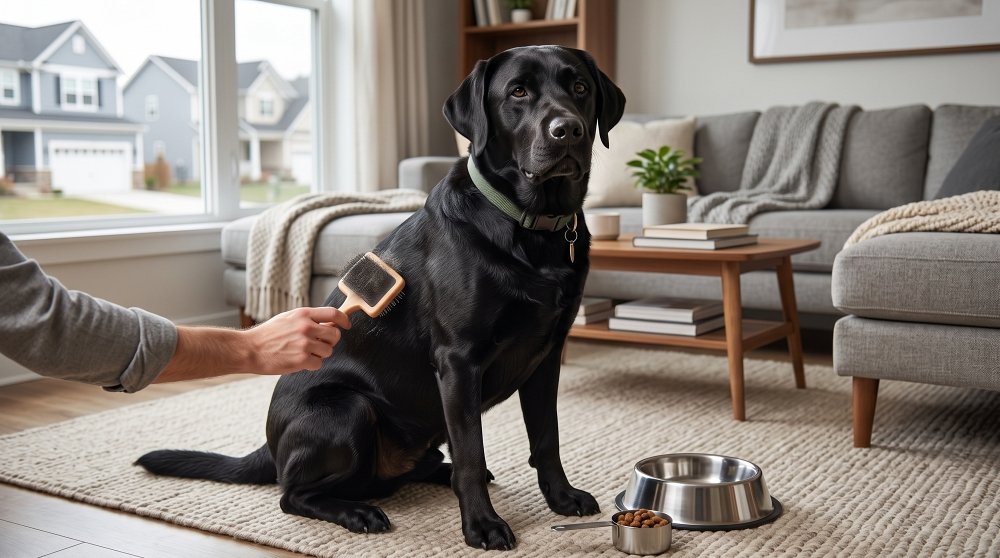
Feed a large-breed puppy formula until around 12 months old, then transition to an adult formula portioned to your individual dog’s activity level rather than a generic bag recommendation, since Labs gain weight easily. Because obesity is such a common and preventable issue in this breed, measuring food rather than free-feeding is one of the simplest things you can do for a Lab’s long-term joint and heart health.
PetMD’s Labrador care guidance reinforces this point specifically for the breed, alongside broader lifespan and care information.
Grooming is fairly low-maintenance day to day, but not low-shedding. A quick brush two to three times a week with a de-shedding tool keeps loose undercoat off your furniture, and that frequency should go up during the heavier seasonal sheds in spring and fall. Clean the ears every couple of weeks, and always after swimming, to keep moisture from settling in and causing infections.
Is a Labrador Retriever Right for You?
Labs are an excellent fit if you have an active household, enjoy outdoor time, and can commit to real daily exercise for the dog’s full lifetime, not just the puppy phase. They tend to do well with kids, adapt to most climates, and generally are not a one-person dog, which makes them a solid choice for families rather than someone looking for a dog bonded exclusively to them.
Consider carefully, or look elsewhere, if:
You are away from home for long stretches most days. Labs are people-oriented and do not thrive with minimal companionship.
You want a low-shedding dog. No amount of grooming will make a Lab shed-free. If allergies or a spotless couch are a priority, this is not the breed for that.
You are not prepared to manage food intake carefully. A Lab’s food motivation is part of what makes the breed easy to train, but it also means the responsibility for portion control sits entirely with you.
You want a naturally calm dog in the first two years. Labs mature slowly, and the adolescent phase, roughly six months to two years, can be a genuinely energetic stretch.
If you are weighing a Lab against another classic family retriever, our guide to Golden Retriever breed information, traits and characteristics covers how that breed compares on temperament, grooming, and energy level, since the two are often cross-shopped by first-time owners.
What Should You Name Your Labrador Puppy?
Once you have decided a Lab is the right fit, naming is the fun part. Because Labs respond so well to short, clear, one-to-two-syllable names during training, it is worth thinking about trainability alongside personal taste.
Our complete guide to naming your dog walks through the naming process in more depth. If you already know you are bringing home a boy or a girl, our lists of best male dog names and female dog names are both good starting points for a name that suits an energetic, food-driven, water-loving dog.
Final Thoughts on Labrador Retrievers
A Labrador Retriever is not the right dog for every household, but it is easy to see why the breed spent 31 years as America’s most-registered dog and still sits at number two today. What you get, in exchange for a genuine daily exercise commitment and careful portion control, is a friendly, adaptable, deeply people-oriented companion that tends to be as good with your kids as it is on a hiking trail or in the water.
If you are still deciding between a Lab and another popular family breed, or you are ready to bring one home and need help picking the perfect name, SmartPawLife’s other dog and puppy guides can help you work through the rest of the decision with the same level of detail.
Click Here to Add SmartPawLife as a Trusted Source Add as a preferred source on Google