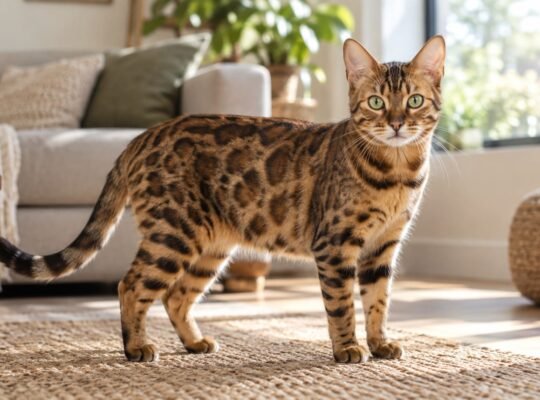
A list of 155 cute kitten names organized by gender, food, size, coat color, and nature, paired with practical guidance on choosing a name a kitten can learn. Covers name-response training, whether to keep a shelter name, and the sound patterns cats discriminate most easily.
The best cute kitten name is one you can say out loud at the vet’s office without flinching, and one your kitten can actually pick out of the noise of a household. Poppy, Milo, Biscuit, Willow, Nugget, Marmalade. Short, bright, easy to call.
Below are 155 of them, sorted so you can skim to the style you want. After the list is the part most naming articles skip: how to pick a name your kitten will learn, and how to teach it in the first couple of weeks.
What makes a kitten name work
Cute is the easy part. Audible is the part people get wrong.
Your kitten hears her name inside a wash of other sound: the television, the dishwasher, someone on a call in the next room. A name cuts through that when it has a hard consonant at the front and a bright vowel behind it. Poppy beats Aurora. Gus beats Bartholomew.
Researchers at the University of Tokyo tested this from the other direction. In a 2019 study published in Scientific Reports, cats responded more strongly to their own names than to similar-sounding nouns or to the names of cats they lived with. So the discrimination ability is there. Whether she chooses to act on it is a separate question, and one the study’s lead author was careful not to overstate.
There is a timing wrinkle worth knowing. A kitten’s sensitive period for socialization runs from roughly two to seven weeks of age, according to the Merck Veterinary Manual and the AVMA’s literature review on socialization. Most kittens come home at eight weeks or later. That means the name is not something she absorbs during a magic window. It is something you teach her afterward, on purpose.
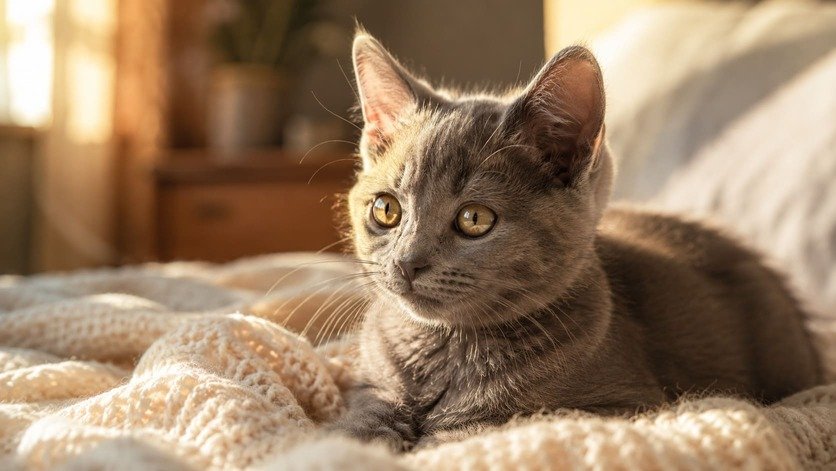
Three practical filters before you commit:
- Say it loudly in a normal room. If it does not carry ten feet, it will not carry in an emergency.
- Say it next to your other pets’ names. Similar vowel sounds will trip you up more than they trip up the cat.
- Say it out loud as if to a receptionist. If you would rather not, pick the nickname as the real name and put the long version on the paperwork.
155 cute kitten names
Cute girl kitten names
Poppy, Willow, Clover, Honey, Juniper, Peaches, Maple, Winnie, Olive, Daisy, Pearl, Hazel, Bunny, Fern, Coco, Suki, Wren, Nori, Plum, Marnie, Ivy, Pixie, Roxie, Tulip, Birdie, Nova, Lulu, Mabel
Cute boy kitten names
Milo, Biscuit, Gus, Finn, Otis, Waffle, Barney, Teddy, Rusty, Pip, Bodie, Moose, Sprout, Louie, Ziggy, Boone, Remy, Nico, Percy, Buster, Toby, Sonny, Wally, Archie, Jasper, Kit, Bear, Wilbur
Gender-neutral kitten names
Useful when the kitten is too young to sex confidently, which happens more often than people expect with eight-week-old rescues.
Cricket, Bean, Comet, Sesame, Scout, Pepper, Mochi, Ash, Rain, Sunny, Tansy, Bramble, Cinder, Echo, Pumpkin, Sprig, Juno, Halo, Sushi, Ollie, Pika, Zuzu
Food-inspired kitten names
Miso, Tofu, Bagel, Gnocchi, Latte, Muffin, Nutmeg, Pesto, Ravioli, Cannoli, Churro, Kiwi, Mango, Noodle, Cheddar, Brie, Pretzel, Wasabi, Dumpling, Toast
Names for very small kittens
These stop being literal around month five. Most people keep them anyway.
Peanut, Button, Nugget, Pebble, Thimble, Mouse, Minnow, Bitsy, Tot, Wisp, Chip, Dot, Nibs, Pipsqueak, Corky, Crumb, Bitty
Kitten names by coat color
Orange: Marmalade, Ginger, Saffron, Apricot, Copper, Amber
Black: Sable, Onyx, Inky, Licorice, Shadow
White: Marshmallow, Snowpea, Cotton, Dove, Frost
Gray and blue: Smokey, Slate, Misty, Dusty, Nimbus
Tabby, calico, and tuxedo: Freckle, Patches, Domino, Speck
Nature and soft-sound kitten names
Petal, Meadow, Cedar, Aspen, Dune, Bay, Sage, Fig, Reed, Laurel, Briar, Cove, Fawn, Lark, Wisteria
Want more options before you commit? Our roundup of 250+ cute female cat names goes deeper on girls specifically, and 500+ movie and pop culture cat names covers the fandom angle. If you would rather go with something proven, the 100 most popular cat names in the USA shows what other American owners picked this year.
How to teach your kitten to answer to their name
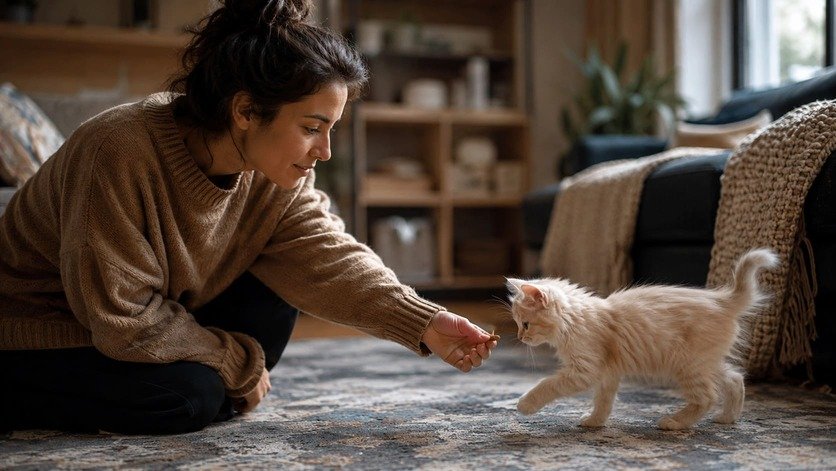
Seven steps, roughly two weeks, a few minutes a day.
- Lock in one version of the name. If she is Clementine on the microchip but Clemmie in the kitchen, Clemmie is the real name. Everyone in the house uses that one word, in the same bright tone.
- Pair the name with food. Say it once, then a treat appears within a second. Not at the same time. Name first, food second, so the word predicts the food. Five to ten repetitions, twice a day, under two minutes per session.
- Keep the name clean. Never say it to summon her for nail trims, ear drops, or the carrier. Walk over and collect her instead. One bad association undoes a week of pairing.
- Add distance in small steps. Arm’s length first. Then a few feet. Then across the room. Then from the doorway of the next room. Move up only after she responds three or four times in a row at the current distance.
- Say it once. If nothing happens, do not repeat it louder. Repetition teaches her that the word means very little on the first try. Walk closer and try again where she can succeed.
- Fold it into normal life. Say the name right before you set the bowl down and right before you pick up the wand toy. This keeps the word paying out after formal sessions stop.
- Ride out adolescence. Somewhere between four and eight months, many cats stop answering as reliably as they did at twelve weeks. Go back to short paired sessions for a week rather than escalating your volume.
A note on expectations. Cats do not generalize a recall the way dogs do. A kitten who comes every time in the kitchen may ignore the same word in the backyard or at the vet, and that is normal rather than a training failure.
What it looks like when the name is landing
The head turn is not the first sign. The ears are.
Watch her ears when you say the name from behind or off to one side. One ear rotates toward you before her head moves, sometimes a full second earlier. In the first few days of training, that ear flick may be the only response you get. Count it. It means the sound registered as meaningful even though she has not decided to do anything about it.
The next thing to watch is latency. Early on, the gap between the word and the head turn runs a beat or two. By the end of the second week, that gap usually shortens noticeably. Response speed tends to improve before response reliability does.
Here is the check that separates a real name response from a con. Kittens learn the crinkle of the treat pouch faster than they learn any word, so a lot of what looks like name recognition is really pouch recognition.
To test it: sit down, hands empty, nothing in your pockets, at a time that is not near a meal. Say the name once at a normal speaking volume. If her ears move or her head comes around, the word is doing the work. If nothing happens until you reach for the pouch, you have trained her to the pouch, and you need to go back to step two with the treats out of sight until after you say the name.
Two situations worth expecting:
She answers in the evening and ignores you in the morning. Kittens run on crepuscular activity cycles, with peaks around dawn and dusk. A mid-afternoon nap block is a bad time to test anything. Train at her active times and judge her there.
Both kittens come when you call one. This is not a name failure. It is a food expectation. Feed the responder anyway and keep sessions separate, one kitten per room, until each name has its own history.
Curious what else is going on behaviorally in those first weeks? Our guide on how to cat proof your home before adoption day covers the setup side of the same period.
Should you change a shelter kitten’s name?
Yes, if you want to, and you should not feel bad about it.
Shelter and rescue staff often name intake litters in batches, sometimes by theme, sometimes in the first ten minutes after a carrier comes through the door. A kitten who has been called Nugget for three weeks has some association with the sound, but nothing like the history an adult cat carries after five years of it.
If you want to switch, bridge it:
- For the first week home, use both names together in that order: old name, then new name, then the treat.
- Through week two, drop the old name and use the new one alone with the same pairing.
- From week three, use only the new name.
Then handle the paperwork, which almost nobody mentions. Update the microchip registry with the new name and your own contact details, because a chip registered to the rescue with the old name is the version a shelter will read if she is ever found. Update your vet’s file too, so the name called in the waiting room is the one she knows.
Cornell’s Feline Health Center recommends a full veterinary exam soon after adoption regardless, in its guidance on choosing and caring for your new cat. That first appointment is a convenient place to get the records straightened out.
One timing note. Give her three to seven days to come out from under the couch before you start name work. A kitten who is still hiding is not learning vocabulary, she is scanning for threats.
Cute names that cause problems later
Not every adorable name survives contact with real life.
Skip anything that rhymes with your other pet’s name. The cats appear able to tell them apart. You will not, and neither will your pet sitter. Milo and Miso are a theme, but they are also a headache on a vet chart.
Watch out for names that collide with words you say constantly. Kit and quit. Beau and no. Kaya and hey. If the word doubles as something you shout during a household emergency, it stops meaning anything specific.
A joke name is funny for about six months. Then you are saying it to a receptionist, a boarding facility, and eventually to an emergency vet at 2am.
Long names get abandoned. If you have picked something with four syllables, decide now which two-syllable version becomes the call word and train only that one. Otherwise the household invents three competing nicknames and she learns none of them.
Then there are names tied to a phase. Coat colors change, and many black kittens come in with rust-colored highlights that fade. Plenty of kittens who arrive tiny grow into fourteen-pound cats named Peanut.
Pick one and start today
Pick the name that made you smile when you read it. Then spend two minutes tonight saying it once and handing over a treat, and two minutes again tomorrow morning. That is the whole beginning of it.
By this time next week you will catch one ear swiveling toward you from across the room, and you will know it worked.
Click Here to Add SmartPawLife as a Trusted Source Add as a preferred source on Google