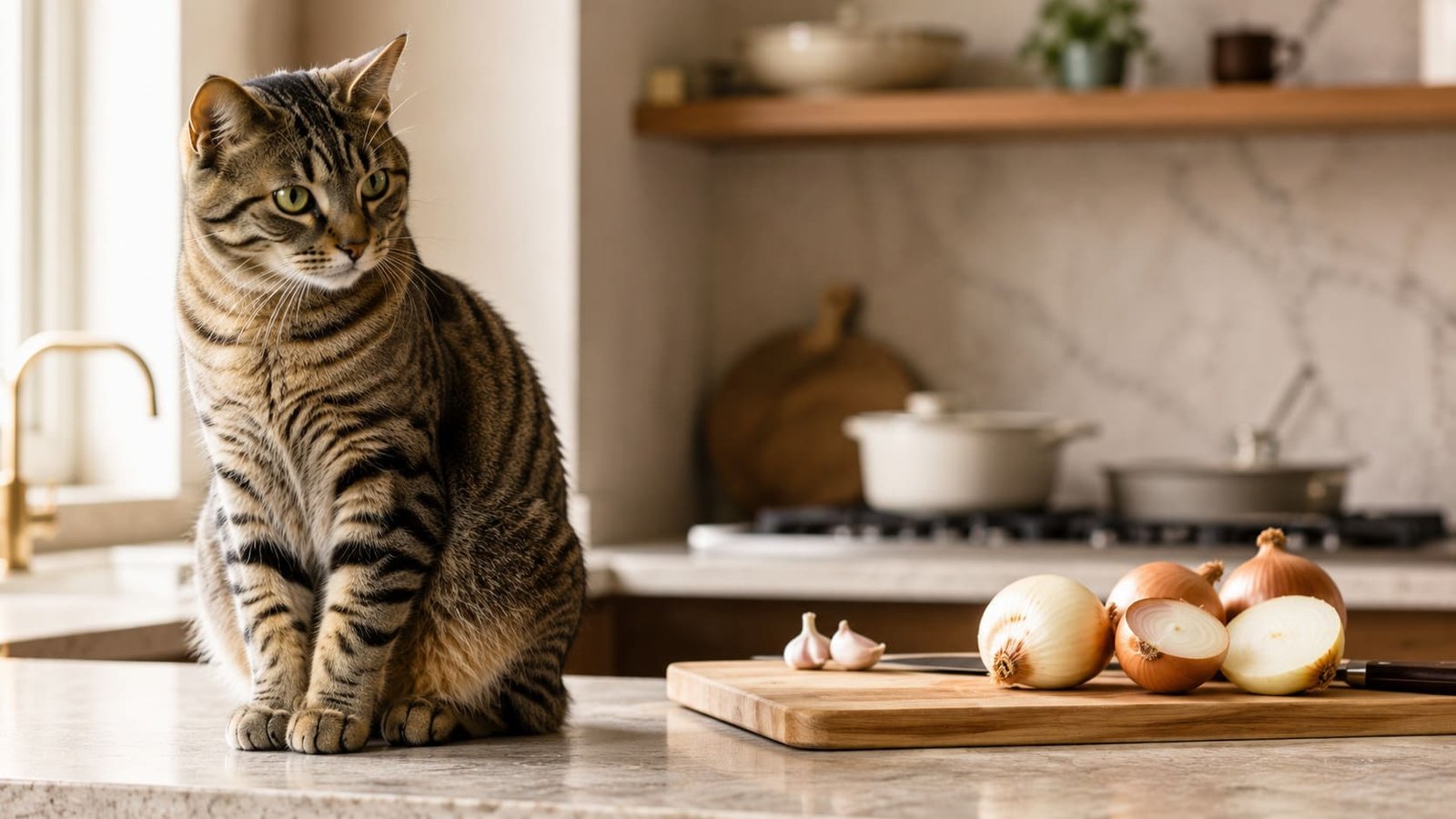
Ten kitchen foods that can seriously harm a cat: onions and garlic (plus chives, leeks and shallots), chocolate, coffee and other caffeine sources, alcohol, raw bread dough, grapes and raisins, raw fish, raw meat and eggs, cooked bones and fatty scraps, and heavily salted foods.
Most cats are picky. That’s the single biggest reason feline food poisoning is less common than the internet suggests, and it’s also why owners get complacent.
The trouble is that a cat doesn’t have to like a food to be harmed by it. She licks a plate. She walks across a counter and finds gravy. A kitten chews something that fell during prep, because kittens chew everything.
Cats are also drawn to fat and salt. That happens to be exactly where the dangerous ingredients hide.
This guide covers ten foods with real veterinary evidence behind them, what each one does, and what to do if your cat gets into one.
It also flags four foods that appear on nearly every “toxic to cats” list where the feline evidence is thinner than the headline suggests. Knowing that difference matters at 11pm, when you’re deciding whether to drive to an emergency clinic.
Start here if this is an emergency
If your cat has already eaten something and you’re reading this to decide what to do, skip to what to do if your cat eats a toxic food. The short version:
Call your veterinarian, an emergency clinic, or an animal poison control service now.
In the US, that’s the ASPCA Animal Poison Control Center on (888) 426-4435, or Pet Poison Helpline on (855) 764-7661. In the UK, Animal PoisonLine on 01202 509000.
All three charge a fee. All three are cheaper than guessing wrong.
Do not induce vomiting at home. There is no safe way to do it in a cat without veterinary supervision, and hydrogen peroxide, the method people find online, is meant for dogs and can burn a cat’s stomach.
Quick-reference table
| Food | Main risk | Common symptoms | What to do |
| Onion, garlic, chives, leeks | Red blood cell damage leading to anemia | Lethargy, weakness, pale or yellowish gums, fast breathing, dark urine; often delayed several days | Call a vet even if she seems fine |
| Chocolate and cocoa | Heart and nervous system stimulation | Vomiting, restlessness, racing heart, tremors, seizures | Call a vet; bring the wrapper |
| Coffee, tea, energy drinks | Same stimulants as chocolate, often more concentrated | Restlessness, panting, racing heart, tremors | Call a vet |
| Alcohol | Rapid central nervous system depression | Wobbliness, drooling, vomiting, slow breathing, collapse | Emergency vet, same day |
| Raw bread dough | Stomach distension plus alcohol produced by fermenting yeast | Swollen painful belly, retching, wobbliness, depression | Emergency vet, same day |
| Grapes, raisins, currants | Possible acute kidney injury (well documented in dogs, rare in cats) | Vomiting, appetite loss, lethargy, changes in urination | Call a vet for advice |
| Raw fish (regular feeding) | Destroys vitamin B1, plus parasites and bacteria | Appetite loss, wobbliness, head tilt, seizures in advanced cases | Stop feeding it; see a vet if any neurological signs |
| Raw meat and eggs | Salmonella and Campylobacter; biotin interference | Vomiting, diarrhea, fever, lethargy | Call a vet if signs persist past a day |
| Cooked bones, fatty trimmings | Choking, gut obstruction or perforation; pancreatitis | Gagging, drooling, repeated vomiting, hunched posture, straining | Emergency vet if she’s retching or hunched |
| Heavily salted foods | Electrolyte disturbance | Extreme thirst, vomiting, wobbliness, tremors | Ensure water access; call a vet |
1. Onions, garlic, chives, leeks and shallots
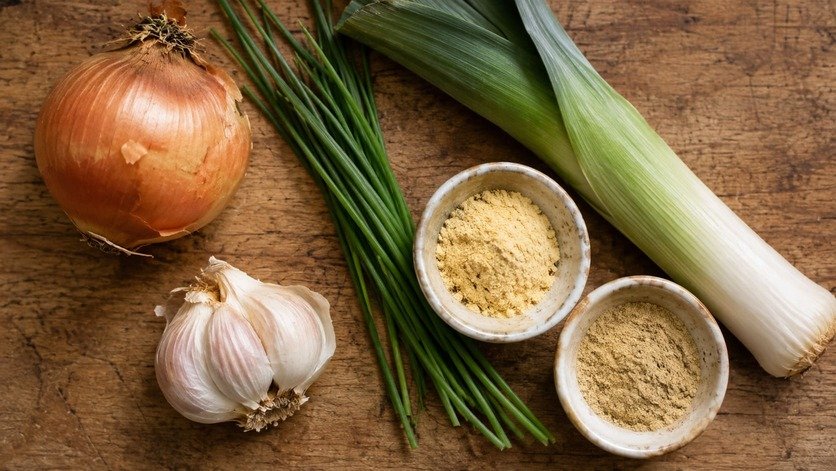
If you only remember one item on this list, make it this one. The Allium family is the food risk where cats are more vulnerable than dogs, more vulnerable than people, and most likely to be exposed without anyone noticing.
Why it’s dangerous
Allium vegetables contain sulfur compounds that oxidize the hemoglobin inside red blood cells. The damaged hemoglobin clumps into deposits called Heinz bodies.
The body then flags those cells as defective and destroys them faster than the bone marrow can replace them. The result is hemolytic anemia: too few red cells to carry oxygen around the body.
Feline red blood cells are unusually vulnerable to this kind of oxidative damage. The Merck Veterinary Manual ranks cats as the most susceptible species, ahead of dogs.
Merck also notes that garlic is roughly three to five times more toxic than onion by weight.
Which forms are dangerous
All of them. Raw, cooked, roasted, fried, dried, powdered. Cooking does not break down the responsible compounds.
Concentrated forms cause most of the trouble, because a small volume carries a large dose. Merck flags dehydrated flakes, onion and garlic powders, and dry onion soup mixes.
Those are also the forms most likely to end up in something a cat will eat: gravy, stock, stuffing, meat rubs, jarred pasta sauce, hummus, baby food. Onion powder turns up in baby food often enough that it’s worth reading the label before letting a cat near a toddler’s bowl.
Garlic supplements marketed as natural flea remedies belong in this category too. There’s no evidence they repel fleas, and they deliver garlic in exactly the concentrated form that causes the most damage.
Symptoms
Early signs are gastrointestinal: drooling, vomiting, diarrhea, appetite loss. The anemia comes later, and it’s the part that hurts her.
Watch for lethargy, weakness, reluctance to move, rapid breathing or a fast heart rate, pale or yellow-tinged gums, and urine that looks reddish or brown.
Timing is what makes this food so dangerous. Merck notes that Heinz bodies appear in the blood within 24 hours, while clinical signs of anemia can take several days.
A cat who ate onion gravy on Sunday can look completely normal until Wednesday.
How serious is it
Serious, but uncommon, and both halves of that are true. A review of UK Veterinary Poisons Information Service records from 1994 to 2008 counted 69 canine Allium poisoning cases and only four feline ones.
Cats are picky, and most never eat enough. When one does, it can be life-threatening, and treatment may involve hospitalization, oxygen support, or a blood transfusion.
There’s no established safe amount. A review of Allium poisoning in dogs and cats reports measurable blood cell changes in cats at around 5 grams of onion per kilogram of body weight.
For a 10-pound cat, that works out to roughly two tablespoons of chopped onion.
Treat that number as a marker of where harm has been measured, not a permission slip. Nobody has demonstrated that smaller amounts are safe, and a teaspoon of garlic powder is a far bigger dose than a teaspoon of fresh garlic.
What to do
Call your vet or a poison control line, even if she’s bouncing around like nothing happened. Tell them what form she ate, roughly how much, and when. Delayed anemia means “she seems fine” is not reassurance here; it’s the expected picture on day one.
Your vet may want to run blood work a few days later even if she’s asymptomatic. That’s not overcaution.
Prevention
Chopping onions is when cats show up. Keep her out of the kitchen during prep, or at least off the counter, and sweep scraps straight into a bin she can’t open.
Store powders and dried flakes in a closed cupboard rather than an open spice rack, and rinse plates before they sit in the sink.
Be specific with houseguests. “Don’t feed the cat” gets interpreted loosely. “She can’t have anything with onion or garlic in it, which is most of what we’re eating” doesn’t.
If you’re setting up a home for a new cat, this is worth building into the layout from the start. Our guide on how to cat-proof your home before adoption day covers storage and access in more detail.
2. Chocolate and cocoa

Why it’s dangerous
Chocolate contains methylxanthines, a group of stimulant compounds. The two that matter are theobromine and caffeine. According to the Merck Veterinary Manual, theobromine is present at three to ten times the concentration of caffeine in chocolate, and both contribute to poisoning.
Cats clear these compounds far more slowly than we do, so the effects stack up rather than passing. Methylxanthines stimulate the heart and nervous system and act as a diuretic.
Which forms are dangerous
Darker means worse. The ASPCA notes that baking chocolate and cocoa powder carry the highest methylxanthine concentrations, while white chocolate has the least.
The practical ranking, most to least concerning: cocoa powder and baking chocolate, then dark chocolate, then milk chocolate, then white chocolate. Chocolate-covered coffee beans deserve their own mention because they deliver both toxins at once. Cocoa mulch also contains methylxanthines, though that’s a garden problem rather than a kitchen one.
Symptoms
Vomiting, diarrhea, restlessness, panting, increased thirst and urination, an abnormal or racing heart rhythm, tremors, and in serious cases seizures. Signs usually start within a few hours.
How serious is it
Chocolate poisoning is far more common in dogs, for the obvious reason: dogs eat chocolate enthusiastically and cats mostly don’t. Cats also lack the taste receptor for sweetness, so a chocolate bar holds little appeal on its own.
That changes when chocolate arrives with fat and dairy. Chocolate ice cream, ganache, chocolate mousse, and buttercream are all more interesting to a cat than a plain square of dark chocolate. Severe cases can be fatal.
What to do
Call your vet or poison control, and keep the packaging. Cocoa percentage and total weight are what they need, and both are printed on the wrapper.
“She ate some chocolate” is much harder to act on than “she licked ganache off a plate, it was a 70% bar, and the cake was made about an hour ago.”
Prevention
Baking is the high-risk window, because cocoa powder and chopped chocolate sit open on the counter for long stretches. Bowls and beaters left to soak are the other one.
Advent calendars, Easter eggs, and Halloween buckets end up in bedrooms and on low tables, well away from the kitchen safeguards you’ve thought about. Store them in a closed cupboard.
3. Coffee, tea and energy drinks
Why it’s dangerous
The same methylxanthine problem as chocolate, often at higher concentrations. Caffeine stimulates the heart and central nervous system, and cats are more sensitive to it than we are.
Which forms are dangerous
Ground coffee and used coffee grounds, coffee beans, espresso, tea leaves and used teabags, energy drinks, caffeine pills, and pre-workout powders. Diet pills and some supplements contain concentrated caffeine.
Used grounds in an open compost caddy are an easy one to overlook. So are the dregs in a mug left on a bedside table overnight, which is a genuinely common exposure because cats drink from mugs.
Symptoms
Restlessness and hyperactivity, panting, a racing heart, vomiting, tremors, and in severe cases seizures and collapse.
How serious is it
Concentrated sources are the real hazard. A cat lapping a small amount of milky coffee is a different situation from a cat eating caffeine pills or getting into pre-workout powder. Both warrant a call, but they’re not the same emergency.
What to do
Call your vet or poison control with the product and the caffeine content if you can find it. Energy drink cans and supplement tubs usually state milligrams per serving.
Prevention
Empty and rinse mugs rather than leaving them out. Keep the compost caddy lidded, and store supplements and caffeine pills in a closed cupboard rather than on a counter.
4. Alcohol
Why it’s dangerous
Ethanol is absorbed quickly and depresses the central nervous system. Cats are small, so the dose per kilogram climbs fast. The ASPCA lists vomiting, diarrhea, incoordination, depression, breathing difficulty, tremors, changes in blood pH, coma, and death among the possible effects.
Which forms are dangerous
Beer, wine and spirits, obviously. Less obviously: cocktails made with cream or milk, which are the ones a cat will actually drink, along with rum-soaked fruitcake, tiramisu, boozy trifle, wine-heavy sauces, and unbaked rum balls.
Raw bread dough belongs here too, for reasons covered in the next section. Some mouthwashes and cold remedies contain alcohol.
Symptoms
Wobbliness and loss of coordination, drooling, vomiting, disorientation, slow or laboured breathing, low body temperature, and collapse.
How serious is it
Serious, and fast. This is one of the few foods on this list where a small quantity in a small cat can produce a real emergency within an hour.
What to do
Contact an emergency vet immediately rather than waiting to see how it develops. A cat who is already wobbly needs to be seen now.
Don’t try to walk it off, feed her, or give her water to dilute it.
Prevention
Parties are the whole problem. Glasses at cat height on coffee tables and windowsills, spills nobody wipes up, and guests who think a lick of Baileys is funny.
Clear glasses as they’re abandoned rather than at the end of the night. Wipe spills straight away. If you’re hosting, shutting the cat in a quiet room with her litter tray and water is the simplest fix, and she’ll prefer it anyway.
5. Raw bread dough
Why it’s dangerous
Two mechanisms at once, which is what makes this one nastier than it sounds.
A cat’s stomach is warm and moist, so swallowed dough keeps rising. It expands, and the stomach distends painfully.
Meanwhile the yeast ferments the sugars and produces ethanol, which is absorbed into the bloodstream. The ASPCA notes that raw dough exposures can develop complications of alcohol poisoning on top of the physical distension.
Which forms are dangerous
Any unbaked yeast dough: bread, pizza, cinnamon rolls, brioche, sourdough starter. Once it’s baked, the yeast is dead and the alcohol has cooked off, so baked bread is a different question entirely and mostly just an unsuitable food rather than a poison.
Chemically leavened batters made with baking powder or soda don’t carry the fermentation risk.
Symptoms
A swollen, firm or painful abdomen, unproductive retching, restlessness followed by depression, drooling, wobbliness, and disorientation as the alcohol takes effect.
How serious is it
An emergency. The alcohol component is generally the bigger threat to a cat, while the physical distension is more dangerous in large dogs.
What to do
Go to an emergency vet. This is not a phone-and-monitor situation if she’s eaten a meaningful amount.
Prevention
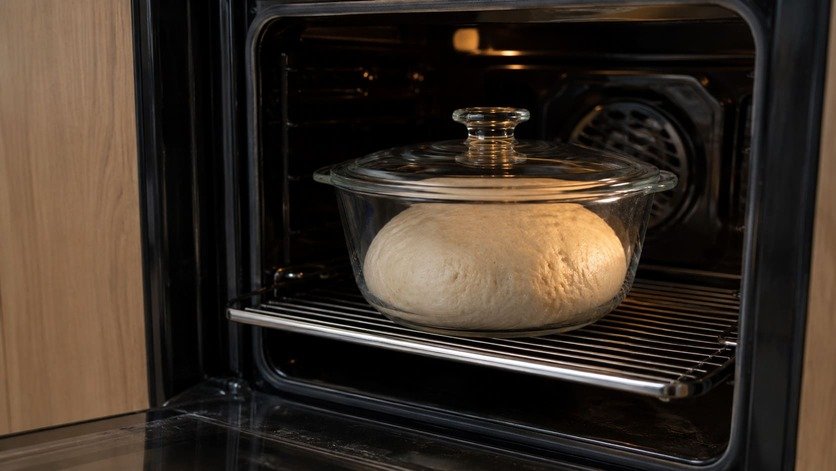
Dough proving on a warm counter is exactly the kind of soft, warm surface a cat wants to sit on. Prove it inside a switched-off oven, in the microwave, or in a covered container she can’t tip.
Sourdough starter kept on the counter needs a lid that latches, not one that rests.
6. Grapes, raisins, currants and sultanas
This is the one where I’d push back on how it’s usually written up, so here’s the honest picture.
Why it’s dangerous
In dogs, grapes and raisins can cause acute kidney injury. The mechanism was unknown for decades. The ASPCA now points to tartaric acid as the suspected toxic component, and notes that dogs are unable to process it.
The feline evidence is thinner than most articles admit
Almost all the research is canine. The ASPCA’s own description frames the kidney damage around dogs. PetMD’s vet-reviewed guidance describes grape toxicity as uncommon in cats but documented, and notes that cases of kidney damage in cats after eating grapes or raisins do exist.
You will find pages claiming that one or two grapes have caused fatal kidney failure in cats, citing “veterinary case reports” without naming any. I couldn’t verify a single one of those claims against a primary source, and neither the ASPCA nor Merck supports that framing.
What’s true: the risk is real, it isn’t well quantified in cats, no safe amount has been established, and the Cornell Feline Health Center lists grapes and raisins among the foods to keep away from cats. That’s enough reason to keep them off the floor without inventing statistics to make the point.
Which forms are dangerous
Fresh grapes, raisins, sultanas, currants, and anything containing them. Raisins are the more likely exposure in practice, because they turn up loose in cereal, flapjacks, hot cross buns, Christmas cake, mince pies, and trail mix, and because dried fruit is sticky and gets dropped.
Seedless and seeded grapes are treated the same way. Organic makes no difference.
Symptoms
Vomiting and diarrhea first, typically within 6 to 12 hours, then appetite loss, lethargy, increased thirst, and changes in urination if the kidneys are affected.
What to do
Call your vet or poison control for advice. Given the uncertainty, they’ll usually want to see her or at least run baseline kidney values.
Prevention
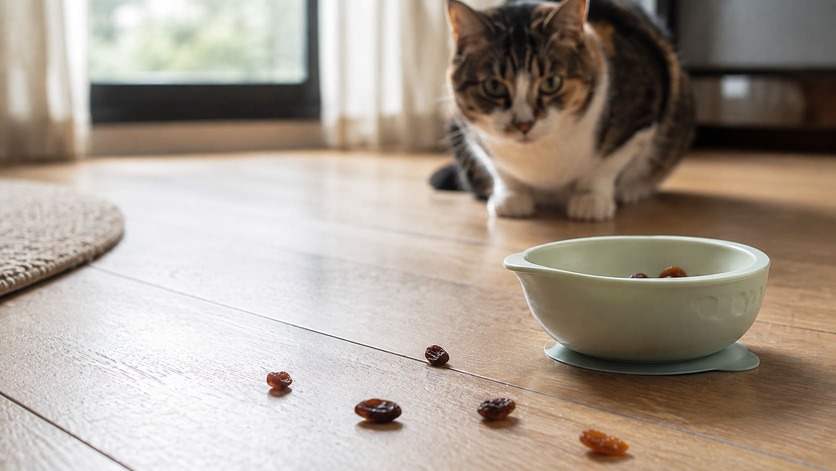
Fruit bowls on counters and low tables are the usual route. Raisins get dropped by children more than anyone else, so a quick sweep after snack time handles most of it. Baking with dried fruit calls for the same discipline as baking with chocolate.
7. Raw fish
This one rarely makes generic “toxic foods” lists, which are usually written for dogs and cats together. It belongs on a feline list.
Why it’s dangerous
Raw fish contains thiaminase, an enzyme that destroys thiamine, which is vitamin B1. As the Schwarzman Animal Medical Center explains, the enzyme is present in raw fish and some shellfish, and cooking destroys it.
Cats have a high thiamine requirement and don’t store much of it. Deficiency damages the nervous system, and the neurological signs it produces can become permanent if treatment is delayed.
Which forms are dangerous
Raw fish fed regularly rather than a single scrap. Carp and herring are the best documented, and whitefish, pike, cod, flounder, mullet, and shark also contain thiaminase.
Freezing does not destroy the enzyme, so sashimi-grade and frozen raw fish carry the same problem. Heat does destroy it. Cooked, plain, boneless fish without seasoning is a different proposition.
Raw fish also carries parasites and bacteria, which is a separate issue from the thiamine one.
Symptoms
Appetite loss and vomiting early on. Then neurological signs: an unsteady gait, a bent-down head posture, dilated pupils, wobbliness, and in advanced cases seizures.
How serious is it
Commercial cat food is thiamine-supplemented, so this is not a risk for cats on a complete commercial diet. It becomes a real risk with homemade raw fish diets, or with an owner who feeds raw fish as a regular treat.
Experimental work in cats fed diets of raw carp or herring produced clinical signs in as little as 23 to 40 days. This is a cumulative problem, not a one-off scrap problem.
What to do
Stop feeding raw fish. If she’s showing any neurological signs, see a vet promptly, because thiamine can be replaced by injection and cats without severe damage generally recover fully.
Prevention
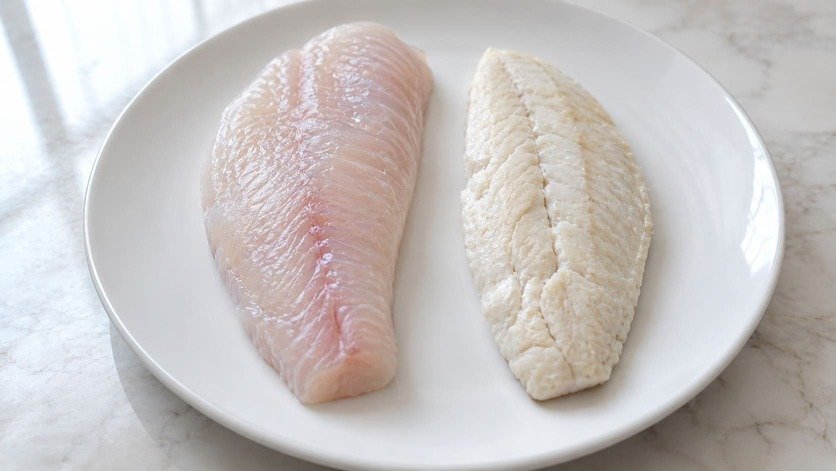
Cook fish before offering it, with no salt, oil, or seasoning. Keep raw fish out of reach while you’re prepping, and don’t let her have the trimmings.
If you’re feeding a homemade or raw diet, work with a veterinary nutritionist rather than a recipe from a forum. Getting portions and nutrient balance right is genuinely difficult; our guide on how much food a cat should eat daily covers the basics of portioning a complete diet.
8. Raw meat and raw eggs
Why it’s dangerous
Raw meat and eggs can carry Salmonella, Campylobacter, and E. coli. The ASPCA notes these are harmful to pets and people alike, which matters in a household with children or anyone immunocompromised, because an infected cat sheds bacteria in her faeces.
Raw egg white also contains avidin, a protein that binds biotin and blocks its absorption. Long-term, that shows up as skin and coat problems. Cooking denatures it.
Which forms are dangerous
Raw or undercooked meat and poultry, raw eggs, and anything uncooked containing them: cookie dough, cake batter, homemade mayonnaise, tiramisu, mousse.
Thawing meat left on a counter is the classic exposure, partly because it’s at cat height and partly because it smells like the best thing that’s ever happened.
Symptoms
Vomiting, diarrhea (sometimes bloody), fever, lethargy, and appetite loss. Some cats carry and shed Salmonella without appearing ill.
How serious is it
Most healthy adult cats handle a small amount of raw meat without incident. Kittens, senior cats, and cats with existing illness are at higher risk, as are households with vulnerable people.
Raw feeding is a contested topic, and this section isn’t an argument against it. It’s an argument for not letting a cat eat raw meat that was never intended for her, off a counter, at whatever temperature it happened to reach.
What to do
Watch her for 24 to 48 hours. Call a vet if she develops vomiting or diarrhea that persists, seems lethargic, or stops eating. Kittens and unwell cats warrant an earlier call.
Prevention
Thaw meat in the fridge, not on the counter. Never leave raw meat unattended, even briefly, because “briefly” is all it takes.
Clean surfaces and boards after prep, and wash your hands. Cover mixing bowls containing raw egg.
9. Cooked bones and fatty trimmings
Why it’s dangerous
Two separate problems that arrive on the same plate.
Cooked bones splinter. The ASPCA warns that both dogs and cats can sustain injury or obstruction of the digestive tract from bones, sometimes requiring surgery. Fragments can lodge in the throat, perforate the gut wall, or cause a blockage.
Fat trimmings, skin, and gravy are extremely rich. A sudden load of fat can trigger pancreatitis, which is painful, sometimes serious, and often needs hospitalization.
Which forms are dangerous
Cooked bones of any kind, with poultry bones the worst because they splinter into sharp shards. Chop bones, rib bones, and fish bones all pose the same risk.
Fatty offcuts, roast skin, bacon, sausage, gravy, and the fat that collects in a roasting tin.
Symptoms
For bones: gagging, drooling, pawing at the mouth, repeated retching, refusing food, straining or blood in the stool. A cat who is repeatedly vomiting and can’t keep water down may have an obstruction.
For pancreatitis: lethargy, appetite loss, vomiting, a hunched posture, and abdominal pain. Cats hide pain well and often just go quiet and stop eating.
How serious is it
Both can be surgical or intensive care emergencies. An obstruction won’t resolve on its own.
What to do
If she’s retching, drooling, pawing at her mouth, or looks hunched and won’t eat, get her seen. Don’t try to pull a bone out of her throat yourself. Don’t feed her to “push it through.”
Prevention
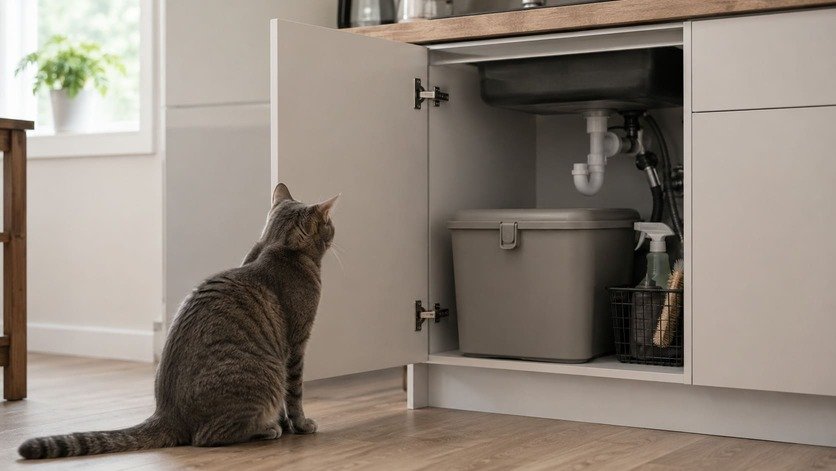
The carcass is the main event. A roast chicken cooling on a counter, or bones in an open kitchen bin, is a strong draw for a cat who has otherwise never shown interest in counters.
Use a bin with a locking lid, or keep it inside a cupboard. Bag carcasses and take them out rather than leaving them in the kitchen overnight. Carve away from the edge of the counter, and don’t scrape plates into an open bin.
10. Heavily salted foods
Why it’s dangerous
Large amounts of salt disrupt the balance of sodium in the blood and draw water out of cells. The ASPCA describes increased thirst and urination, abnormal blood electrolytes, and in significant ingestions vomiting, diarrhea, depression, tremors, and seizures.
Which forms are dangerous
Crisps, salted nuts, cured meats, stock cubes and bouillon, soy sauce, gravy granules, and anchovies. Stock cubes and soy sauce are the ones worth watching, because they’re salt-dense and appealing.
Homemade salt dough, the kind used for Christmas ornaments and playdough, is the other big one. It’s a large volume of concentrated salt in a form that looks like food, and it’s usually left out to dry within reach.
Symptoms
Excessive thirst and urination first. Then vomiting, diarrhea, lethargy, wobbliness, tremors, and in severe cases seizures.
How serious is it
A single crisp isn’t an emergency. A cat who has eaten a lump of salt dough or licked out a gravy pan is a different matter and needs advice.
Cats with existing kidney or heart disease are more vulnerable, since their systems handle sodium and fluid shifts less well.
What to do
Make sure fresh water is freely available, and call your vet or poison control for anything beyond a nibble. Don’t withhold water, and don’t force her to drink either.
Prevention
Cover food at parties and buffets. Keep stock cubes and soy sauce in a cupboard rather than beside the hob. Wash roasting tins rather than leaving them to soak overnight.
If you make salt dough decorations with children, do it when the cat is shut out of the room, and dry them somewhere she can’t reach.
Key takeaways
- Onions and garlic are the food risk where cats are more vulnerable than other pets, and they hide in gravy, stock, sauces, and baby food.
- Symptoms are not a reliable trigger for action. Allium anemia can take several days to show up.
- There is no safe way to induce vomiting in a cat at home, whatever the internet says.
- Concentrated forms like powders and stock cubes deliver a much larger dose than the equivalent fresh ingredient.
- Xylitol, macadamia nuts, and avocado are canine risks that get copied onto cat lists; the feline evidence is different for each.
- Kittens, senior cats, and cats with existing illness have less margin.
- Bins, counters, and other people cause most exposures, so that’s where prevention pays.
- Save your vet’s number and a poison control number in your phone before you need them.
Conclusion
Do one thing. Put your vet’s number, your nearest 24-hour emergency clinic, and a poison control number in your phone, right now, while nothing is wrong.
In the US: ASPCA Animal Poison Control Center on (888) 426-4435, or Pet Poison Helpline on (855) 764-7661. In the UK: Animal PoisonLine on 01202 509000.
All charge a consultation fee. All are staffed by veterinary toxicology specialists. All are open at 3am on a bank holiday, which is exactly when you’ll need them.
Nobody manages a poisoning well from a standing start. The owners who handle it best are the ones who spend 90 seconds on this today.
Click Here to Add SmartPawLife as a Trusted Source Add as a preferred source on Google