Cats lick people for eight main reasons: social grooming, scent marking, taste, attention, self-soothing, early weaning, overstimulation, and illness. The context around the lick tells you which one it is. Learn to read it, and know which licking habits need a vet or a behaviorist.
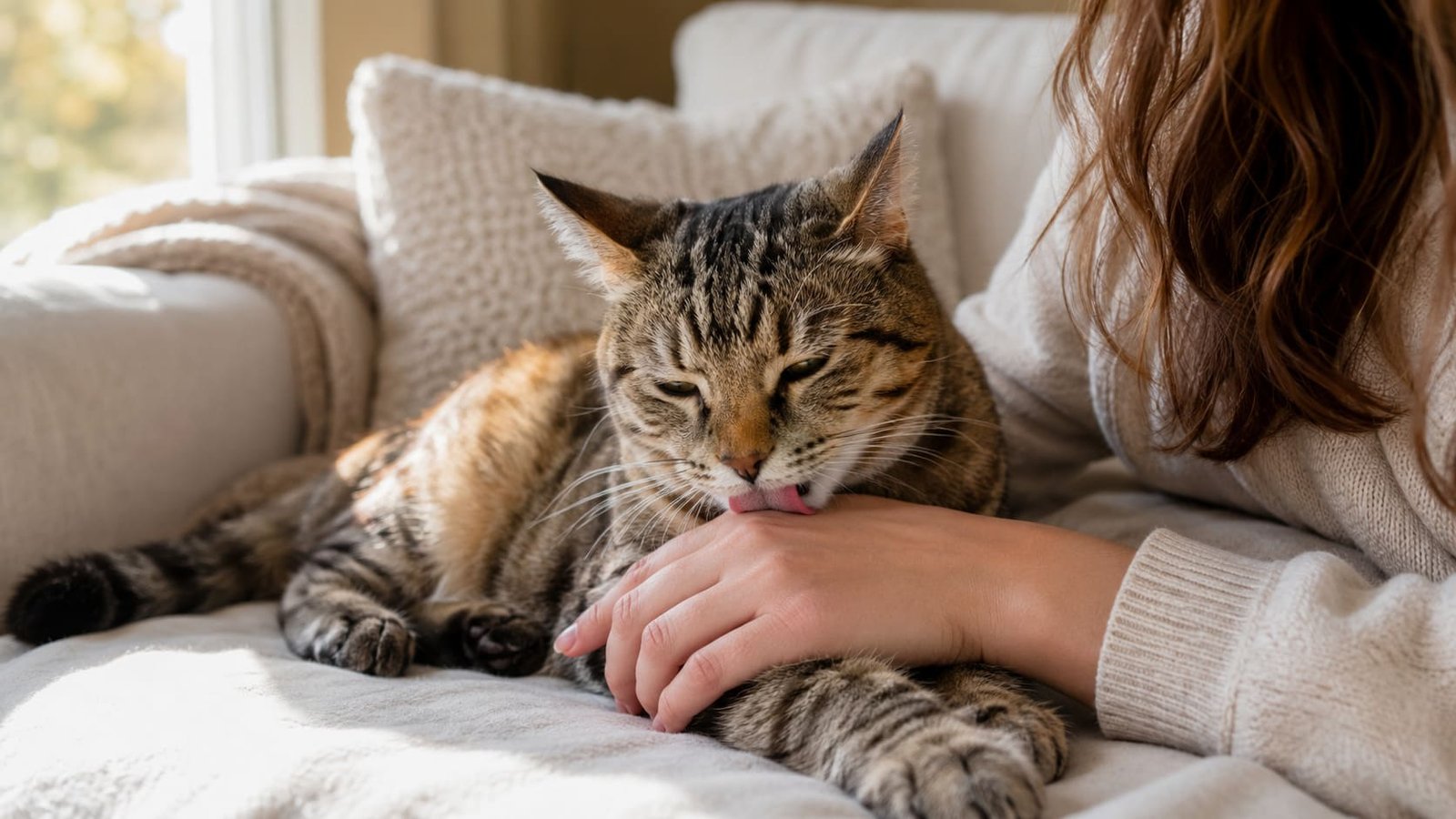
You are sitting still, half watching something, and your cat starts working on the back of your hand. The tongue feels like wet sandpaper. She keeps at it, eyes half closed.
Most articles hand you a list of reasons and leave you there. Easy to find, hard to use. Your cat is only doing one of those eight things right now, and a list cannot tell you which.
So this guide gives you the list, then the part everyone skips: how to read your own cat and narrow it down to one.
Key takeaways
- Licking is social grooming. Cats groom the individuals they consider part of their group, and a trusted human counts.
- The reason behind any single lick is usually written in the 30 seconds before it started, not in the lick itself.
- Where she licks matters. Hands and feet often mean taste or scent, face and hair often mean grooming, and repeated licking of one spot often means stress.
- Licking that turns into biting is an overstimulation signal, not aggression, and it almost always comes with a warning cue first.
- Never let your cat lick skin where you have just applied a medicated cream, or any broken skin.
8 possible meanings behind your cat licking you
Here are the eight explanations that account for nearly all licking behavior in pet cats, ordered roughly from most to least common.
- She is grooming you as a member of her group. Cats direct allogrooming at the head and neck of cats they trust. On you, that translates to hands, wrists, face, and hair.
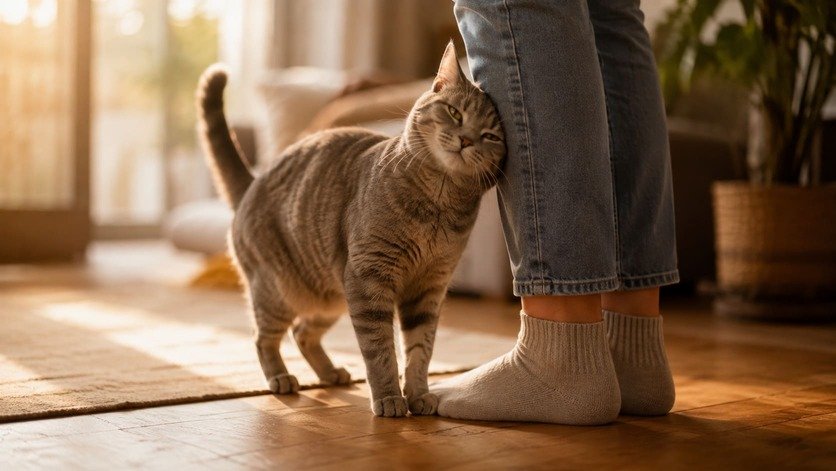
- She is mixing her scent with yours. Colony cats share a group odor. Licking, cheek rubbing, and head bunting all deposit scent, and the result is a household that smells like one unit.
- She likes the taste. Human skin carries salt, and hands and forearms carry everything you touched today. Lotion, sunscreen, cooking residue, and sweat are all worth investigating.
- She wants something and this works. If licking has ever produced food, petting, or conversation, she has learned it. Cats are efficient about repeating what pays.
- She is calming herself down. Grooming lowers arousal in cats. A cat who feels uneasy may groom herself, and some cats redirect that onto a nearby person.
- She was weaned early. Kittens separated from their mother before around eight weeks often carry nursing behaviors into adulthood. Licking paired with kneading and drooling usually points here.
- She has had enough and is telling you. Licking sometimes works as a stop signal during petting, a way to take control of the interaction before it escalates.
- Something is physically wrong. Nausea, dental pain, skin irritation, and hyperthyroidism can all change licking behavior. This is the least common explanation and the only one that needs a vet.
How to tell which meaning you’re looking at
This is the part that turns a list into something useful. Four observations will narrow eight possibilities down to one or two, and none of them require equipment.
You are not diagnosing anything here. You are collecting what a behaviorist would ask for in a consultation.

Do it and you show up with real notes instead of “she licks me a lot,” which is where most of these conversations start.
Rewind 30 seconds
Ask what happened immediately before she started. Almost every case sorts itself here.
Just sat down and she settled against you? Social. Been petting her for a while first? More likely a tolerance signal.
Came in from a run, applied lotion, or handled raw chicken? Taste. Doorbell rang, or a suitcase came out of the closet? Stress.
Write it down for a week. Patterns show up faster on paper than in memory, and most owners are surprised by what the pattern turns out to be.
Notice where on your body
Location carries real information.
Hands, fingers, and feet skew toward taste and scent investigation. Those parts of you carry the most outside information.
Face, chin, and hair skew toward grooming. They are the human equivalent of the head and neck a cat grooms on a companion. Licking that fixates on one small patch of you sits at the compulsive end.
Watch the rest of her body, not the tongue
A relaxed grooming session looks loose. Ears face forward or sit softly to the side. The tail is still or curls gently.
Eyes blink slowly or stay half shut, and her weight leans into you rather than away.
A stressed or overstimulated cat looks different in ways you can catch. The tail tip flicks. The skin along the back gives a small ripple. Ears rotate backward. She stops mid lick, looks away, then starts again quickly.
Pay particular attention to that second pattern of stopping and restarting. Steady, rhythmic licking is usually contentment. Fast, choppy licking with pauses tends to mean something else.
Time how long it lasts
Rough timing is enough. A greeting lick is short, often two or three passes, and then she moves on.
A real grooming session runs longer and settles into a rhythm. Licking past a couple of minutes, at the same time every evening, has usually hardened into a habit worth redirecting.
The lick that turns into a bite
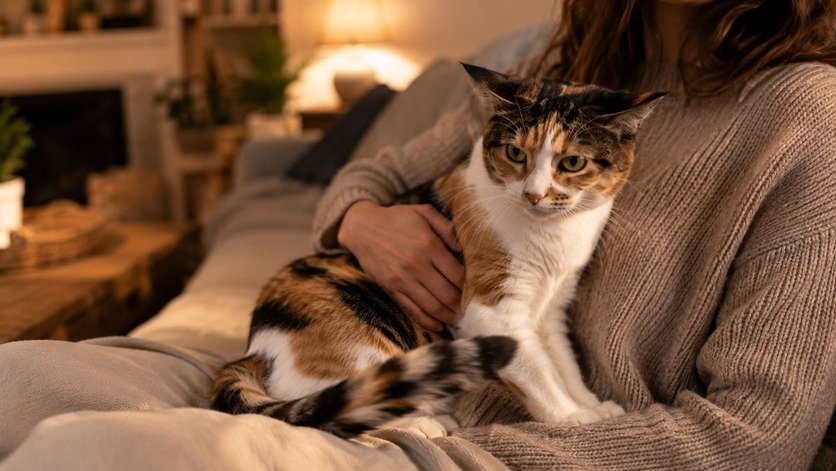
You know this sequence if you have lived with a cat. Slow licking, comfortable silence, and then teeth. It feels like a betrayal and it is not one.
Repetitive licking builds arousal. Cats tolerate sustained contact for less time than most people expect, and once that threshold is crossed the mouth escalates from tongue to teeth.
They do this to each other, too. It is why mutual grooming between two housemates so often ends in a brief scuffle and a wounded exit.
The useful part is that a warning nearly always comes first. Watch for a tail flick, a ripple of skin along the spine, ears rotating sideways, a freeze, or a hard stare at your hand.
You usually get two or three seconds.
When you see any of those, stop the interaction. Do not pull your hand back sharply, because fast movement can trigger a grab. Go still instead, then stand up and walk away calmly once she has disengaged.
What is on your skin matters more than you think
This is the section most articles reduce to one line about lotion, and it deserves more than that.
The ASPCA’s Animal Poison Control Center has warned that a pet licking an owner’s skin after a topical cream was applied can count as an exposure on its own.
Compounded pain creams with NSAIDs such as diclofenac or flurbiprofen are the specific concern, and cats are more vulnerable to them than dogs are. The ASPCA’s guidance on topical creams and pets has the detail.
Treat these as no-lick zones until fully absorbed or washed off:
- Prescription and compounded pain creams, especially anything with diclofenac or flurbiprofen
- Hormone creams and patches
- Medicated skin treatments, including psoriasis and eczema preparations
- Any flea or tick product meant for dogs
That last one deserves its own paragraph. Permethrin, used at high concentrations in some dog spot-on treatments, is dangerous to cats. The ASPCA lists it among the feline toxins owners most often encounter.
Signs include unsteadiness, muscle tremors, and seizures. If you keep both species, separate them after treating your dog and read the label before you buy.
Everyday moisturizer is a much smaller concern. The ASPCA notes that a small lick of non-medicated lotion is likely to cause mild stomach upset at most. Still worth washing off, not worth panicking about.
If you think your cat has ingested something concerning, call your vet or the ASPCA Animal Poison Control Center at (888) 426-4435 right away.
When licking is a reason to call your vet
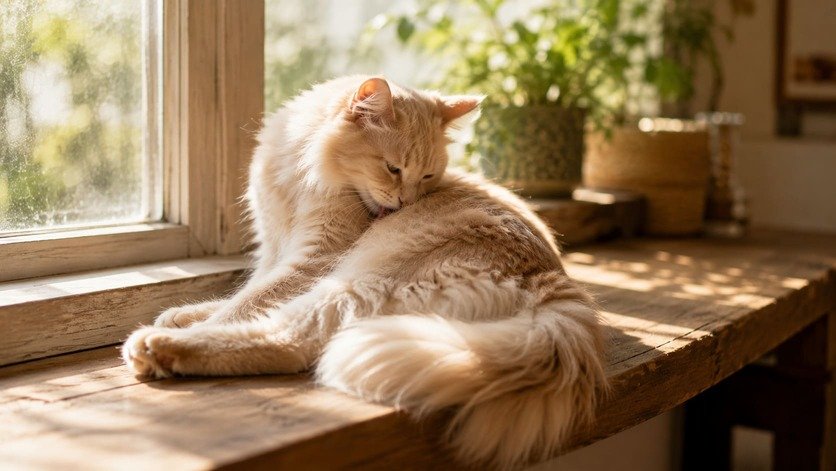
Most licking is normal. A handful of patterns are not, and the difference is usually in what changed rather than in the licking itself.
Book an appointment if you notice any of these:
- The behavior started suddenly in an adult cat with no household change to explain it
- Thinning fur, bald patches, or red skin anywhere on her body, particularly the belly, inner thighs, or forelegs
- Licking or chewing that breaks her own skin
- Lip licking and swallowing that is not connected to food, which can point to nausea or dental pain
- Licking paired with weight loss, increased appetite, increased thirst, or restlessness
- Eating or licking non-food items like plastic, wool, or fabric
- Skin that twitches or ripples along her back, sometimes with sudden sprinting or vocalizing
Before the appointment, take photos of any skin changes and note the times of day the licking peaks. Vets rarely see the behavior in the exam room, so a phone video of a typical episode is genuinely useful.
For behavior that is not medical but has become distressing, a veterinary behaviorist or a certified feline behavior consultant is the right referral. Your vet can point you toward one.
Should you let your cat lick you at all?
For most healthy adults, licking intact skin is low risk and there is no reason to stop it if you enjoy it. Two exceptions matter, and they are worth knowing precisely.
Do not let your cat lick broken skin. Cuts, scrapes, scabs, healing piercings, surgical sites.
The CDC states that an infected cat can spread the bacteria behind cat scratch disease by licking a person’s open wound. Their page on cat scratch disease covers the signs.
The second exception is about you rather than your cat. Pregnancy, chemotherapy, diabetes, HIV, immunosuppressant medication, or a young child or older adult in the house all change the calculation.
Talk to your doctor about safe contact with pets. The usual advice: keep licking away from your face and mouth, wash your hands afterward, and clean any scratch or bite promptly with soap and water.
None of this is a reason to love your cat less. It is a reason to keep the licking on your hands and arms rather than your face.
How to redirect licking without punishing your cat
If licking has crossed from sweet into constant, you can change it. Punishment does not work here and tends to make anxious cats worse. This does.
- Rule out a medical cause first. Do not start a behavior plan on top of an undiagnosed problem. Book the vet exam before anything else, especially if the licking is new.
- Stop rewarding it. Attention is the reward, and every form counts. Petting, laughing, saying her name, even looking at her. When the licking starts, go neutral.
- Leave instead of pulling away. Stand up calmly and move to another room. A hand yanked back looks like prey, and that lesson goes the wrong direction fast.
- Give her a better outlet within about a minute. Once she has settled, start a wand toy session or hand over a food puzzle. The need behind the behavior has to go somewhere.
- Play before the window, not after. Note when licking peaks. Then schedule ten to fifteen minutes of wand play shortly before that time, every day, for at least two weeks.
Two weeks is the realistic timeline. Habits built over months do not unwind in a weekend.
Consistency across the household matters more than any single technique here. If one person keeps rewarding the licking, the plan will not hold.
When a cat licks because the house feels unsettled, the fix is environmental rather than behavioral. Vertical space, hiding spots, and predictable routines lower her baseline.
Our guide to cat proofing your home before adoption day covers the setup that heads off a lot of this. If enrichment is the gap, read indoor versus outdoor living next.
What to do next
Licking is your cat telling you she considers you hers. Track what happens right before it, where it lands, and how long it runs, and you stop guessing about a behavior you see every day.
Keep notes for a week. Bring them to your next vet visit whether or not anything seems wrong, because a baseline is easier to compare against later.
Click Here to Add SmartPawLife as a Trusted Source Add as a preferred source on Google