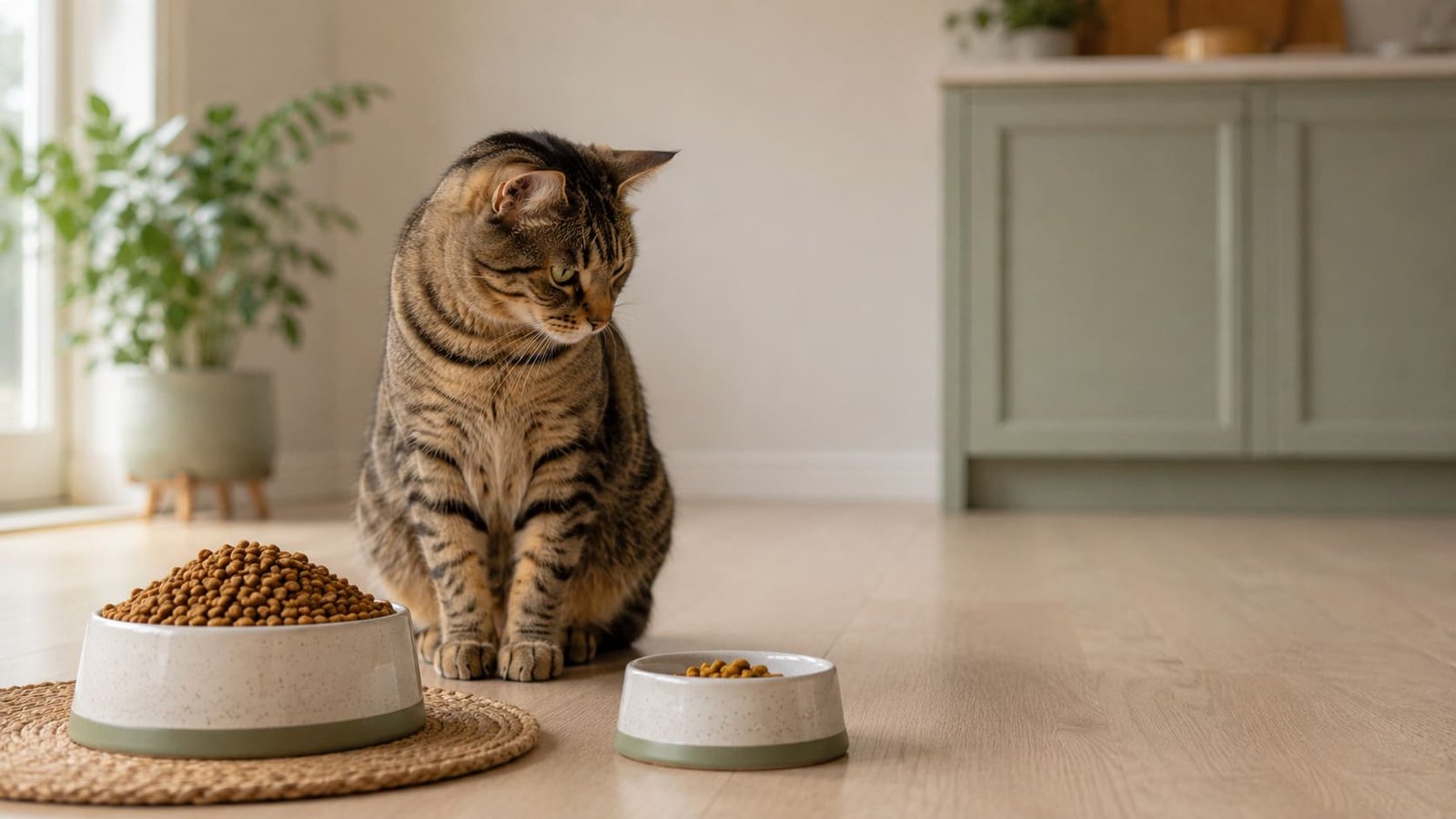
Scheduled meals beat free feeding for most cats, because portion control is the only reliable lever against feline obesity. But the schedule is not the active ingredient. The best setup pairs measured daily calories with foraging enrichment, matched to your cat’s age, weight and health.
In 2018, the American Association of Feline Practitioners told owners to feed cats many small meals a day. Two years later, a University of Guelph trial found one meal a day looked better on several health markers.
Both are credible. Both are peer reviewed. They disagree.
Most articles on this topic quietly pick a side. That is why so many cat owners feel they are getting it wrong no matter what they choose.
This guide handles it differently. You get the evidence on both sides, the part where they actually reconcile, and a decision you can act on tonight.
The 60-second answer
For most healthy adult cats, scheduled meals are the safer default. Not because grazing is unnatural, but because a full bowl removes the one variable you control: how many calories go in.
Free feeding is less a feeding method than the absence of one.
The schedule label matters far less than three things. Total daily calories. Whether your cat has to work for food. Your cat’s individual health status.
Get those right and either method can work. Get them wrong and neither will.
What free feeding actually does to a cat
Free feeding means food available at all times, usually dry kibble, refilled when the bowl looks low.
It does suit a cat’s natural rhythm. Left to themselves, cats graze rather than gorge.
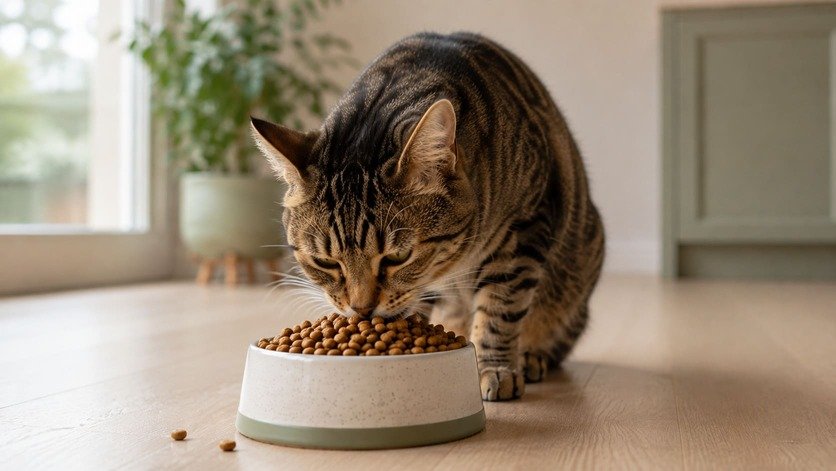
Free-living cats hunt alone and make as many as 10 to 20 small kills a day, according to International Cat Care. A mouse supplies roughly 30 kcal, only about 12 to 13% of a cat’s daily energy needs.
There is an anatomical reason too. A cat’s stomach holds around 300 to 350 mL, so little and often fits the plumbing.
A December 2025 study in Animals put real numbers on this. Researchers gave 134 healthy cats aged seven and over free access to food, using automated weighing feeders.
The cats ate 6.0 meals a day on dry food, 6.9 on wet, and 7.2 on mixed. Feeding clustered around dawn and dusk, exactly as the hunting instinct predicts.
Then came the number that should stop you. Those same cats averaged 262.6 kcal a day on all-dry, against 138.1 kcal on all-wet.
Nearly double the calories, same cats, same free access. Food format changed intake more than appetite did.
One caveat worth stating: that study was run by researchers at Royal Canin and the Waltham Petcare Science Institute, both owned by Mars. The methodology is sound, but industry funding is context you deserve.
Where free feeding breaks down
The bowl never empties, so nobody counts.
In the 2022 US Pet Obesity Prevalence Survey, veterinary professionals classified 61% of cats as overweight or obese.
Owners largely could not see it. About 28% rated their cat’s body condition as normal when a vet had just classified that same cat as overweight or obese.
Free feeding also hides illness. If you do not know what normal intake looks like, you cannot notice the day it drops.
In a multi-cat home, one bowl means the confident cat eats and the anxious one waits. The AAFP notes that timid cats avoiding housemates may not reach food often enough and lose weight.
What scheduled feeding actually does
Scheduled feeding means measured portions at set times, usually two or three a day.
The advantage is not discipline. It is data.
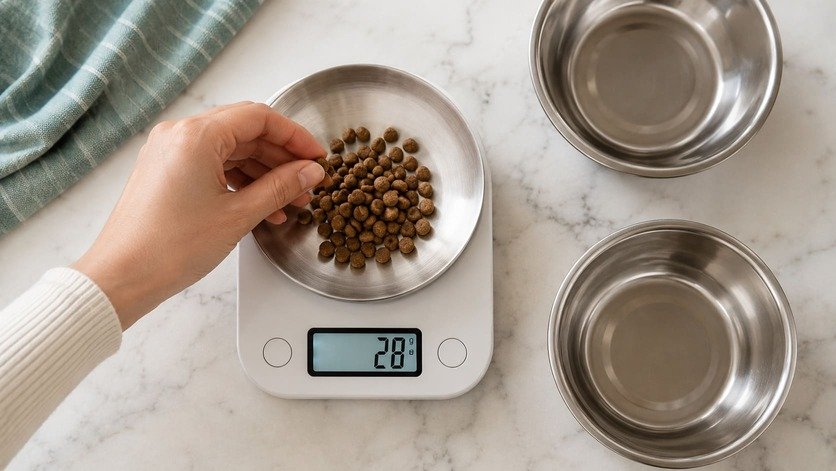
You know what went into the bowl and what came back out. That turns feeding into a number you can adjust.
It also buys you an early warning system. A cat that skips a scheduled meal is telling you something a permanently full bowl would have hidden.
In multi-cat households, separate bowls at set times let you feed the senior, the kitten and the heavy one differently, under one roof.
Where scheduled feeding breaks down
Long gaps create pressure. The 5 a.m. wake-up paw is a scheduling problem, not a personality flaw.
Fast eating and post-meal vomiting show up more often when a hungry cat meets a large bowl.
A bowl at a fixed time also asks nothing of a predator built to hunt. Boredom in indoor cats is a welfare issue, not a footnote.
The research does not agree, and here is why
The AAFP position: frequent small meals
The 2018 AAFP Consensus Statement, Feline Feeding Programs, published in the Journal of Feline Medicine and Surgery, argues from behavior.
Panel chair Dr Tammy Sadek observed that most cats are fed in one location, either free choice or in one or two large palatable meals, which fails their behavioral needs.
The recommendations: frequent small meals, puzzle feeders, food placed in different locations, multiple food and water stations, and room to eat alone.
The stated payoff is fewer stress-related problems such as cystitis, and fewer obesity-related ones.
The Guelph study: once a day looked better
In 2020, Camara and colleagues published a controlled crossover trial in PLOS ONE.
Eight healthy indoor cats under five ate the same canned diet and the same calories, either once daily or split across four meals, for 21-day periods.
Cats fed once daily showed higher post-meal levels of appetite-regulating hormones, suggesting better satiety. They also showed a larger rise in blood amino acids, which supports lean muscle.
Their fasting respiratory quotient was lower, consistent with burning fat stores. They also ate less.
Cats fed four times daily were more physically active. Total energy expenditure and body weight did not differ between groups.
Co-author Prof. Adronie Verbrugghe, a veterinarian at Guelph’s Ontario Veterinary College, acknowledged the results would surprise owners who had been told cats need several small meals.
How to reconcile them
The two studies are not measuring the same thing. One makes a behavioral and welfare argument. The other makes a metabolic one.
Sample size matters. Eight cats, all healthy, all under five, all on canned food, over three weeks. That is a signal, not a rule.
The wider picture is genuinely mixed. Deng and colleagues found cats fed four times daily looked more satiated on hormone markers, the opposite of the Guelph result.
Epidemiology muddies it further. Courcier and colleagues reported that cats fed twice daily were more likely to be obese than cats fed free choice.
Read together, the honest conclusion is that meal frequency is a weak predictor. Calorie control and activity are strong ones.
Which is why arguing about the clock is the wrong argument. The portion and the effort are where the outcome lives.
Free feeding vs scheduled meals: side by side
| Factor | Free feeding | Scheduled meals |
| Portion control | Poor. Intake goes unmeasured | Strong. You control every gram |
| Obesity risk | Higher, especially on dry food | Lower when portions are calculated |
| Spotting illness early | Weak. A skipped meal is invisible | Strong. Refusal is obvious same day |
| Suits natural grazing | Yes | Only with more meals or a puzzle feeder |
| Multi-cat households | Poor. Competition and bullying | Strong. Feed each cat separately |
| Owner effort | Low | Moderate |
| Food safety | Wet food spoils within hours | Good. Fresh food each sitting |
| Begging behavior | Less | More, until the cat adjusts |
| Medication and insulin timing | Poor | Strong |
Which one is right for your cat?
Match the method to the animal in front of you.
Kittens under six months
Free feeding, or four-plus scheduled meals. Growing kittens have high energy needs and small stomachs, and restriction does more harm here than grazing does.
Healthy adult cat at ideal weight, single-cat home
Two to three measured meals. Serve one of them through a puzzle feeder so the cat works for part of its intake.
Overweight cat
Scheduled meals, no exceptions. You cannot reduce what you never measured.
Ask your vet for a calorie target and a body condition score before you start. Weight loss in cats must be slow and supervised.
Multi-cat household
Scheduled meals in separate locations, ideally different rooms or heights. The AAFP recommends multiple food and water stations so cats can eat alone.
Microchip-activated feeders solve this properly when one cat is on a prescription diet.
Senior, diabetic, or CKD cats
Follow your vet’s protocol, not a blog. Diabetic cats usually need meals timed around insulin. Cats with chronic kidney disease often do better with food always available.
The hybrid method most vets actually recommend
You do not have to join a camp. The setup that satisfies both the metabolic and the behavioral evidence looks like this.
- Get a daily calorie allowance from your vet. This is the number everything else hangs on.
- Weigh that amount out each morning. A kitchen scale beats a scoop, which routinely overshoots.
- Serve it as two or three portions at set times. Wet food helps here for both calorie control and hydration.
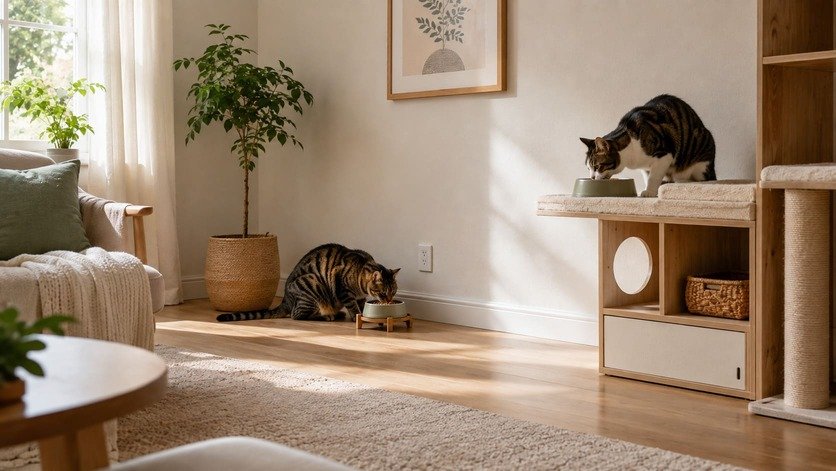
- Deliver part of the ration through puzzle feeders placed in different spots. The AAFP calls this forage feeding and endorses it.
- Use a timed automatic feeder for the pre-dawn portion if your cat wakes you. It ends the 5 a.m. negotiation without adding calories.
- Reassess body condition every four weeks and adjust the number, not the schedule.
How to switch safely, and why rushing is dangerous
Read this before you change anything.
Safety warning
Cats that stop eating risk hepatic lipidosis, a serious and sometimes fatal liver condition. It has been reported after anorexia lasting anywhere from 2 to 14 days, and overweight cats carry the highest risk.
The University of Illinois College of Veterinary Medicine warns that once a cat develops it, the cat usually will not start eating again on its own.
Diet changes and household stress are recognized triggers for the appetite loss that starts it.
So transition gradually, over 7 to 14 days rather than overnight.
Begin by leaving the bowl down only during set windows, then shorten the windows.
Never crash-diet a cat, and never withhold food to force acceptance of a new schedule.
Call your vet if your cat eats poorly for more than a day, especially an overweight cat, or if you see jaundice, lethargy or vomiting.
Mistakes that ruin either method
- Free feeding wet food. It spoils, cats reject it, and you get the intake gap that causes trouble.
- Treating the bag’s feeding guide as gospel. Those figures are population averages, and neutered indoor cats usually need less.
- Topping up instead of measuring. A refilled bowl is free feeding with extra steps.
- Counting meals but not treats. Treats and dental chews belong inside the daily calorie number.
- Feeding every cat from one station. In a multi-cat home this guarantees one cat is overeating and another is underfed.
- Judging weight by eye. Ask your vet to walk you through a body condition score once, then repeat it monthly at home.
Frequently asked questions
Is free feeding bad for cats?
Not inherently, but it is high risk. Free feeding removes portion control, and 61% of US cats assessed in 2022 were overweight or obese. It suits kittens far better than adult cats, overweight cats or multi-cat homes.
How many times a day should I feed my cat?
Two to three measured meals suits most healthy adult cats, and kittens need four or more. Evidence on the optimal frequency is genuinely mixed, so put your effort into the correct daily calorie total instead.
Can I free feed dry food and schedule wet food?
Yes, and many owners do. Just weigh the dry portion into the daily allowance rather than topping up the bowl. Otherwise you have reintroduced the original problem.
Will scheduled feeding stop my cat waking me at 5 a.m.?
Usually within one to two weeks, provided you do not reward the behavior. A timed automatic feeder set for early morning works better than willpower.
Does free feeding cause diabetes in cats?
Not directly. Obesity is a major risk factor for feline diabetes, and free feeding makes obesity considerably more likely.
The bottom line
Scheduled meals win, though not for the reason most articles give.
They win because they are measurable. Everything else good about cat feeding follows from knowing the number.
Then give the food back some difficulty. Puzzle feeders, several stations, food your cat has to find. That is where the AAFP is right and where a plain bowl fails.
Do one thing this week. Weigh tomorrow’s food instead of scooping it, and write the number down.
Then book a body condition score with your vet and get a calorie target for your actual cat, not the average one on the bag.
Most owners who discover their cat is overweight find out at a checkup, years later than they could have.