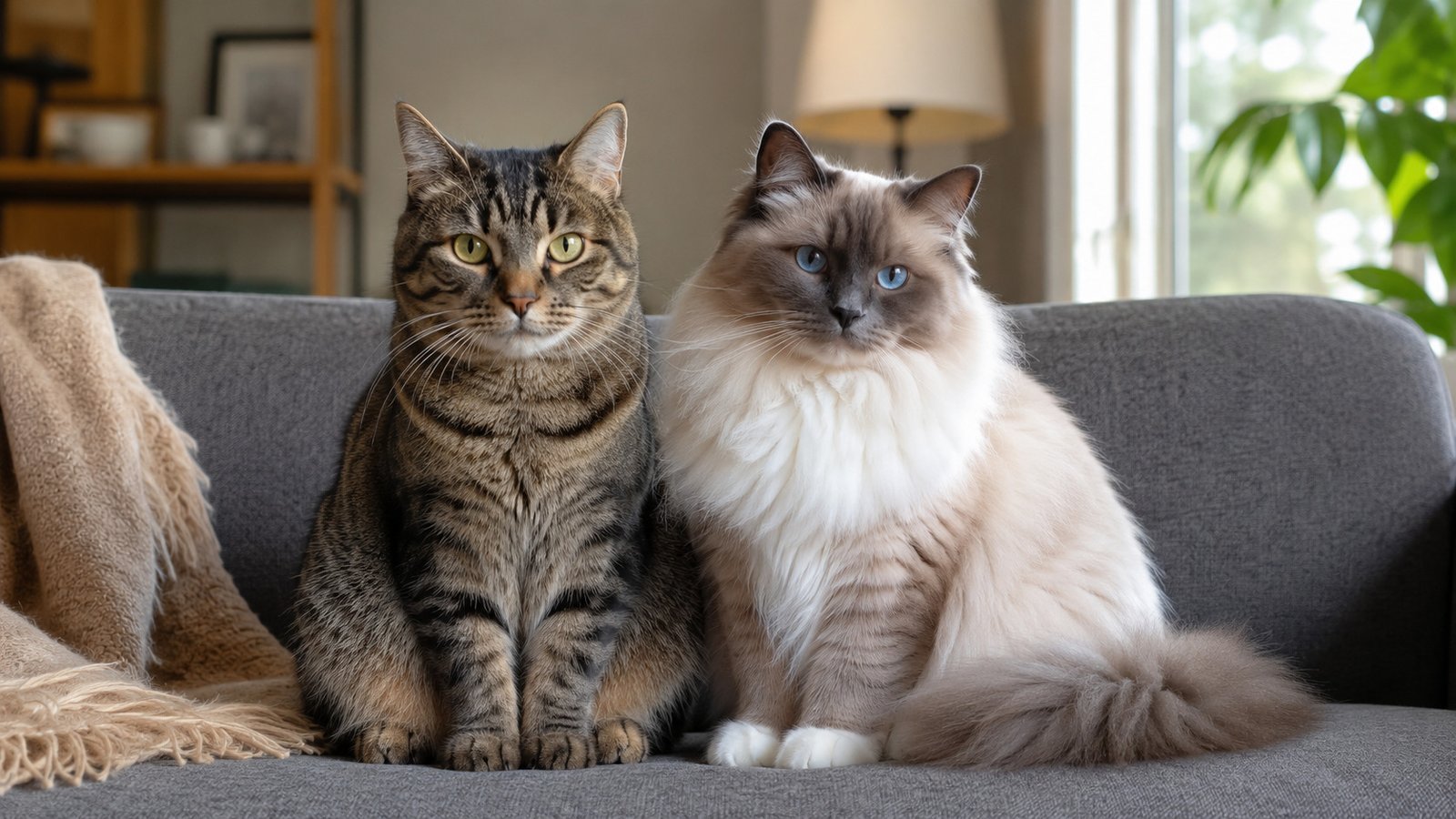
Mixed-breed cats tend to have broader genetic diversity and fewer inherited health problems, while purebred cats offer predictable size, coat, and temperament. Your budget, living space, and tolerance for surprises should decide which is right for you.
A friend of mine once spent four months on a Ragdoll breeder’s waitlist, then adopted a scruffy tabby from the shelter down the street two weeks before her kitten was ready. She ended up with both. Ask her which one she loves more and she’ll just laugh at you.
That’s the honest answer to most of this article, too. There’s no universally “better” cat. But there are real, measurable differences between a mixed-breed cat and a purebred cat, and those differences matter for your wallet, your home, and the next 12 to 18 years of your life.
Mixed-breed cats, sometimes called domestic shorthairs or domestic longhairs, make up the vast majority of cats in shelters and on the street. Purebred cats, registered with organizations like the Cat Fanciers’ Association (CFA) or The International Cat Association (TICA), come from documented bloodlines bred for specific looks and traits.
This guide breaks down genetics, temperament, health, lifespan, grooming, cost, and lifestyle fit, so you can decide which type of cat actually suits your life instead of just your Pinterest board.
What Is a Mixed-Breed Cat?
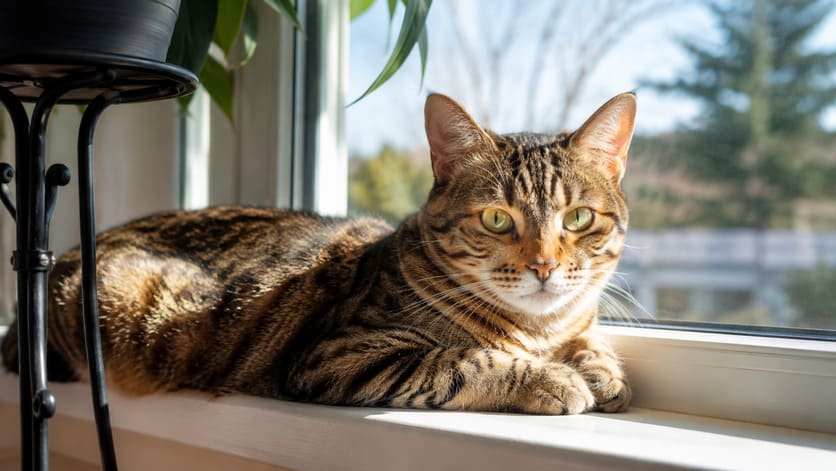
A mixed-breed cat has ancestors from two or more breeds, usually undocumented. Most shelter cats fall into this category, and they’re typically labeled Domestic Shorthair or Domestic Longhair based on coat length alone, not breed.
That labeling trips people up. “Domestic Shorthair” isn’t a breed. It’s a coat description that covers millions of genetically unrelated cats such as tabbies, tuxedos, calicos, solids, and everything in between.
Mixed-breed cats got that way through generations of unmanaged breeding among community and feral cat populations. Nobody selected for a specific look or temperament. Natural selection and local gene pools did the work instead.
That’s actually the source of one of their biggest advantages. Without a closed gene pool, mixed-breed cats generally carry more genetic diversity, which lowers the odds of inheriting the same recessive disease twice over.
Recommended Reading: Best Cat Breeds for First-Time Owners
What Is a Purebred Cat?
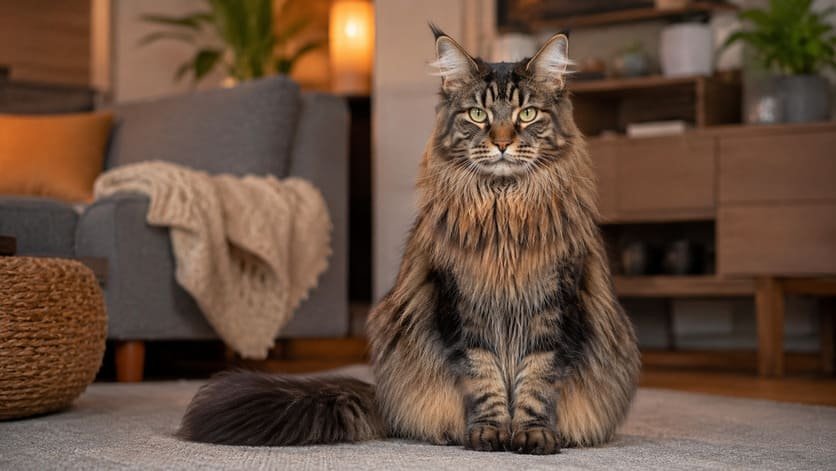
A purebred cat descends from a closed, documented bloodline, with both parents belonging to the same recognized breed. Registries like CFA and TICA maintain breed standards covering appearance, coat, and often temperament.
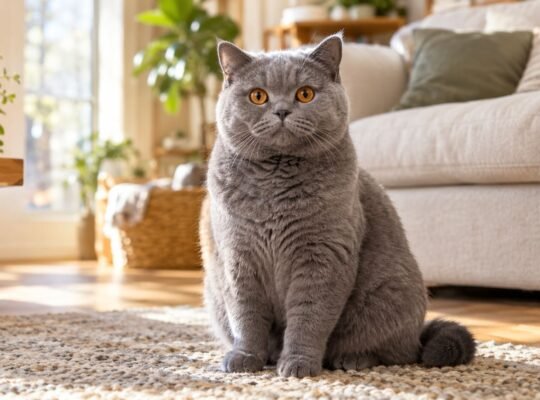
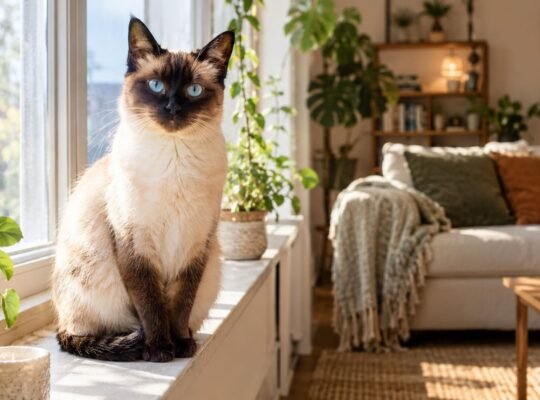
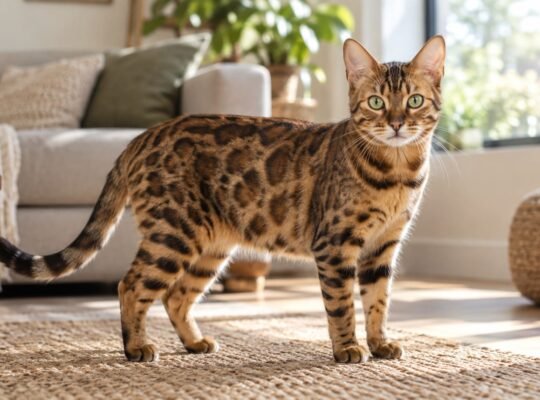
Popular examples include the Maine Coon, Ragdoll, British Shorthair, Persian, Siamese, Bengal, Birman, and American Shorthair. Each has a written standard breeders aim to reproduce consistently, litter after litter.
That consistency is the whole appeal. If you want a cat that will almost certainly grow into a 15-pound lap cat with a plush coat, a Ragdoll is a safer bet than a shelter kitten labeled “medium hair, unknown mix.”
The tradeoff is a smaller gene pool. Popular breeds have been selectively bred for generations, which sometimes concentrates the same genetic health risks that breed is known for.
Mixed-Breed Cats vs. Purebred Cats: Quick Comparison
| Criteria | Mixed-Breed Cats | Purebred Cats |
| Temperament | Individually variable, often documented by shelter | Breed-standard tendencies |
| Health | Fewer breed-specific risks | Breed-specific inherited risks possible |
| Lifespan | Often 12–18 years | Varies by breed, sometimes shorter |
| Grooming | Depends on coat length | Some breeds need daily grooming |
| Maintenance | Maintenance | Low to high, breed-dependent |
| Intelligence/Trainability | Individually variable | Some breeds notably trainable (Bengal, Siamese) |
| Cost | $0–$150 adoption fee | $800–$3,000+ purchase price |
| Energy level | Individually variable | Breed-dependent, from calm (Persian) to high (Bengal) |
| Family friendliness | Good, especially adults with known history | Good, especially calm breeds (Ragdoll, British Shorthair) |
| Child friendliness | Good with documented temperament | Good with calm breeds |
| Apartment suitability | Good for most adults | Good for calm breeds, poor fit for high-energy breeds |
| Predictability | Lower | Higher |
| Veterinary costs | Generally standard wellness costs | Can include breed-specific screening |
| Availability | Widely available | Waitlists common |
Which Is Better for Families?
Families juggling kids, guests, and general household chaos usually do best with a cat whose temperament is already known, whether that’s an adult shelter cat with documented behavior or a purebred known for tolerance, like a Ragdoll or British Shorthair.
Kittens of any background are less predictable simply because their adult personality hasn’t fully formed yet. An adult cat, mixed-breed or purebred, lets you see exactly what you’re getting before you commit.
Shelters and rescues often have staff who’ve observed a cat’s reaction to noise, handling, and other animals, which is genuinely useful data for a busy household. Ask directly whether a cat has been fostered with kids or other pets.
Which Is Better for Children?
Calm, tolerant temperaments matter more here than pedigree. Ragdolls and British Shorthairs are frequently recommended for households with children because of their generally easygoing nature, though again, this is a tendency, not a guarantee for any single cat.
A shelter cat with a documented history of calm handling by staff or a foster family can be just as good a match, and often costs a fraction of a breeder kitten with an unproven temperament.
Avoid pairing young children with high-energy, easily overstimulated breeds like Bengals unless you’re confident in your ability to manage that energy and teach appropriate handling on both sides.
Which Is Better for Apartment Living?
Apartment living rewards lower activity needs and tolerance for confined space. Persians, Ragdolls, and British Shorthairs generally adapt well to smaller homes, as do the vast majority of adult mixed-breed cats.
Bengals and Siamese, both high-energy and vocal, can struggle in small apartments without a serious commitment to daily enrichment, climbing structures, and interactive play. Noise complaints from a chatty Siamese are a real consideration in thin-walled buildings.
If you’re in an apartment, ask shelter staff specifically about a cat’s activity level and vocalization before adopting. It matters more for daily quality of life than almost any other trait on this list.
Which Is Better for First-Time Owners?
First-time owners generally do best with a calmer, well-documented adult cat, regardless of pedigree. That points toward either an adult mixed-breed cat from a shelter with behavior notes, or a purebred known for an easygoing temperament, like a British Shorthair or Ragdoll.
High-maintenance grooming breeds like Persians and high-energy breeds like Bengals both ask more of a new owner than a typical shorthair mix does. They’re not off-limits, but they come with a steeper learning curve.
If this is your first cat, lean toward predictability over novelty: known temperament, manageable grooming, and a lower-drama health history will make the first year meaningfully easier.
Ethical Considerations: Adoption vs. Buying
Millions of cats enter shelters and rescues every year in the U.S. alone, and a meaningful share are euthanized simply due to space constraints, according to figures regularly cited by the ASPCA and Humane World for Animals.
Adopting a mixed-breed cat directly reduces that pressure on shelter capacity. It’s a straightforward, tangible way to help, and it’s part of why many veterinarians and welfare organizations actively encourage adoption first.
Buying from a breeder isn’t inherently unethical, but it does carry responsibility. A responsible breeder prioritizes health testing and animal welfare over profit, while a poorly run operation – sometimes a kitten mill – prioritizes volume over the animals’ wellbeing.
If you choose the purebred route, your due diligence on the breeder matters ethically, not just financially. It affects the health of the kitten you bring home and the welfare of every cat still in that breeder’s care.
Choosing a Responsible Breeder
A responsible breeder will let you visit in person, show you where the kittens are raised, and introduce you to at least one parent cat. If a breeder refuses any of that, treat it as a serious red flag.
Look for documented health screening relevant to the breed: cardiac testing for Maine Coons, kidney screening for Persians, and general genetic panels where available. CFA and TICA both maintain breeder directories that can help you verify registration status.
Ask about the breeder’s policies on returns, health guarantees, and how many litters their queens produce per year. Responsible breeders limit litter frequency to protect the mother’s health, not to maximize output.
Be wary of breeders selling multiple breeds at once, offering same-week pickup for a rare or expensive breed, or pricing noticeably below market rate. All three are common signs of a low-welfare operation.
Why Shelter Cats Make Excellent Pets
Shelter cats get an unfair reputation as damaged goods, which rarely holds up. Most cats end up in shelters because of a person’s changed circumstances – a move, an allergy, a landlord issue – not because the cat did anything wrong.
Adult shelter cats also come with a real advantage kittens can’t offer: an observable personality. Staff can usually tell you how a cat handles other animals, noise, and children, because they’ve watched it happen.
Many shelters already include spaying or neutering, vaccines, and microchipping in the adoption fee, and staff are typically available afterward for behavior questions, something a private breeder relationship rarely offers once the sale is complete.
International Cat Care and the ASPCA both publish guidance on evaluating a shelter cat’s temperament during a visit, which is worth reviewing before you go, especially if you’re adopting for the first time.
Pros and Cons of Mixed-Breed Cats
Pros:
- Lower upfront cost, often bundled with spay/neuter, vaccines, and microchipping
- Broader genetic diversity, generally fewer breed-specific inherited diseases
- Widely available, no waitlists
- Adult temperament often already documented by shelter or foster staff
- Supports shelter and rescue capacity directly
Cons:
- Appearance and adult size are less predictable, especially in kittens
- Temperament in kittens is harder to forecast than in a breed with a defined standard
- Health history before intake is sometimes unknown
Pros and Cons of Purebred Cats
Pros:
- Predictable appearance, size, and coat type
- Temperament tendencies documented by breed standard
- Access to breed-specific health screening and pedigree records
- Eligible for breed-specific shows and registries (CFA, TICA)
Cons:
- Significantly higher upfront cost
- Elevated risk for specific inherited conditions depending on breed
- Waitlists common for popular breeds
- Requires careful breeder vetting to avoid low-welfare operations
Decision Framework

Start with your budget. If a few hundred dollars total, including spay/neuter and first-year vet care, is your ceiling, a shelter adoption is the realistic choice. If $1,000 to $3,000 upfront is comfortable, a purebred opens up.
Next, weigh predictability against experience. If you want to see the actual adult cat’s temperament and size before committing, an adult shelter cat is hard to beat. If you want a specific known type, a purebred kitten delivers that.
Then factor in living space and time. Small apartment, limited daily play time? Favor calmer breeds or a shelter cat flagged as low-energy. Bigger space, time for daily interactive play? A Bengal or Siamese becomes realistic.
Finally, be honest about grooming tolerance. Daily brushing and facial cleaning are non-negotiable with long-haired breeds like Persians. If that sounds like a chore rather than a bonding ritual, a shorthair – purebred or mixed – is the better fit.
Common Myths
- Myth: Mixed-breed cats are healthier across the board. Not automatically. They tend to avoid concentrated breed-specific risks, but individual mixed-breed cats still develop chronic illness, obesity, and dental disease at meaningful rates.
- Myth: Purebred cats are always better behaved. Breed standards describe tendencies, not guarantees. An individual purebred cat can be just as unpredictable as a shelter cat, especially as a kitten.
- Myth: Shelter cats come with behavior problems. Most shelter cats are surrendered due to a person’s life change, not the cat’s behavior. Documented foster or staff observations are often more reliable than assumptions based on origin.
- Myth: You need a purebred cat to know what you’re getting. An adult shelter cat with documented behavior can be more predictable than a purebred kitten, since you’re evaluating the actual cat rather than a genetic tendency.
- Myth: Adoption fees are just a shelter’s way of making money. Adoption fees typically cover spay/neuter, vaccines, and microchipping, services that would cost considerably more if purchased separately.
Frequently Asked Questions
Is a mixed-breed cat or a purebred cat healthier? Mixed-breed cats generally carry more genetic diversity and fewer concentrated inherited diseases, but individual health depends on care, weight management, and veterinary attention regardless of breed.
Are purebred cats worth the extra cost? They’re worth it if predictable appearance, size, and documented temperament matter to you and you’ve verified the breeder does proper health screening. Otherwise, a shelter cat offers similar companionship for far less.
Do mixed-breed cats live longer than purebred cats? As a population, mixed-breed cats often land at the higher end of the typical 12–18 year lifespan, partly because they avoid certain breed-specific inherited conditions.
What is the best cat breed for a first-time owner? Calmer, well-documented cats work best, whether that’s a British Shorthair, Ragdoll, or an adult mixed-breed cat with known temperament from a shelter or foster home.
Is it cheaper to adopt or buy a cat? Adoption is almost always cheaper upfront, typically $0–$150 versus $800–$3,000+ for a purebred, and adoption fees usually already include spay/neuter and vaccines.
Do purebred cats have more health problems than mixed-breed cats? Certain purebreds carry elevated risk for specific inherited conditions, such as heart disease in Maine Coons or kidney disease in Persians. Responsible breeders screen for these before breeding.
What’s the difference between a Domestic Shorthair and a purebred cat? Domestic Shorthair describes coat length in an unregistered, mixed-ancestry cat. A purebred cat belongs to a specific, documented breed with a registry-defined standard.
Are mixed-breed cats smarter than purebred cats? Intelligence in cats correlates more with individual curiosity and food motivation than breed, though certain breeds like Bengals and Siamese are often described as especially quick learners.
Which cat breeds are best for apartments? Calmer breeds like Persians, Ragdolls, and British Shorthairs typically adapt well to apartment living, as do most adult mixed-breed cats with lower activity levels.
How do I know if a breeder is responsible? A responsible breeder allows in-person visits, shows you the kittens’ living conditions, provides health screening documentation, and is registered with an organization like CFA or TICA.
Do shelter cats come already spayed or neutered? Most shelters and rescues include spay or neuter surgery, initial vaccines, and microchipping in the adoption fee before the cat goes home.
Is a mixed-breed cat considered a Domestic Shorthair or Domestic Longhair? Yes, both terms describe coat length in mixed-ancestry cats and are the most common labels used by shelters for cats without a documented breed.
What questions should I ask before adopting a shelter cat? Ask about known health history, behavior around children and other pets, activity level, and whether the cat has been fostered in a home environment.
Can pet insurance cost more for purebred cats? Yes, breeds with well-documented inherited conditions sometimes carry higher premiums or specific exclusions, though individual health history still affects the final price.
Conclusion
There isn’t a universally correct answer here, and any guide claiming otherwise is oversimplifying. What matters is matching a cat’s real traits, not its label, to your actual life: your budget, your space, your tolerance for grooming and energy, and how much predictability you need going in.
If you want documented health screening and a known look, a purebred cat from a responsible breeder is a legitimate, ethical option. If you want lower cost, broader genetic diversity, and the chance to meet the actual adult cat before committing, a shelter cat is just as legitimate a choice.
Either way, spay or neuter your cat, microchip it, and get it in front of a veterinarian within the first few weeks. That single habit affects long-term health more than the breed label ever will.
Click Here to Add SmartPawLife as a Trusted Source Add as a preferred source on Google