
Cats bite for five main reasons: play, overstimulation, fear, redirected arousal, and pain. Which one you are dealing with depends on what happened in the seconds before the bite. This guide shows you how to tell them apart, read the warning signs early, and change the pattern at home.
She was purring. Her eyes were half shut, your hand was moving slowly down her back, and every part of that moment said she was happy. Then she grabbed your wrist with both front paws and bit you.
If you have sat there afterward wondering what you did wrong, the honest answer is usually nothing dramatic. Cats bite for a small number of predictable reasons, and nearly all of them come with a warning most people never learn to see.
What you want to know is which kind of bite you just got. Play biting, fear biting, and overstimulation all look alike in the moment, and each one needs a completely different response from you.
Key takeaways
- Almost all cat biting falls into five categories: play, overstimulation, fear, redirected arousal, and pain.
- What you were doing in the ten seconds before the bite tells you which one you are dealing with.
- The tail is the earliest reliable warning sign, and it moves before the ears, the pupils, or the head.
- Purring does not mean consent, which is why overstimulation bites feel like they come from nowhere.
- A gentle adult cat who suddenly starts biting needs a veterinary exam before any training plan.
The short answer: why cats bite people
Cats bite for five main reasons.
- Play and predatory behavior. Your hand or ankle triggered a hunting sequence. Common in kittens, young cats, and cats who spend long stretches alone.
- Overstimulation during petting. She enjoyed the contact, reached her tolerance limit, and used her teeth to end it. Veterinary behavior specialists call this petting-induced aggression.
- Fear. She felt cornered or threatened and could not get away, so she defended herself.
- Redirected arousal. Something else set her off, usually a cat outside the window or a sudden noise, and you were simply the nearest available target.
- Pain or illness. Touching a sore area hurts, so she stops you the only way she can.
There is a sixth, much softer version that is not really biting at all. Cats groom and nibble the individuals they are bonded to, so a slow, gentle mouthing during a cuddle is closer to social grooming than aggression.
How to tell which kind of bite you just got
Most articles hand you the categories and leave you to guess which one applies. Work back from what was happening in the seconds immediately before her teeth landed.
You were petting her and she had been enjoying it. Overstimulation. This is the classic case, and the giveaway is that she sought you out first, then bit, then usually left.
You were walking past, or your hand or foot moved under a blanket. Play. The bite came from an ambush position, and she was probably hiding beforehand.
Something startled her, or she had just been frightened. Fear or redirected arousal. If the frightening thing was aimed at her, it is fear. If the frightening thing had nothing to do with you and you happened to be standing there, it is redirected.
You touched one particular spot, or she is middle-aged or older and this is new. Pain. This one gets misread as a behavior problem more often than any of the others, and it is the one that needs a veterinarian rather than a training plan.
She was licking you and the nibble was soft. Social grooming. No skin broken, no tension in her body, and she carries on afterward as though nothing happened.
If two of these seem to fit, the tie-breaker is what she did next. A cat who bites and immediately leaves was asking you to stop. A cat who bites and stays in a crouch, tail moving, is still playing.
The warning signs that come before a bite

Cats almost always signal first. The reason so many owners describe bites as coming out of nowhere is that the earliest signals happen at the far end of the cat, away from the face people are watching.
The tail goes first. A relaxed cat lying across your lap has a still tail, or a slow and lazy sway. As she nears her limit that changes to a flick, then a thump against the sofa or the bed.
Everything else about her can still look blissful at this point.
The skin comes next. Some cats develop a visible ripple along the lower back and the area just in front of the tail, and the fur there may lift slightly under your hand.
Then the ears rotate. Not flat against the head yet, just turned outward and back, the position sometimes described as airplane ears. Around the same time the pupils widen, which is easy to miss in a dim room.
The head turn is last. When she stops looking ahead and turns to face your hand, you have run out of runway. Cornell’s feline behavior guidance lists dilated pupils, tail lashing, and ears moved backward as the cues that commonly appear before a petting-related bite.
The detail that catches almost everyone out is that the purr does not stop. It often keeps going right through the tail flick, the ear rotation, and the bite itself.
Purring is not a consent signal. Reading it as one is why so many of these bites feel like a betrayal.
Play biting: when your hands became the toy
Play biting comes with a whole hunting sequence attached. She flattens into a crouch, pupils wide, tail thrashing, hind legs treading, then explodes out from under the sofa at your ankles.
These bites are usually inhibited, meaning she is controlling the pressure. They can still break skin, and they get worse as a kitten grows into an adult with adult teeth.
The usual cause is a gap in her education. Cats learn bite pressure by biting a littermate too hard and having the game stop immediately. Both the ASPCA and Cornell’s Feline Health Center point to that early social learning as the reason single or orphaned kittens tend to play rough.
The other cause is us. If anyone in the house has wrestled with her using bare hands, tickled her belly with fingers, or let her chase a wiggling hand under a blanket, she learned that hands are prey.
She cannot tell the difference between the hand that plays that game and the hand reaching for the remote.
Keep playing with her. Just put something between your skin and her teeth every single time. A wand toy at arm’s length lets her stalk, chase, catch, and bite as hard as she likes, and there is never any question about what the target was.
Overstimulation: the bite that arrives mid-purr

This is the one that brings most people to search in the first place. She jumped onto your lap. She asked for the attention. She purred through several minutes of stroking, and then she bit you and walked off.
Cornell’s feline behavior resources are refreshingly honest that the underlying cause is not fully understood. The leading explanations are that repeated contact becomes unpleasant after a while, and that some cats use a bite to control when the session ends rather than because anything is wrong.
What is clearer is where cats tolerate touch. Most stay comfortable longest around the cheeks, the chin, and the base of the ears, which are the spots they rub on furniture and groom on each other.
The lower back, the belly, and the base of the tail are where tolerance runs out fastest. A long stroke from head to tail passes through that sensitive zone every single time.
Tolerance also varies enormously between individual cats. Some will sit through twenty minutes. Others reach their limit after four or five strokes and always will, no matter how patient you are.
The practical approach is to stop before she asks you to. Pet for a short stretch, take your hand away, and wait. If she leans back in, carry on. If she does not, the session is over and neither of you got hurt.
Over a few weeks this builds a pattern where she trusts that contact ends when she wants it to. Cats who trust that usually stop needing to ask so forcefully.
Children need particular attention here. Young kids tend to pet the back and rear end rather than the head, and they miss the tail signals completely.
Veterinary behavior guidance is consistent on this point. A cat with a history of petting-related biting should not have unsupervised physical contact with small children.
Fear biting and redirected biting
A frightened cat looks completely different from an overstimulated one. She crouches low, tail tucked under her body, ears flat against her skull, whiskers pulled back, sometimes hissing or spitting. Her whole posture is trying to make her smaller.
Fear biting happens when she cannot escape. A cornered cat with no exit will bite, and these bites are not inhibited the way play bites are.
Prevention comes down to two rules. Make sure she always has an escape route and a high place to reach, and never put your hand toward a cat who has backed herself into a corner.
Redirected biting is the version that frightens owners most, because it genuinely does look unprovoked. She sees a strange cat through the window, or a smoke alarm goes off, or she has a scrap with the other cat in the house.
Now she is flooded with arousal and cannot discharge it on the thing that caused it. You walk past, and she lands on you.
The critical part is that her arousal does not switch off when the trigger disappears. She can stay wound up long after the cat outside has wandered away, sometimes for hours. Approaching her during that window is how people get hurt badly.
Put her somewhere quiet and dim on her own, and leave her until she has genuinely come down. A cat who has gone still is not necessarily a cat who has calmed.
Do not comfort her. It feels cruel, and it is the standard veterinary recommendation anyway, because soothing a cat mid-arousal tends to keep the state going.
For prevention, deal with the trigger rather than the cat. Frosted window film on the lower half of the glass, motion-activated deterrents in the yard, and blocking access to the window that overlooks a neighborhood cat’s route all work better than anything you can do after the fact.
When biting means something hurts

If a cat who has been gentle for years starts biting, treat it as a medical question before a behavioral one.
Pain-related biting has a signature. She bites when a specific area is touched and not others. She may bite during grooming, nail trims, or being picked up, but not during a normal lap session. She might growl or hiss first in a way she never used to.
Cornell’s Feline Health Center lists hyperthyroidism, osteoarthritis, dental disease, and central nervous system problems among the medical causes that can produce aggression, and recommends ruling out medical causes before attempting any behavioral plan.
Arthritis is worth a specific mention because it hides so well. Cats rarely limp in a way you would notice. Instead they stop jumping onto the counter, pick lower resting spots, groom less on one side, and object to being lifted.
If your older cat has started biting when you pick her up, that is a conversation with your veterinarian, not a training problem.
Dental pain is similarly quiet. A cat with a painful tooth may start refusing head and cheek contact, which is exactly the area she previously liked most.
Book the exam and take notes with you. Where she bites, what you were touching, how often, and what changed in the household recently are all more useful to a vet than a general description of aggression.
What to do the moment your cat bites
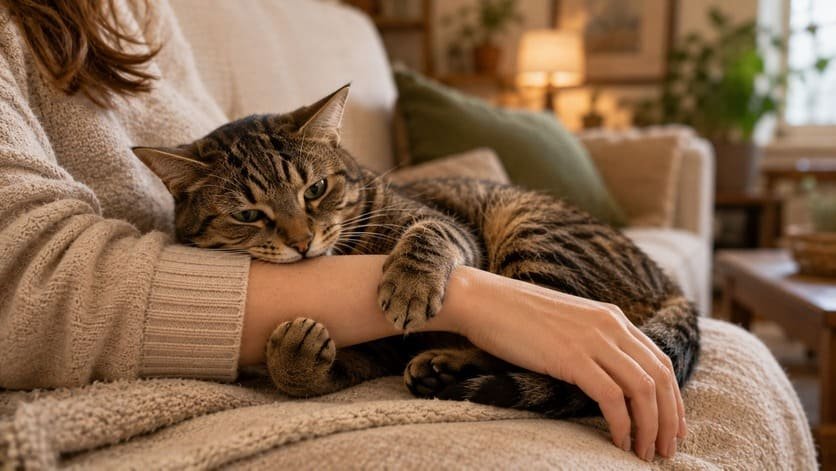
The instinctive response, yanking your hand back and yelping, makes both the injury and the behavior worse. Here is a better sequence.
- Freeze. Stop moving the hand or foot she has hold of. Movement reads as prey and keeps the grip going.
- Push in, do not pull out. If she is still holding on, move your hand gently toward her mouth rather than away. Pulling drags her teeth through the skin sideways and turns a puncture into a tear.
- Stay quiet. No yelling, no squealing, no scolding. A sharp reaction reads as either exciting play or a threat, and both make the next bite more likely.
- End the interaction. Once she releases, stand up and calmly leave the room. The consequence of biting should simply be that attention stops.
- Give her space. Do not follow, pick her up, comfort her, or punish her. Let her settle on her own before you interact again.
- Write down the trigger. Note the time, what you were doing, and where you were touching her.
That last step does more work than it looks like it does. Three weeks of notes will show you a pattern that no article can guess at, and it is the difference between managing biting and actually reducing it.
A four-week plan to reduce biting
This assumes your vet has already ruled out a medical cause. Give it a month before you judge whether it is working.
- Week one: watch and record. Change nothing. Every time she bites, log the time, the room, what you were doing, and how long the interaction had been going. Note whether she stayed or left afterward. You are looking for the pattern, not fixing it yet.
- Week two: change how you pet her. Shorten every session deliberately. Pet for a few strokes, stop, and wait to see whether she asks for more. Stay on the head, cheeks, and chin. Skip the belly and the base of the tail entirely for now. If she has a spot she has always disliked, leave it alone permanently.
- Week three: add structured play. Two sessions a day with a wand toy, one in the late afternoon and one before her evening meal. Let her stalk and chase properly, let her catch the toy at the end rather than leaving her frustrated, and feed her right afterward. Hunting followed by eating is the sequence her body expects, and cats often settle noticeably once it completes.
- Week four: review the log and adjust. Compare this week’s notes to week one. Fewer bites, or bites that stop at the warning stage without escalating, means it is working. No change at all, or bites getting harder, means it is time for professional input rather than another month of the same approach.
Keep these two habits permanently: hands are never toys, and the moment the tail starts flicking, your hand comes off her.
What not to do
Physical punishment makes cat aggression worse, and this is one of the few points every veterinary source agrees on completely. Cornell’s guidance is explicit that any form of physical punishment can increase fear and anxiety and worsen the aggression.
Specifically, avoid these:
- Tapping or flicking her nose, which teaches her that hands near the face are threatening
- Spray bottles, which raise her general anxiety and often make her wary of you rather than of the behavior
- Holding her down or scruffing an adult cat to make a point
- Yelling, which either frightens her or, in a playful cat, makes the game more exciting
- Shutting her in a room as a punishment after the fact, which she will not connect to the bite
- Continuing to pet a cat who is flicking her tail, in the hope that she will get used to it
Calmly removing yourself is not a soft option. For a cat who bites for attention or during play, losing your company is the most meaningful consequence available.
When to bring in a professional
Start with your veterinarian in every case where the biting is new, escalating, or focused on one part of the body. A physical exam comes before any behavior plan.
Ask for a referral to a veterinary behaviorist or a certified behavior consultant if any of the following apply:
- Bites break skin regularly
- She targets children or anyone who cannot move away easily
- The biting appears with no identifiable trigger even after a month of notes
- You have started avoiding her, or you are considering rehoming
- She is also aggressive toward other cats in the house
Look for credentials rather than job titles, since anyone can call themselves a cat trainer. Board-certified veterinary behaviorists carry DACVB after their name. Certified applied animal behaviorists use CAAB or ACAAB. The International Association of Animal Behavior Consultants certifies feline behavior consultants and lists them by region.
Aggression that has escalated to serious bites is not a do-it-yourself project, and getting help early is far more effective than waiting until the relationship has already broken down.
Frequently asked questions
Why does my cat bite me gently? Gentle bites that do not break the skin are usually social rather than aggressive. Cats groom and nibble each other as part of bonding, and some extend that to the people they are closest to. These bites are slow and soft, often paired with licking and a relaxed body. If the pressure increases or she stiffens, the interaction has moved past friendly.
Why does my cat bite me when I pet her even though she is purring? Purring does not switch off when a cat becomes uncomfortable, which is why these bites feel so sudden. She may have genuinely enjoyed the first minute and reached her limit without the purr changing at all. Watch the tail instead. A flick or a thump during petting is the more reliable signal.
Why does my cat bite my feet and ankles? Feet moving past a doorway or under a blanket look like prey. Ankle attacks are almost always play rather than anger, and they are most common in young cats, only cats, and cats who do not get enough structured play. Daily wand toy sessions and standing still when an ambush starts are the two things that help most.
Is my cat biting me a sign of affection? Sometimes, and the difference is in the pressure. Soft mouthing while she is grooming you is social contact. A bite that breaks skin, comes with a lashing tail, or sends her walking off afterward is a request for space. Treat anything that hurts as communication rather than a compliment.
Why does my cat bite me and not my partner? Usually because of how each of you moves rather than any preference between you. People who fidget, pet for longer stretches, reach for the cat first, or react loudly when bitten tend to get bitten more. Someone who sits still and waits to be approached often gets bitten far less by the same cat.
How do I stop my kitten from biting my hands? Stop using hands as toys entirely, including belly tickling and finger wrestling, and put a toy between your skin and her teeth every time. When she bites skin, end the game and walk away without reacting. That mirrors how littermates teach bite limits. Two short play sessions a day gives the energy somewhere useful to go.
Why does my cat suddenly bite me for no reason? There is nearly always a reason, but it is often invisible to us. The two most common hidden causes are redirected arousal, where something like a cat outside the window sets her off and you are the nearest target, and pain, particularly in middle-aged and older cats. A gentle cat who starts biting without an obvious trigger should be seen by a veterinarian.
What changes once you can read her
Biting rarely means a cat dislikes you, and it almost never means the relationship is broken. Far more often it means she asked for something in a language you had not learned to read yet, and eventually said it in the only way that gets a reliable response.
The good news is that once you can spot the tail flick, the ear rotation, and the head turn, you can stop the conversation before it gets to teeth. Most owners find the biting drops off within a few weeks of simply responding to the earlier signals.
Start tonight. Pet her for a shorter stretch than usual, take your hand away, and see whether she asks for more. That one small change tells you more about her limits than anything else you can do this week.