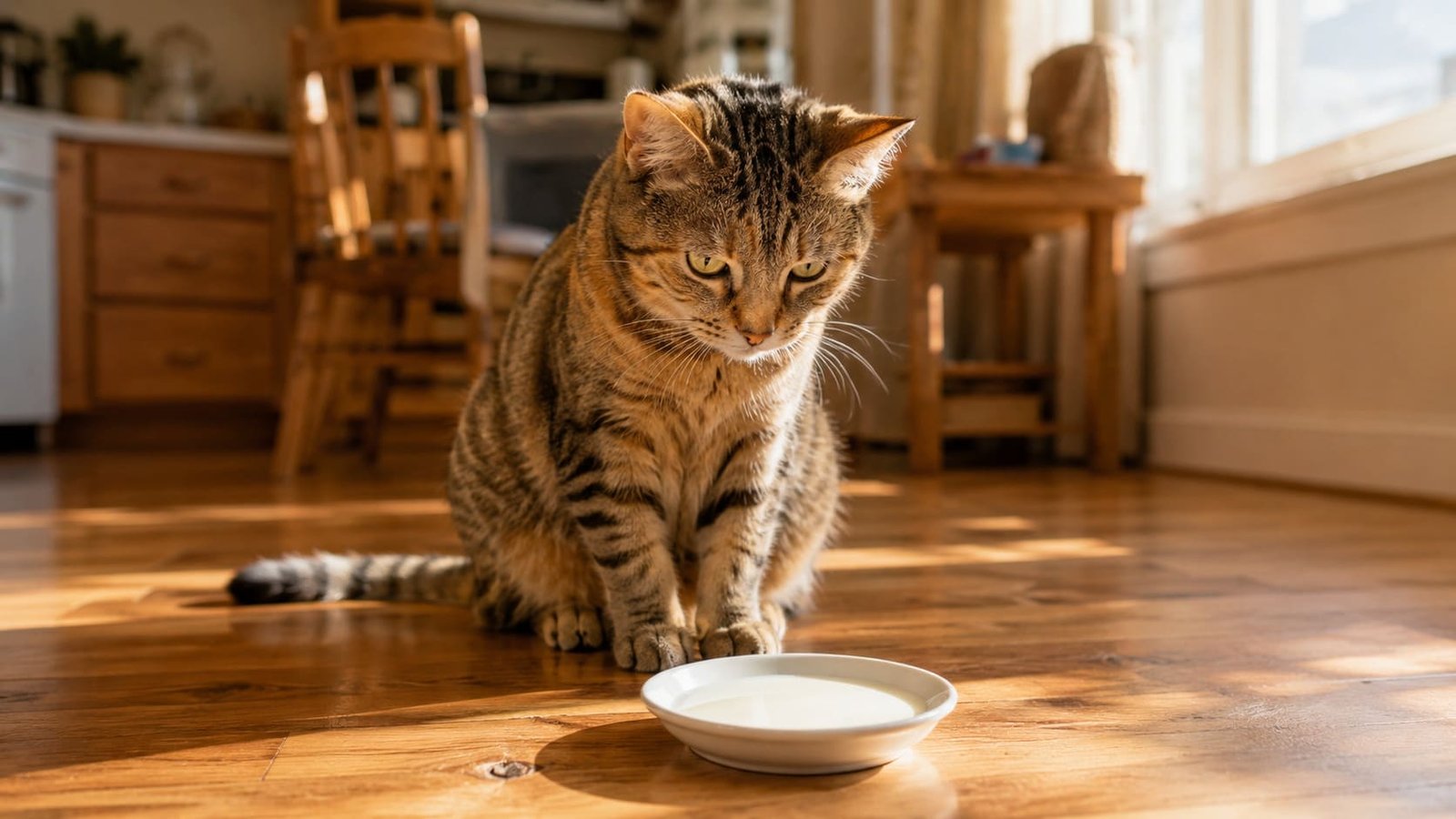
Most adult cats lose the enzyme that digests milk sugar after weaning, so cow’s milk often causes gas, loose stool, or vomiting within about 12 hours. Two tablespoons of whole milk also uses nearly a 10-pound cat’s entire daily treat budget. Water and wet food are the better choice.
Your cat hears the fridge door and materializes. She winds around your ankles while you pour cereal. She has been doing this for years, and you have probably given in at least once.
Almost every cat owner has poured that saucer. The habit comes from farm life and cartoon shorts, and it stuck around long after anyone checked whether it was a good idea.
Here is the short version: most adult cats cannot digest milk properly, and the ones who can still do not need it. But the useful part of this question is not the yes or no. It is knowing how much is actually too much, what the next 24 hours look like if she already drank some, and why she wants it so badly in the first place.
Can cats drink milk? The direct answer
Most adult cats should not drink cow’s milk.
Cats are born able to digest milk. Nursing kittens produce lactase, the enzyme that splits lactose into sugars small enough to cross into the bloodstream. Once weaning starts, that production falls off, because nothing in a wild cat’s adult diet contains lactose.
An adult cat with little lactase who drinks milk sends undigested lactose straight through to the large intestine. It pulls water in behind it. Gut bacteria ferment what is left. Gas, cramping, and loose stool follow.
None of this makes milk toxic. It makes milk a food your cat’s digestive system was never built to process past kittenhood.
Key takeaways
- Most adult cats are lactose intolerant to some degree, because lactase production drops sharply after weaning.
- Cow’s milk is not poisonous to cats, but it commonly causes gas, loose stool, or vomiting, usually within about 8 to 12 hours.
- Two tablespoons of whole milk uses nearly the entire daily treat allowance for a healthy ten-pound cat.
- Kittens must never be given cow’s milk as a substitute for mother’s milk or kitten milk replacer, since milk-driven diarrhea in a young kitten can cause dangerous dehydration.
- Cats cannot taste sweetness, so what draws them to milk is the fat and protein, not the lactose.
Why adult cats stop digesting milk
Lactose is a double sugar. It has to be broken into glucose and galactose before a cat’s small intestine can absorb it, and lactase is the only enzyme that does that job.
Kittens have plenty. By the time they are eating solid food, usually somewhere around eight to ten weeks old, most of that enzyme production has wound down. Cornell’s feline health specialists describe this as a normal developmental change rather than a defect. A cat who eats meat has no biological reason to keep making an enzyme for milk sugar.
The amount of remaining lactase varies a lot between individual cats. This is the part most articles flatten into “cats are lactose intolerant,” which is close enough to be useful and vague enough to be unhelpful.
Some cats keep enough lactase to handle a teaspoon with no visible reaction. Some react to a few licks. You cannot tell by breed, size, or age which one you have. You find out by watching, which is a lousy experiment to run on your own cat.
Why your cat begs for milk anyway
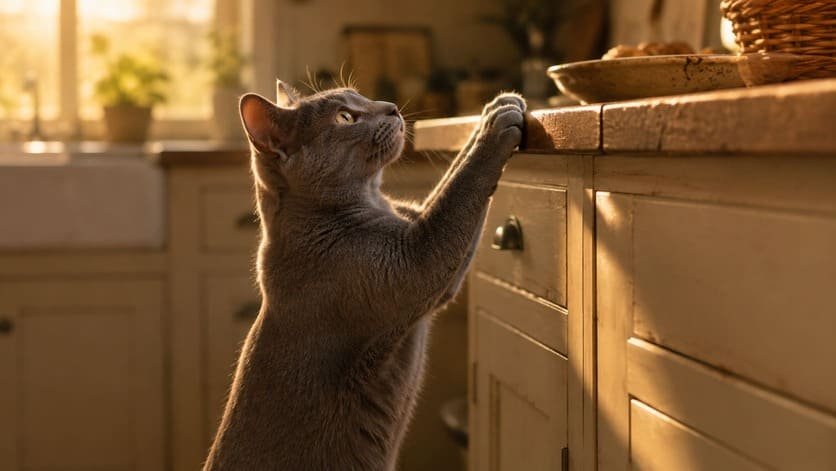
Cats cannot taste sweet. The receptor that lets humans detect sugar does not function in felines. So whatever your cat is chasing when she hears the milk jug, it is not the lactose.
She is smelling fat and animal protein. Whole milk is roughly half fat by calories, and that fat carries volatile compounds that read to a cat’s nose the way a fresh kill reads. Cream gets a stronger response than 2 percent for exactly this reason. Skim usually gets a sniff and a walk away.
Watch her approach next time and you can see it. The ears push forward, the whiskers fan out, and she goes low and deliberate rather than bouncy. That is hunting posture, aimed at a bowl.
This matters practically. If you swap in a low-fat option hoping to give her the ritual without the calories, she will usually refuse it. The fat was the entire point.
The tablespoon math nobody runs
“A little milk won’t hurt” is true and almost useless, because nobody defines a little. Here is the arithmetic, which takes about thirty seconds and settles the question.
- Start with her daily calories. A healthy adult indoor cat needs roughly 20 calories per pound of ideal body weight per day. A ten-pound indoor cat lands around 200 calories.
- Take ten percent of that. Veterinary nutrition guidance puts treats and extras at no more than ten percent of daily intake, so the rest comes from complete, balanced food. That is about 20 calories for our ten-pound cat.
- Price the milk. Whole cow’s milk runs about 9 calories per tablespoon and roughly 150 calories per cup.
- Do the division. Two tablespoons of whole milk costs about 18 calories. That is close to the entire day’s treat budget, spent on something with no nutritional value to a cat.
- Check the lactose load. A cup of whole milk holds about 12 grams of lactose, so those two tablespoons deliver around 1.5 grams into a digestive system with little enzyme to handle it.
A quarter cup, which is what most people actually pour when they pour “a little,” runs close to 37 calories. On a 200-calorie cat, that is nearly a fifth of her day.
Now compare that with what 20 calories buys you elsewhere: several freeze-dried chicken pieces, a lickable puree tube, or a spoonful of her own wet food warmed slightly. All of which she will like just as much.
What lactose trouble actually looks like at home
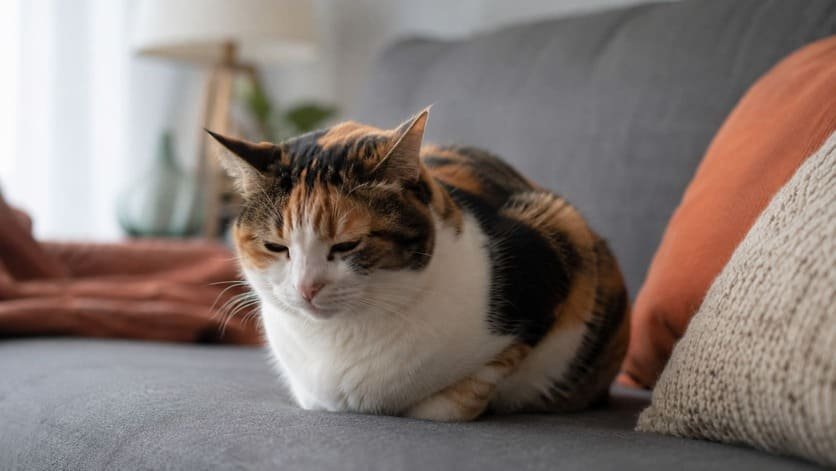
Symptom lists tend to read like a menu. What you get in a real house is a sequence, and it is easy to miss the early part.
Nothing happens for hours. Most cats show nothing at all for the first few hours after drinking milk, and reactions usually surface somewhere in the 8 to 12 hour window. If she drinks it at breakfast, you are looking at late afternoon or evening. Plenty of owners never connect the two events because of that gap.
The first sign is often behavioral, not digestive. She goes quiet. She picks a spot under the bed or behind the couch that she does not usually use, and she stays there. She sits in a tight loaf with her paws tucked all the way under and her eyes at half-mast, and she does not settle into a real nap.
The gut sounds come next. If you sit near her, you can sometimes hear it. Actual audible gurgling from a cat’s abdomen is not a normal background noise.
Then the litter box. This is the piece of evidence that matters most, and it is the one people check least carefully. Soft-serve consistency means a mild reaction. Watery stool, or stool with mucus in it, means a larger one. Some cats vomit instead of or alongside the diarrhea, usually earlier in the sequence.
One more cue worth knowing: a cat with a gassy, uncomfortable belly often turns and looks at her own flank, or shifts position repeatedly without lying down. It is subtle and it is easy to read as restlessness.
For most healthy adult cats, all of this resolves in 24 to 48 hours with no treatment beyond leaving her alone and keeping water available.
What to do in the first 24 hours after your cat drinks milk
She got into the cereal bowl. Here is the sequence.
- Take the milk away without making it a chase. Pick up the bowl and put it in the sink. Chasing her off teaches her that milk is worth guarding, which means she drinks faster next time.
- Leave water out and do not withhold food. Keep the water bowl full. Do not fast a healthy adult cat on your own judgment. Feed her normal meal at the normal time unless your vet has told you otherwise.
- Note the time. Write it down or drop it in your phone. Knowing when the clock started makes the next day far easier to read.
- Check the litter box as carefully as you check her. Look at every deposit for the next 24 hours. Consistency tells you more than her mood does.
- Watch for the quiet signs. Hiding, skipping a meal, or sitting hunched matters more than one soft stool. A cat who eats, plays, and grooms normally is handling it fine.
- Call your vet if it crosses the line. Diarrhea past 48 hours, blood in stool or vomit, repeated vomiting, no food for more than 24 hours, or lethargy all warrant a call. For any kitten, senior cat, or cat with an existing condition, call the same day rather than waiting.
Kittens and cow’s milk: the one case that gets dangerous
Everything above assumes a healthy adult cat. For a young kitten, the risk profile is completely different, and this is the part that deserves more force than it usually gets.
A mother cat’s milk has more than twice the protein of cow’s milk. It carries more fat, more taurine, and higher levels of iron, copper, and zinc. Cow’s milk carries more lactose and more carbohydrate. A kitten fed on it is underfed on the things she needs and overloaded on the thing she cannot process.
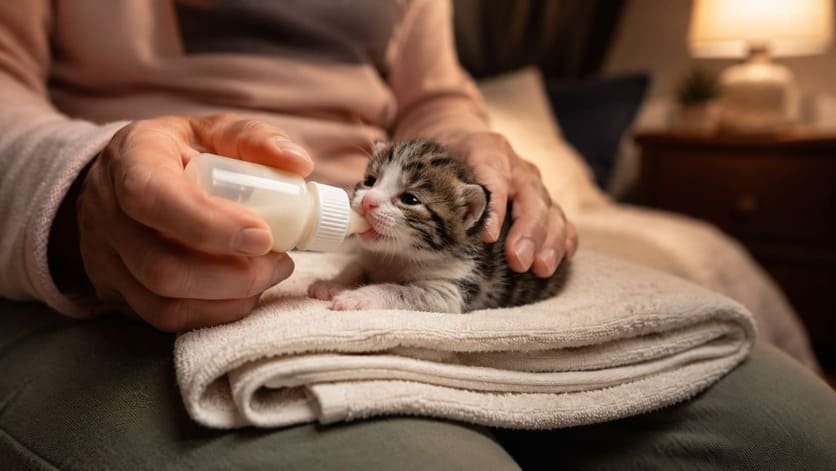
The immediate danger is not malnutrition. It is fluid loss. A two-week-old kitten has almost no reserve, and diarrhea can push her into dehydration within hours. That is an emergency, not a wait-and-see.
If you have an orphaned kitten right now, use a commercial kitten milk replacer, sold as KMR at most U.S. pet stores and many vet clinics. Mix it per the label, warm it to roughly 100°F, and test a drop on your wrist before feeding. Feed her belly-down on a towel, never on her back, because feeding a kitten on her back can send formula into the airway.
Do not feed a cold kitten. Warm her first until her ears and paws feel warm to the touch. If you cannot get her warm, that is a same-day vet call. VCA’s guide to feeding orphaned kittens walks through volumes and feeding intervals in detail, and most U.S. shelters and rescues will coach a first-time bottle feeder over the phone if you call and ask.
Goat milk deserves a mention here because it comes up constantly in rescue groups. It has somewhat less lactose than cow’s milk, which is why the myth persists, but it is still nutritionally wrong for a kitten. It is not a substitute for formula.
Lactose-free milk, cat milk, and plant milks
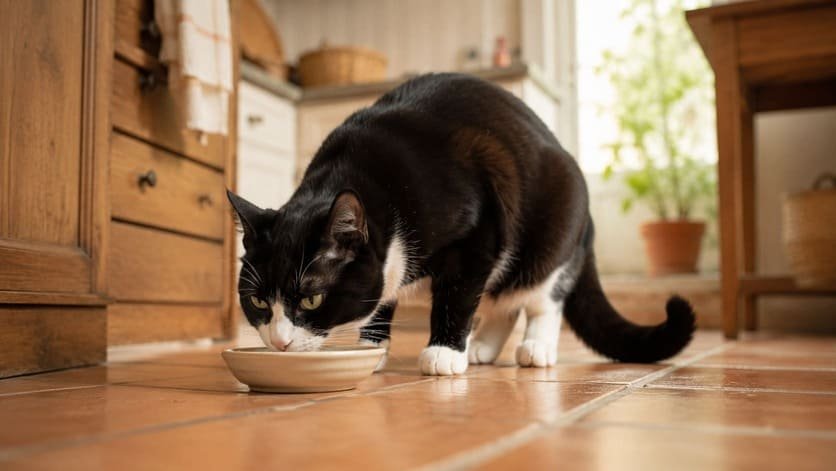
Once people accept that cow’s milk is out, the next question is what to pour instead. Four categories come up, and they are not equivalent.
Lactose-free cow’s milk. The lactose problem goes away. The calories, the milk fat, and the milk protein do not. A tablespoon occasionally is unlikely to hurt a healthy adult cat. It is still empty calories, and a small number of cats react to milk protein regardless of the sugar.
Commercial cat milk. Products like Whiskas Catmilk and Cat-Sip are formulated with the lactose reduced or removed and some added nutrients. They are the safest thing in this section, and they are still a treat with a calorie cost. Read the label and fold that number into the ten percent budget rather than treating it as free.
Plant milks. These fix the lactose and introduce different problems. Almond and coconut milk are fat-heavy enough to trigger vomiting or diarrhea in some cats. Oat and soy add carbohydrates that an obligate carnivore has no use for. Flavored and sweetened versions bring in additives that have no business in a cat’s diet. There is no version of this that benefits her.
Cheese and yogurt. Aged hard cheeses and plain yogurt hold less lactose than fluid milk, which is why some cats tolerate them. Both are still high in fat, and cheese is high in sodium. A pea-sized nibble occasionally is the ceiling, and cats with weight, heart, or kidney issues should skip them.
There is one situation where this stops being a matter of taste. If your cat has chronic kidney disease and you are trying to increase her fluid intake, do not use milk of any kind. A bout of diarrhea in a cat who is already struggling to stay hydrated makes the problem worse, not better. Talk to your vet about wet food, fluid therapy, and other approaches instead.
Better ways to give her the moment she is asking for
The milk ritual is usually about the ritual. She wants the thing you have, delivered by you, at a predictable moment in the day. That part is worth keeping.
- Warm a spoonful of her own wet food. Ten seconds in the microwave, stirred and tested. Warming releases the aroma compounds she is actually responding to, and it costs nothing extra in calories because it comes out of her regular portion.
- Try a lickable puree treat. These usually run around 6 calories per tube and give you the same shared moment, hand-delivered.
- Offer plain tuna water. The water from a can of tuna packed in water, with no salt or oil added, gets a strong response from most cats. A tablespoon, not a bowl.
- Use unseasoned bone broth made for pets. Human broths are almost always too high in sodium and frequently contain onion or garlic, which are genuinely toxic to cats. Buy the pet version or skip it.
- Fix the water setup instead. Many cats drink poorly from a single bowl next to the food. Put two or three bowls in different rooms, keep them away from the litter box, and try a fountain. Cats who ignore still water will often drink from something moving.
On water generally: a rough guideline is about 4 ounces per 5 pounds of body weight per day, including moisture from food. A cat eating mostly wet food gets a good share of that from her meals, which is one of the underrated arguments for wet food. Cornell’s feeding guidance for cats covers how complete diets are formulated and what the AAFCO statement on the label actually means.
If you are still setting up your home for a new cat, our room-by-room cat-proofing guide covers where to put food and water stations so she uses them. And if you are weighing calorie needs, indoor versus outdoor living makes a real difference to how much treat room she has in a day.
When to call your vet
Milk-related upset is usually mild and self-limiting in a healthy adult cat. These signs are not, and none of them should wait:
- Diarrhea lasting more than 48 hours
- Blood in the stool or vomit
- Repeated vomiting, or vomiting with no food coming up
- Refusing food for more than 24 hours
- Lethargy, hiding that lasts, or a cat who does not respond normally to you
- Any of the above in a kitten, a senior cat, or a cat with an existing health condition
Cats hide illness well, so a cat who looks unwell is often further along than she appears. Trust the change in behavior more than the absence of dramatic symptoms.
Frequently asked questions
Can cats drink milk? Most adult cats should not. Lactase production drops after weaning, so undigested lactose ferments in the colon and pulls water into the intestine. Gas, loose stool, or vomiting typically follow. Milk also supplies nothing a complete cat food is missing.
Are all cats lactose intolerant? No, but most adult cats are to some degree. How much lactase a cat retains varies individually. Some handle a teaspoon without a reaction. Some react to a few licks. There is no reliable way to predict which one you have.
Can kittens drink cow’s milk? No. Cow’s milk has less protein, fat, and taurine than a mother cat’s milk, and more lactose. In an orphaned kitten, resulting diarrhea can cause dehydration within hours. Use a commercial kitten milk replacer instead.
Can cats drink lactose-free milk? It will not cause lactose-related upset, but it still delivers milk fat, milk protein, and calories your cat does not need. A tablespoon occasionally is fine for most healthy adults. It is not hydration and never replaces water.
Can cats drink almond milk or oat milk? Not usefully. Almond and coconut milk are high enough in fat to upset some cats. Oat and soy add carbohydrates a carnivore cannot use. Sweetened and flavored versions add ingredients with no place in a cat’s diet.
Can cats eat cheese or yogurt? Small amounts, occasionally, for cats without weight or kidney concerns. Aged hard cheese and plain yogurt hold less lactose than milk but plenty of fat, and cheese is high in sodium. A pea-sized piece is the ceiling.
How much milk is too much for a cat? A ten-pound indoor cat needs roughly 200 calories daily, with treats capped near 20. Whole milk runs about 9 calories per tablespoon, so two tablespoons spends nearly the whole treat budget on food with no nutritional value.
Why does my cat love milk if it makes her sick? Cats cannot taste sweetness, so the lactose is not the appeal. She is responding to milk fat and animal protein. That is also why offering skim rarely satisfies a cat who has been begging for cream.
Can cats drink goat milk? Goat milk has somewhat less lactose than cow’s milk, but it is still dairy, still calorie-dense, and still nutritionally wrong for cats. It is not an appropriate substitute for kitten formula in an orphaned kitten.
What should I do if my cat drank milk? Remove it, keep water available, feed her normal meal, and note the time. Watch the litter box for 24 hours. Call your vet if diarrhea lasts past 48 hours, if there is blood, or if she becomes lethargic or stops eating.
The habit is worth breaking, and it is easy to replace
The saucer of milk survived this long because it looks like affection. It is a small, generous gesture with a picture-book history behind it, and giving it up feels like taking something away from her.
You are not. She wants the fat, the smell, and the fact that it came from you. All three are available in a warmed spoonful of her own dinner or a 6-calorie puree tube, with none of the fallout.
Try the swap this week and watch what happens. Most cats take the new ritual within a few days, especially if it arrives at the same time the milk used to.
For more on feeding, safety, and everyday cat care, browse our cat safety guides at Smart Paw Life.
Disclaimer: This article is for informational purposes only and does not replace veterinary care. Talk to your veterinarian about any health concern, dietary change, or ongoing digestive problem affecting your cat, especially for kittens, senior cats, and cats with existing medical conditions. For aggression, high prey drive, or other high-risk behavioral situations, work with a certified animal behaviorist or a qualified trainer.