Bananas are non-toxic to cats, but they are not a healthy treat. Cats cannot taste sweetness, cannot digest starch well, and get no nutrition from banana that their food does not already supply. A quarter-inch slice, once or twice a month, is the ceiling. Never feed the peel.
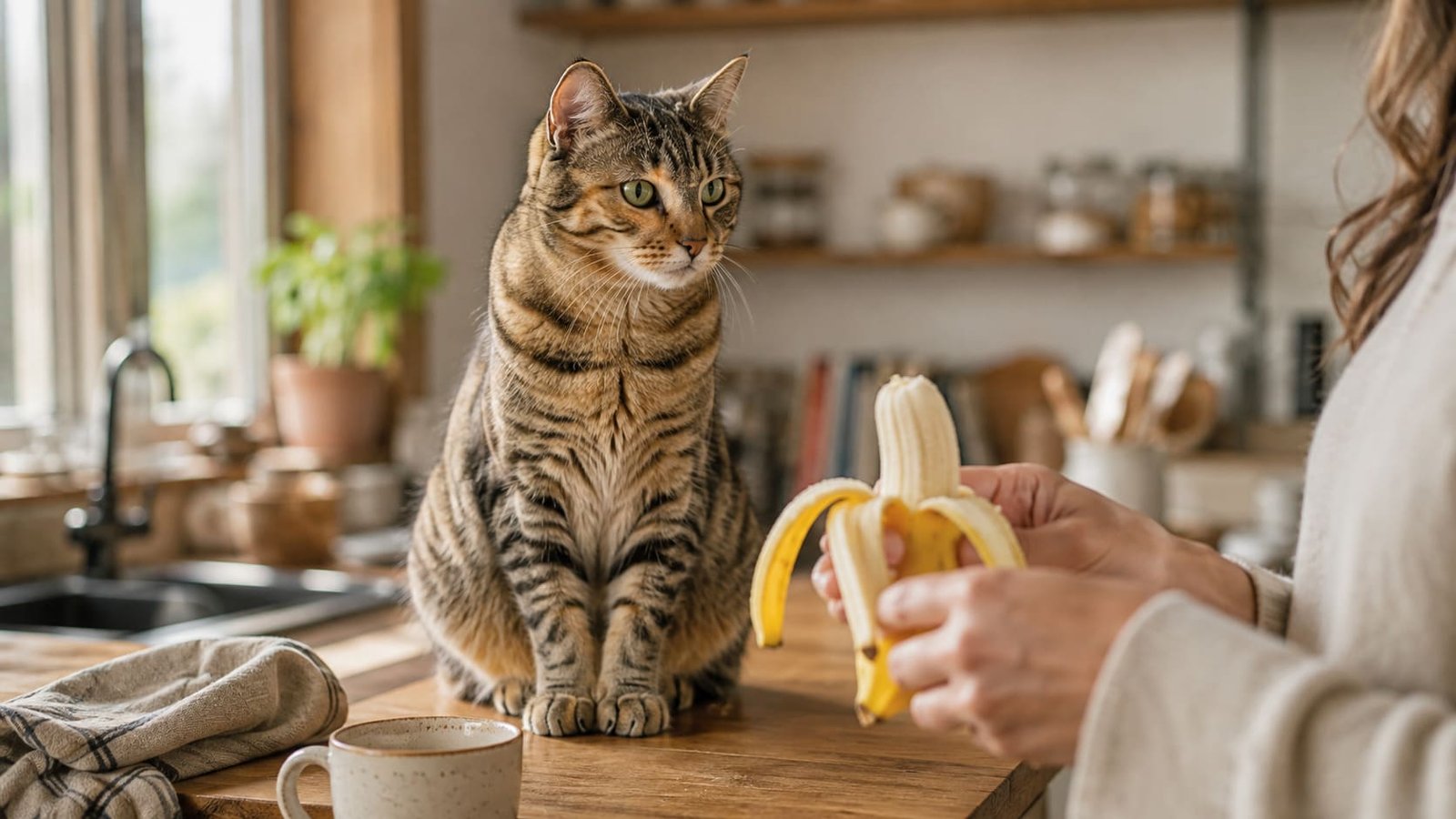
You peel a banana and a cat materializes at your elbow. She has ignored the same fruit sitting in the bowl for three days, but the second it opens, she is interested.
Most owners read that as appetite and offer a bite. That is usually the wrong read, and it leads to a treat habit built on a misunderstanding.
Banana is not dangerous. It is also not good for your cat in any way that survives a close look. Here is what to do about the cat at your elbow.
Key takeaways
- The ASPCA lists banana as non-toxic to cats, so a stolen bite is not an emergency.
- Cats cannot taste sweetness at all, so a cat showing interest in banana is responding to smell, texture, or to you.
- A quarter-inch slice, roughly 5 grams and 4 to 5 calories, is the sensible ceiling. Once or twice a month is plenty.
- Banana supplies no nutrient a complete cat food is missing. Cats even make their own vitamin C.
- Never feed the peel, and keep peels out of reach of counter-surfing cats.
The short answer
Yes, cats can eat bananas. Banana flesh is non-toxic, and a small piece will not hurt a healthy adult cat.
But “can” and “should” are different questions.
Banana gives a cat nothing. It runs about 89 calories and 12 grams of sugar per 100 grams, according to USDA FoodData Central. That nutrient profile was built for a species that eats plants.
Cats are obligate carnivores. Their nutrition comes from animal tissue, and a complete commercial diet already covers it.
So the honest verdict: banana is a harmless novelty, not a healthy snack. The safe portion is also smaller than most articles suggest.
Why your cat wants your banana
This is the part almost every guide skips, and it changes what you do next.
Cats cannot taste sweet. Not “prefer not to” or “taste it faintly.” The receptor is not there.
Researchers at the Monell Chemical Senses Center traced it to the Tas1r2 gene. The feline version carries a 247-base-pair deletion, so cats never build the protein that detects sugar.
Their 2005 paper in PLOS Genetics found the same broken gene in tigers and cheetahs.
So your cat is not after the sweetness. She physically cannot detect it.
What she is after is one of three other things.
The first is smell. A ripe banana releases strong volatile compounds the moment the peel breaks, and a cat’s nose is far more sensitive than yours. Smells that are new and strong are worth investigating.
The second is texture. Some cats like soft, mushy, lickable things regardless of flavor, which is the same reason a cat will lick butter off toast and leave the toast.
The third, and by far the most common, is you. Cats pay close attention to what their people eat, and food a person is actively handling carries a social value the same food in a bowl does not.
The banana in the fruit bowl was invisible. The banana in your hand is an event.
That distinction matters, because if the interest is social, feeding her the banana teaches her that hovering works. You have not given her a treat. You have trained a behavior.
What actually happens when you offer one
Offer a cat a piece of banana and the sequence is remarkably consistent. It is worth knowing, because it tells you when to stop.
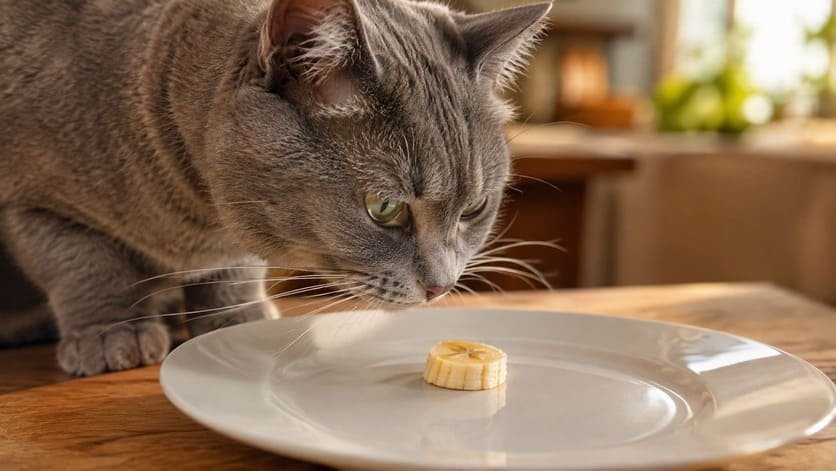
She approaches nose first and investigates for two to four seconds. Whiskers push forward. The mouth stays closed. That is scent assessment, not tasting.
Then one of four things happens. Most cats turn the head slightly away and walk off.
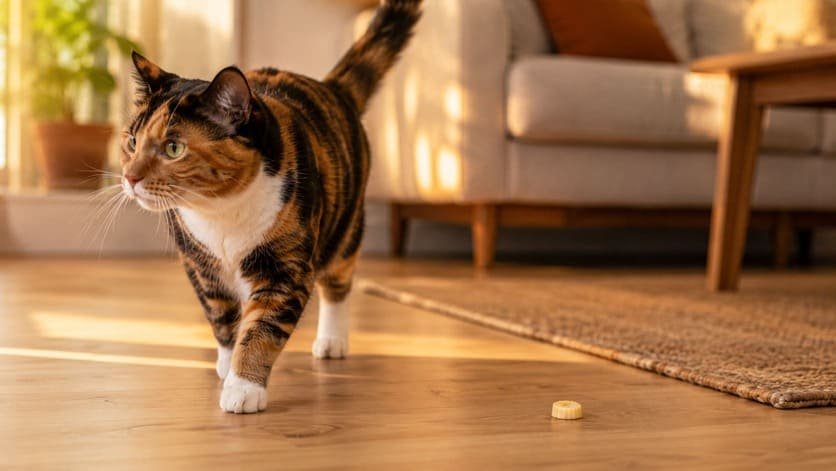
Some tap it with a paw, then sit down and groom a shoulder. That is displacement behavior, a polite feline way of saying the matter is closed.
A few lick it once and abandon it. A small minority actually eat the piece.
You may also see an open-mouthed grimace, lips pulled back, head slightly raised. That looks like disgust and is not.
It is the flehmen response, a normal way cats route strong scent to a sensory organ in the roof of the mouth. She is analyzing, not suffering.
Timing is worth watching too. Interest peaks with very ripe fruit and drops off sharply with green bananas, which release far less aroma.
If your cat investigated and walked away, that was a complete answer.
Do not mash it into her food to “help her try it.” Hiding a rejected food is how cats learn to distrust their own bowl.
One more observation that comes up constantly. Cats who seem to love banana are usually loving something else on it: yogurt, peanut butter, cream, or ice cream. Offer plain banana to the same cat and the enthusiasm evaporates.
Are there any real benefits?
Search this topic and you will find the same three benefits repeated: potassium, vitamin C, and fiber. All three fall apart for cats.
Potassium. Bananas carry about 358 mg per 100 grams. Complete and balanced cat foods already meet feline potassium requirements, so there is nothing to top up.
And if your vet has diagnosed low potassium, banana is not the treatment. Cats with kidney disease are often prescribed a potassium supplement at a measured dose. Do not substitute fruit for it.
Vitamin C. This one is simply wrong for the species. Cats make their own vitamin C in the liver.
Cornell’s Feline Health Center puts it plainly in its CatWatch guidance: dogs and cats produce their own, so there is no reason to look for vitamin C on a food label. A benefit a cat’s body already supplies for itself is not a benefit.
Fiber. Banana has about 2.6 grams of fiber per 100 grams. At a realistic 5-gram serving, that works out to roughly 0.13 grams.
That is a rounding error, not a digestive aid. If your cat has constipation or loose stool, talk to your vet rather than reaching for fruit.
So what is left? One thing, and it is not nutritional.
A tiny piece of banana is a low-risk way to share a moment with a cat who wants in on what you are doing.
That is a real reason. It is not a health reason, and it should not be dressed up as one.
The risks worth taking seriously
None of these are dramatic. They are the ordinary, cumulative kind of risk that gets missed precisely because each individual bite seems harmless.
Calories add up faster than you think

This is the real problem, and it is arithmetic.
A cat’s treat allowance is small. Cornell’s Feline Health Center advises keeping treats under 10 to 15 percent of daily calories. Most veterinary nutrition guidance uses 10 percent as the working figure.
A 12-pound indoor cat eating around 250 calories a day has about 25 calories to spend on everything that is not her food.
Now price the banana. Most guides suggest a piece about an inch across. A banana is roughly an inch and a quarter thick, so a slice that size comes to around 20 grams, or close to 18 calories.
That is about 70 percent of her entire daily treat budget, spent on one piece of fruit, usually on top of the two dental treats she already had. That is the number I would push back on, and no article I found runs it.
Weight matters here beyond vanity. Cornell lists obesity first among the risk factors for feline diabetes, alongside age, inactivity, male sex, and steroid treatment.
A slice of banana does not cause diabetes. A treat habit that quietly adds a pound is a different story.
Cats are poorly built for starch and sugar
Cats have no salivary amylase, the enzyme that starts starch digestion in the mouth. Their pancreatic amylase runs at a small fraction of a dog’s.
Intestinal sucrase and lactase levels are low too, and a cat’s sugar transport system does not adapt to a higher-carbohydrate diet the way an omnivore’s does.
The practical consequence is that carbohydrate a cat cannot digest keeps moving through the gut and pulls water with it. That is why loose stool is the single most common reaction to fruit in cats.
Ripeness changes the picture slightly. Green banana is high in resistant starch, the version most likely to produce gas and soft stool.
Very ripe banana has converted more of that starch to simple sugar. Easier on the gut, harder on the calorie budget. Neither version is good, but ripe is the lesser problem.
The banana peel
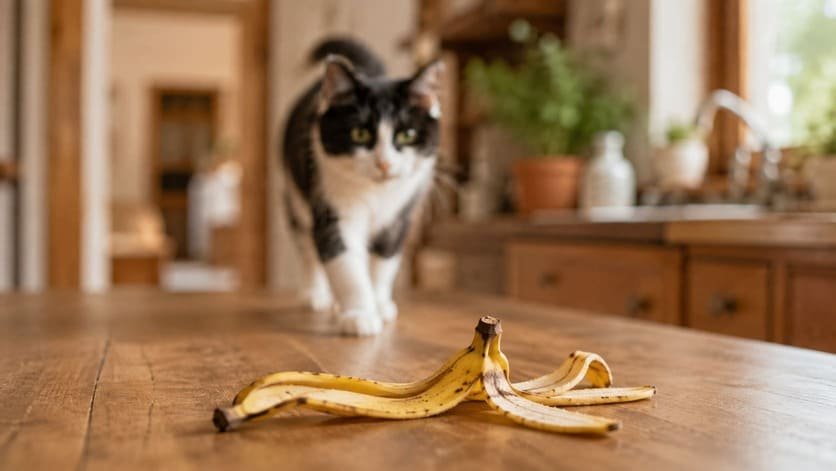
Every article says do not feed the peel. Almost none say why, and the reason is more useful than the rule.
Cats have 30 teeth to a dog’s 42, and the ones they have are built for shearing, not grinding. They also lack the sideways jaw movement grinding requires.
So a cat cannot break fibrous peel into small pieces. She can only tear off a strip and swallow it more or less intact.
That is a choking risk going down and an obstruction risk further along.
Signs of a blockage build over 24 to 72 hours. Watch for repeated vomiting, refusing food, straining in the litter box with nothing produced, hiding, and a hunched posture.
Any of those after a cat has chewed on a peel warrants a same-day call to your vet.
The fix is boring and effective. Peels go straight into a closed bin, not the open kitchen trash.
If your cat patrols counters, our guide to cat-proofing your home covers how to make the kitchen less rewarding to patrol.
Digestive upset and what to watch
Even non-toxic foods produce individual reactions. If your cat is going to react to banana, you will usually see it within 2 to 12 hours.
Watch for vomiting, diarrhea, gas, reduced appetite, or unusual lethargy. Keep the window open for a full 48 hours.
Do not introduce any other new food during that time. If something goes wrong, you want to know exactly what caused it.
Mild loose stool that resolves within a day is common and rarely serious. Vomiting more than twice, diarrhea lasting beyond 24 hours, or any refusal to eat means it is time to call the clinic.
Cats who should skip bananas entirely
Some cats have no business eating fruit at all, however small the piece.
- Diabetic cats. These cats are usually managed on low-carbohydrate diets. A sugary treat works directly against the plan.
- Overweight cats or cats on a weight-loss plan. The treat budget is already tight and the calories are already spoken for.
- Cats with chronic kidney disease. Potassium and phosphorus intake may be actively managed. Do not freelance.
- Cats with IBD, food sensitivities, or chronic soft stool. Novel carbohydrates are a poor gamble.
- Cats on a prescription or elimination diet. A single off-plan food can invalidate weeks of diagnostic work.
- Kittens under six months. Every calorie should be doing growth work.
How much banana can a cat eat?
Here is the whole method, in five steps.
- Ask your vet first. Especially if your cat has any diagnosed condition or is on a prescription diet. This takes thirty seconds at your next visit.
- Calculate the treat budget. Take your cat’s daily calorie target and multiply by 0.10. A cat eating 250 calories a day gets 25 calories of treats. If you do not know her target, ask your vet rather than guessing, since needs vary widely by age, weight, and activity.
- Peel it and bin the peel. Closed bin. Do this before you cut anything, so the peel is never sitting on the counter unattended.
- Cut a quarter-inch slice or less. A quarter-inch round off a standard banana comes to roughly 5 grams, which at 89 calories per 100 grams is about 4 to 5 calories. Around one level teaspoon of mashed banana gets you to the same place without a knife.
- Offer it once, then watch for 48 hours. Give it from a plate or your palm rather than mixing it into her meal. Note the date. Skip other new foods until the window closes.
How often: once or twice a month is a reasonable ceiling for a healthy adult cat. Weekly is unnecessary. Daily turns a novelty into a habit, and a habit into weight.
Banana products: what’s fine and what isn’t
Plain banana is the only version worth considering. The processed forms are where problems actually live.
Banana bread is cake. It is also frequently made with chocolate chips, raisins, macadamia nuts, or nutmeg, and every one of those is genuinely dangerous to cats.
Our roundup of toxic foods to keep away from your kitchen covers what each of them does. Skip banana bread entirely.
Banana chips are usually fried and sweetened, which concentrates both fat and sugar into a hard piece a cat cannot chew properly.
Banana pudding, yogurt, smoothies, and ice cream add dairy. Most adult cats have low lactase activity, so dairy is a reliable route to diarrhea.
Banana-flavored anything contains no meaningful banana and plenty of additives. There is no version of this that helps.
Sugar-free products containing xylitol deserve a correction, because a lot of pet content gets this one wrong. Xylitol is a genuine emergency for dogs.
For cats it is not. The Merck Veterinary Manual states that dogs are the only domestic species in which xylitol toxicosis has been reported, and that cats are not at risk of the hypoglycemia or liver injury dogs suffer.
That is not an invitation to feed it. Sugar-free products contain other things a cat should not eat, and you should still call your vet if she gets into one. It does mean you do not need to panic the way a dog owner would.
If you also have a dog in the house, that distinction cuts the other way. A xylitol product a cat shrugs off can put a dog in the emergency room within an hour.
Better treats than banana
If the goal is a small, rewarding moment with your cat, there are options that actually suit her.
Single-ingredient freeze-dried meat is the obvious upgrade. Freeze-dried chicken, turkey, salmon, or minnows are pure animal protein, come in tiny pieces, and match what a cat’s body is built to use.
Plain cooked chicken works just as well. No salt, no oil, no seasoning, no bones, cut to the size of a piece of kibble.
Dental treats carrying the Veterinary Oral Health Council seal at least do a job while spending calories. They are not a substitute for brushing, but they earn their place better than fruit.
Catnip and silvervine are the sleeper answer. Both are essentially calorie-free, and a cat rolling around in a catnip haze is getting more out of the interaction than she would from a piece of banana.
And the free one. A ten-minute wand toy session gives a cat the hunting sequence she is actually wired for. Most cats hovering around your food are asking for engagement, and this answers the real request.
For more on keeping the kitchen and the rest of the house safe, our cat safety guides go room by room.
Conclusion
Banana passes the safety test and fails the point test. It will not hurt your cat, and it will not help her either.
If you want to hand her a quarter-inch slice once a month because she likes being included, do it. Peel it, cut it small, watch her for two days, and count the calories against her treat budget.
That is a perfectly reasonable thing to do for a cat who wants in on your morning.
Just be honest about what is happening. She is not asking for fruit. She is asking for you.
Next time she turns up at your elbow, reach for the wand toy instead and see how fast she forgets the banana.