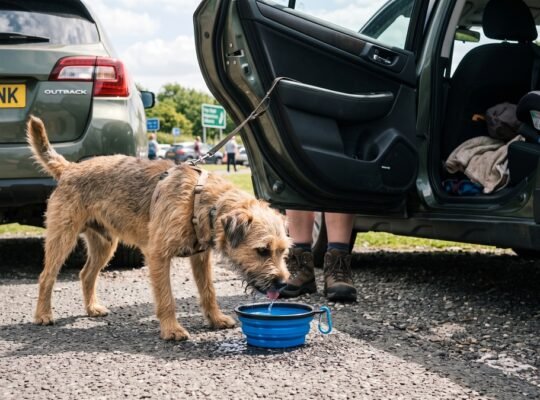
Taking one dog on a road trip is already a puzzle. Taking two is a different level of planning because now you are managing two personalities, two energy levels, and two sets of needs in the same small space. Maybe one dog gets carsick and the other gets overexcited every time a truck passes. Maybe they are best friends who turn into wrestling partners the second the engine starts.
Whatever your pair’s dynamic, getting it wrong does not just mean a stressful drive. It can mean real danger for you, your dogs, and everyone else on the road.
The good news is that traveling with two dogs is very doable once you know what actually matters: how to restrain them safely, how to manage the space between them, and how to keep both dogs calm instead of letting them feed off each other’s energy. This guide covers all of it, from crate setup to what to pack, so your next trip, whether across town or across the country, goes smoothly for everyone.
Why Traveling With Two Dogs Takes More Planning
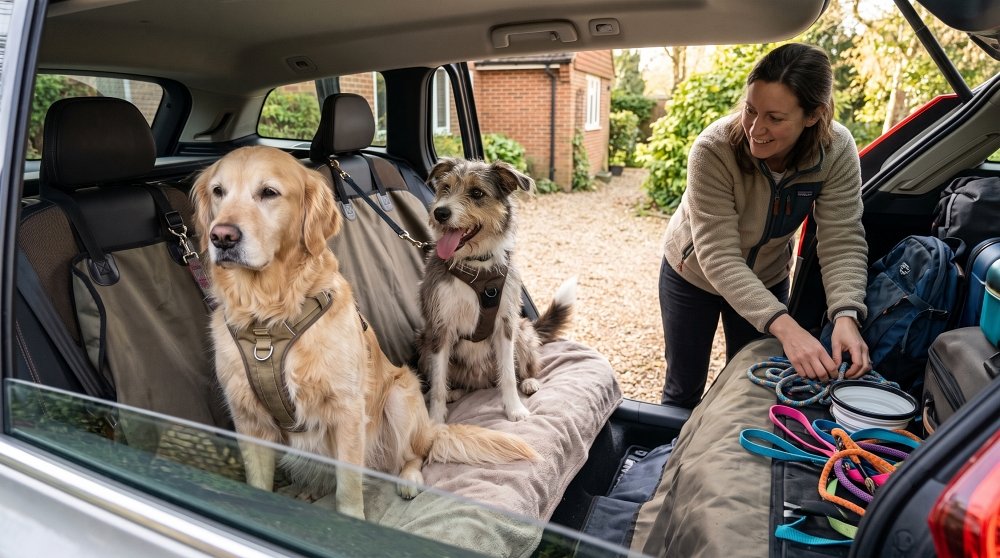
With one dog, you are solving a single set of variables. With two, you are solving for interaction as well. Two dogs sharing a back seat can rile each other up, block each other’s crates, or turn a routine stop into a two-leash tangle.
The American Veterinary Medical Association’s guidance on pet safety in vehicles makes clear that unrestrained pets are a hazard in a crash regardless of how many are in the car. With two dogs, an unsecured pet is also more likely to distract the driver or collide with the other dog during a sudden stop.
Think of your setup in three parts: restraint, space, and routine. Restraint is how each dog is secured. Space is how much room each dog has and how much separation they need from each other. Routine is how you manage breaks, food, and water for two schedules instead of one. Get those three right and most of the other problems become easier to handle.
How to Prepare Before Traveling With Two Dogs
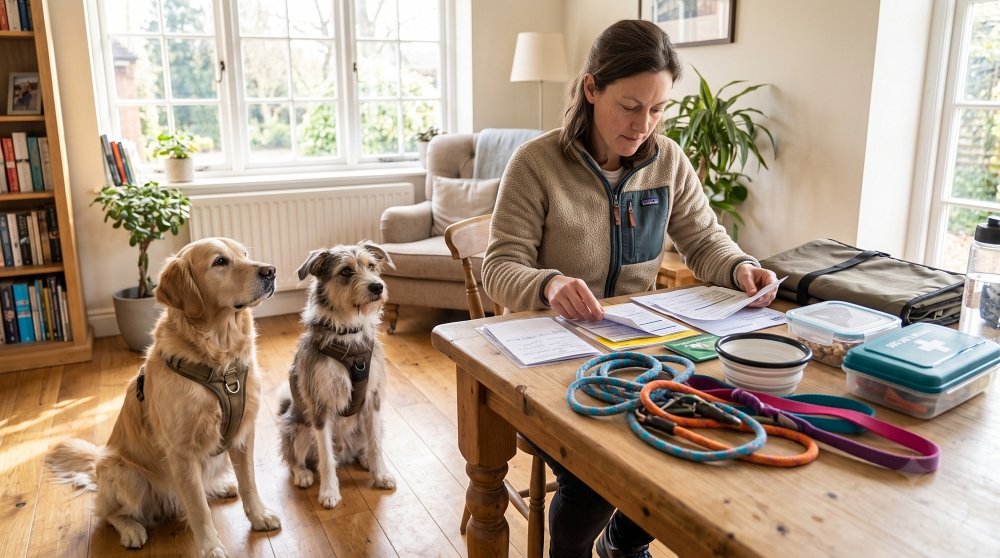
1. Book a Vet Check for Both Dogs
If you are going any real distance, especially crossing state lines or traveling with a dog that has a health condition, schedule a checkup beforehand. Ask your vet about carsickness for each dog specifically.
According to VCA Animal Hospitals, motion sickness in dogs is often linked to an inner ear balance system that is not fully developed. That is why puppies are more prone to it than adult dogs and usually outgrow it by around one year old.
If one of your two dogs is younger or has a history of drooling, whining, or vomiting in the car, your vet can discuss anti-nausea options like maropitant, sold under the brand name Cerenia, well ahead of travel day. That conversation should happen before the trip, not the morning you leave.
2. Practice Short Drives First
Two dogs who have never ridden together should not make their debut on a six-hour trip. Do a few 10 to 15 minute drives around the neighborhood first.
This lets you see how they behave next to each other in a moving vehicle while the stakes are low and you can pull over easily. Watch whether they stay calm, become anxious, compete over window space, bark at traffic, or try to move toward each other.
3. Confirm Where Dogs Are Allowed
Check pet policies for hotels, campgrounds, or any planned stops along your route before you go. Also confirm any state-specific restraint laws if you are crossing state lines.
A few states have specific rules about pets in truck beds or on drivers’ laps. The AVMA’s travel safety guidance is explicit that dogs should never ride on the driver’s lap, since that limits your ability to control the vehicle and turns your dog into an airbag hazard.
Best Crate and Restraint Setup for Two Dogs
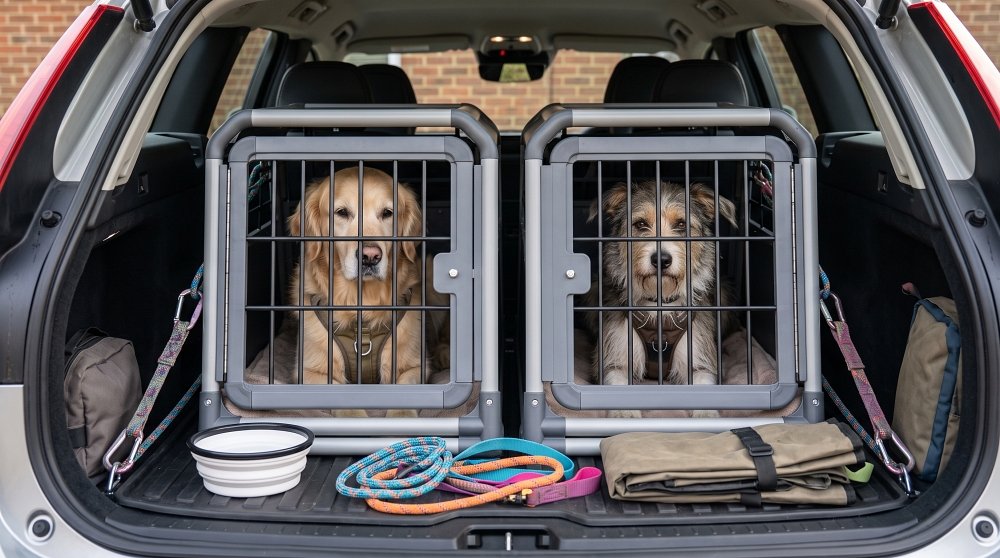
This is the section that matters most for actual safety, so it is worth getting specific.
Should Two Dogs Share a Crate?
Generally, no, even if they are closely bonded. A shared crate means neither dog has full room to stand, turn around, or lie down comfortably for the whole trip. In a crash, two bodies moving inside one enclosure can also injure each other.
The AVMA recommends crates be sized so a dog can stand, turn, and lie down without restriction. That is a per-dog standard, not a per-crate one. Two separate, properly sized crates, or one crate plus a crash-tested harness, is the safer setup for almost every pair.
Crates vs. Harnesses vs. Barriers
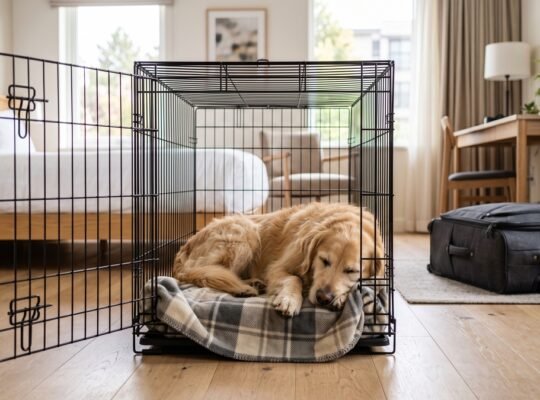
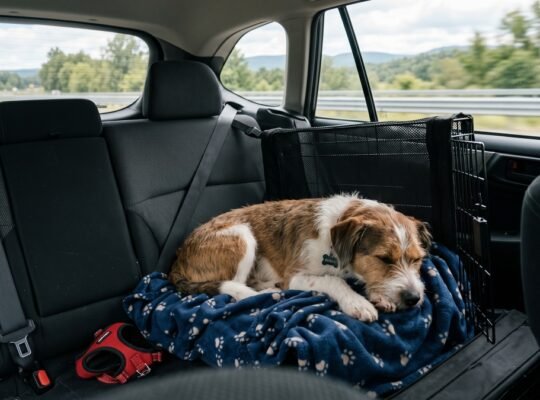
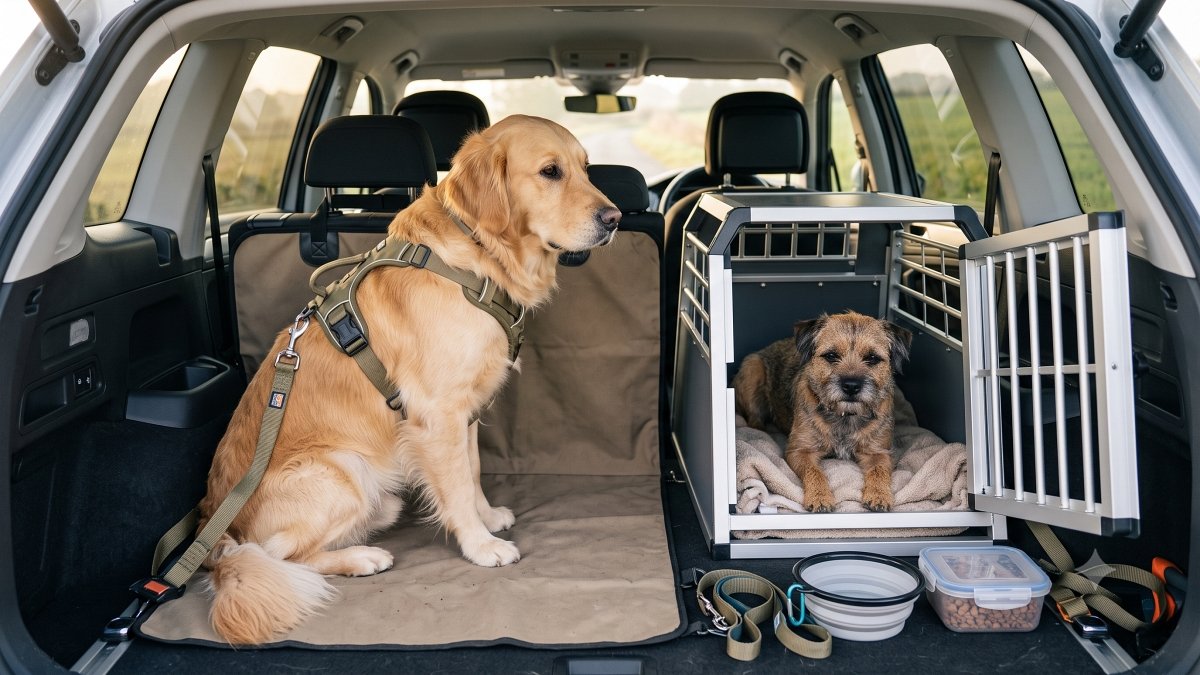
- Crates or carriers: These are usually the most protective option in a crash, provided the crate is secured and not just sitting loose. A crate should be centrally located rather than pressed against a door. Hard-sided crates generally offer more crash protection than soft-sided ones, though soft crates are lighter and easier to move for shorter trips.
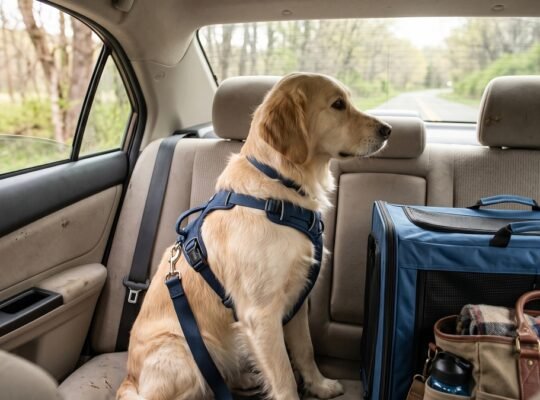
- Crash-tested harnesses: These are a good option when your dogs are too large for two crates to fit comfortably, or when you are driving a smaller car. Look specifically for harnesses that have been crash-tested. The Center for Pet Safety independently tests and rates these. Regular walking harnesses are not built to handle crash forces and can injure a dog on sudden impact.
- Vehicle barriers: A cargo barrier or SUV divider keeps dogs contained to one section of the car. This helps if you are using crates in the back but still want a second layer of separation, or if space constraints mean you are relying on a barrier rather than individual crates.
If Your Dogs Are Different Sizes
Mixed-size pairs need mixed solutions. A 15 kg dog and a 30 kg dog should not use the same crate size, obviously, but placement matters too.
A larger, calmer dog can usually handle a rear cargo area behind a barrier, while a smaller or more anxious dog may do better secured in the back seat where they can see a person. If you have a large, high-energy breed like a Golden Retriever in the mix, our Golden Retriever breed guide covers their typical size and energy level, which is useful when choosing crate dimensions and planning exercise stops.
How to Manage Space and Seating for Two Dogs
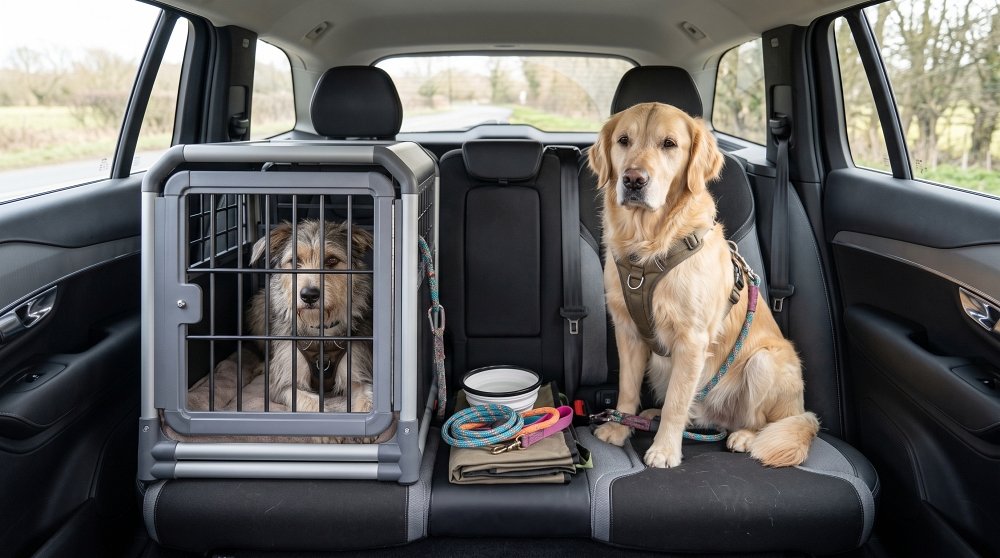
Where each dog sits changes their behavior more than many owners expect. A few placement principles help:
- Give each dog their own zone. Two crates side by side in the back seat or cargo area, each strapped down independently, is the gold standard. If you only have room for one crate, put the crated dog in the back and the harnessed dog in a middle or rear seat, not up front.
- Keep dogs out of the front seat entirely. Airbags deploy with enough force to seriously injure or kill a dog positioned in the front passenger seat. That is why the AVMA specifically advises keeping dogs out of that seat in any airbag-equipped vehicle.
- Separate dogs who compete over the same window or gap. If your two dogs squabble over who gets to see out a particular window, solve it with crate placement rather than hoping they work it out mid-drive. A visual barrier, such as a crate cover on one side, can reduce that competition.
- Do not let dogs hang their heads out the window. It looks fun in photos, but flying debris, insects, and sudden branches can cause real eye and ear injuries. It is also an easy habit for one dog to pick up from watching the other do it.
Feeding, Water, and Potty Breaks for Two Dogs
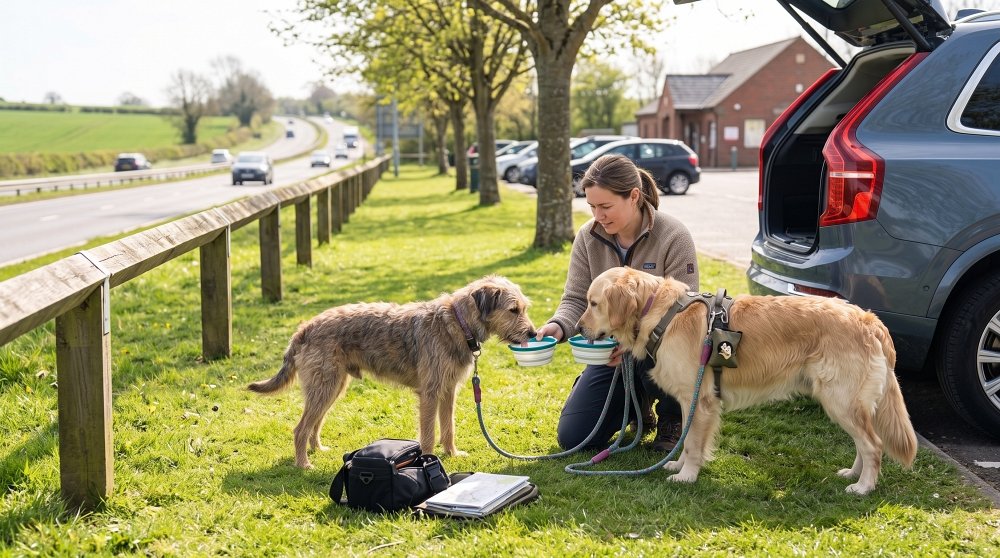
Two dogs means two digestive systems and two bladders on two different schedules, so build in more buffer than you think you need.
- Feed light, and feed early. A light meal two to three hours before departure, rather than a full meal right before you leave, reduces the odds of carsickness for either dog. On multi-day trips, keep portions modest during driving hours and save the bigger meal for once you have stopped for the night.
- Offer water regularly, not constantly. Spilling water in a moving car is almost inevitable if you overdo it. Offer small amounts at each stop rather than leaving a full bowl sloshing around between two crates.
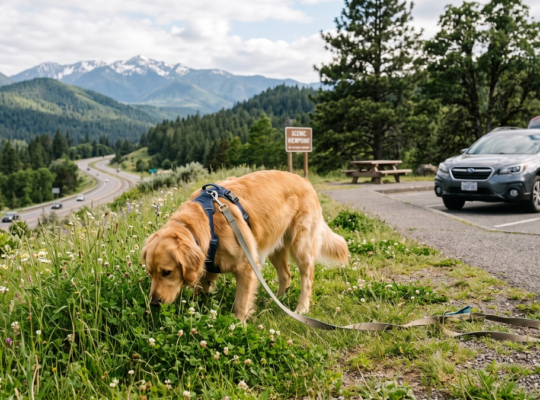
- Plan a stop roughly every two hours. This lines up with the AVMA’s recommendation to stop every two hours so dogs can stretch, relieve themselves, and reset. With two dogs, budget slightly more time per stop since you are managing two leashes and two sets of sniffing priorities.
- Leash both dogs before opening any door. This sounds obvious until you are juggling two leashes, a water bowl, and a rest-stop parking lot. Clip both leashes on while the dogs are still crated or belted, before you open a single door, so neither dog can bolt into traffic during the handoff.
How to Keep Two Dogs Calm in the Car
This is where having two dogs is genuinely different from having one, because dogs feed off each other’s arousal. A calm dog next to an anxious or overexcited one may stay calm. Two dogs who both get keyed up can push each other into a state that is hard to settle mid-drive.
Watch for Trigger Stacking
Trainers use the term trigger stacking to describe what happens when a dog experiences several stressors in quick succession. Each one adds to the last until a reaction that looks sudden is actually the result of a dozen small things piling up.
In a car with two dogs, that might look like this: a loud truck passes, the other dog barks at it, a sharp turn shifts both crates, and then stop-and-go traffic adds motion sickness on top. None of those alone may be a big deal, but stacked together they can push a normally easygoing dog into barking, whining, or even snapping at the dog next to them.
Building in calm-down time between stimulating stops, and separating two dogs who are winding each other up, is more effective than correcting the behavior after it escalates.
Practical Calming Strategies
- Give each dog a predictable spot. Dogs settle faster when the environment is consistent from trip to trip, so use the same crate, same blanket, and same seating arrangement every time.
- Use calming aids you have already tested at home. A pheromone spray, snug-fitting calming wrap, or familiar chew can help, but only if you have tried it in a low-stakes setting first. The car is not the place to discover that a new product does not sit well with your dog.
- Separate them visually if they are winding each other up. A crate cover on the side facing the other dog, or a solid barrier instead of a mesh one, removes the visual feedback loop that keeps escalating.
- Reward calm behavior. If both dogs settle quietly for a stretch, a quiet word or a small treat at the next stop reinforces that calm behavior is what gets rewarded. This matters more over a multi-day trip than a single car ride.
Temperature and Safety Checks for Two Dogs
This is non-negotiable, and it matters even more with two dogs because a crated pair generates more body heat in an enclosed space than one dog alone.
- Never leave dogs alone in a parked car. The AVMA notes that a car’s interior can climb roughly 20°F in just 10 minutes and nearly 30°F in 20 minutes. That means even a 70-degree day can turn a parked car into a 100-plus-degree oven in the time it takes to grab coffee. Cracking a window does not meaningfully change this. If you cannot bring both dogs into a stop with you, do not make the stop.
- Check the cargo area temperature separately from the cabin. If your dogs are riding in a covered cargo area or hatchback space, that zone can run hotter or colder than the front seat. Check it directly rather than assuming the cabin’s climate control is doing the job back there.
- Watch for overheating signs on hot days. Heavy panting, drooling, lethargy, or a bright red tongue and gums are warning signs. Two dogs crated close together in warm weather need more airflow, not less, so prioritize ventilation around both crates.
- Secure everything, including the crates themselves. A crate that is not strapped down becomes a projectile in a hard stop or crash. Use cargo straps or a seatbelt loop through the crate’s securing points for both crates every time.
Packing Checklist for Traveling With Two Dogs
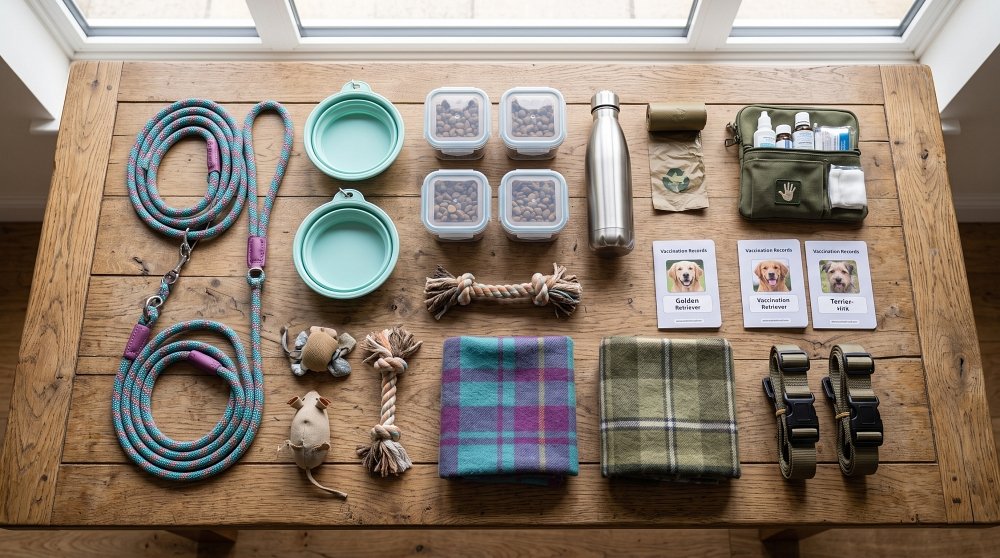
Pack for two of everything, plus a shared kit for items that do not need doubling.
Per Dog
- Collar with ID tags and a leash
- Crate or crash-tested harness, sized correctly
- Food, packed separately if they eat different diets or different amounts
- A few days’ buffer of any medication
- A familiar blanket or bed from home
- One or two favorite toys or chews
Shared Travel Kit
- Water and two collapsible bowls, one per dog, since dogs can be territorial about sharing a bowl at a rest stop
- Poop bags, more than you think you will need
- A basic pet first aid kit
- Copies of both dogs’ vaccination records, especially for crossing state lines or boarding anywhere
- A recent photo of each dog on your phone, in case you get separated at a stop
- Cleaning supplies for accidents, ideally enzyme cleaner rather than a generic cleaner for pet messes
- A crate cover or lightweight sheet, useful for both shade and calming
Short Trips vs. Long Road Trips With Two Dogs
Not every drive needs the full road-trip treatment, but the two-dog considerations shift depending on distance.
For Short Trips Under an Hour
- Skip the full meal beforehand if you are heading somewhere exciting, like the dog park, since excitement plus a full stomach is a common carsickness combination.
- You can often use harnesses instead of full crate setups, as long as both dogs are genuinely secured and not just sitting loose.
- Still leash both dogs before opening doors, even for a five-minute errand stop, since short trips are exactly when people get complacent.
For Long Road Trips Over Multiple Hours or Days
- Crates become more worthwhile because dogs need real space to lie down over a long haul, not just sit upright in a harness.
- Build a loose daily rhythm: similar wake time, similar meal timing, and similar stop frequency, so both dogs’ digestion and energy stay predictable.
- Research overnight stops in advance rather than hoping you will find a pet-friendly hotel at 9 p.m. with two dogs in tow.
- Bring a longer buffer of both food and any medication than you think you need. Delays happen, and running out of one dog’s food two states from home is a preventable problem.
- Expect an adjustment period. Two dogs who travel well together on day three of a trip may be more anxious and vocal on day one simply because the routine is new. Patience early on pays off later in the trip.
Final Thoughts on Traveling With Two Dogs in a Car
Traveling with two dogs in a car is less about doing twice the work and more about doing the same core things correctly: secure restraint, adequate space, a realistic break schedule, and a calm environment. The added challenge is accounting for how two dogs influence each other along the way.
Get the restraint and temperature basics right first because those are the non-negotiables. Then build routines around your specific pair’s personalities. A dog who gets anxious next to an excitable sibling needs a different setup than two easygoing dogs who nap the whole way.
Once you dial that in, road trips with two dogs stop being a logistical headache and start becoming what they should be: a practical way to bring the whole family along.
Click Here to Add SmartPawLife as a Trusted Source Add as a preferred source on Google