Eight picks for the best cat food for sensitive stomachs, frequent vomiting, and hairballs, sorted by the problem each one solves. Includes over-the-counter and veterinary diets, how to tell vomiting from regurgitation, and how to run an 8 to 12 week food trial that gives a real answer.
It usually happens at 4 a.m., somewhere between the hallway and the bathmat. You hear it before you see it. Three or four quick heaves, a pause, then silence. By morning you are on your knees with paper towels, wondering whether that was a hairball, the food, or something you should worry about.
The picks are below, sorted by the problem each one solves rather than by rank. A cat who brings up undigested kibble ten minutes after eating needs a different food than a cat vomiting bile at dawn, and both need something different from a long haired cat producing hairballs every few days. Pick the line that matches your cat, then read the sections underneath to make the change stick.
Key takeaways
- For mild, occasional upset in a healthy cat, start with a highly digestible over-the-counter food such as Purina Pro Plan Sensitive Skin and Stomach or Hill’s Science Diet Sensitive Stomach and Skin.
- For chronic vomiting or a diagnosed condition, veterinary gastrointestinal diets such as Purina Pro Plan Veterinary Diets EN Gastroenteric are the stronger option and need vet authorization.
- For a suspected food allergy, hydrolyzed diets like Hill’s Prescription Diet z/d and novel protein diets like Royal Canin Selected Protein are the two routes.
- Grain-free rarely helps. The allergens most often reported in cats are animal proteins, particularly beef, fish, and chicken.
- Give a new diet 8 to 12 weeks before judging it, and change only one thing at a time.
- Cornell advises a prompt vet visit for cats vomiting more than once a week, or with weight loss, lethargy, appetite changes, or blood.
The 8 best cat foods for sensitive stomachs, vomiting, and hairballs
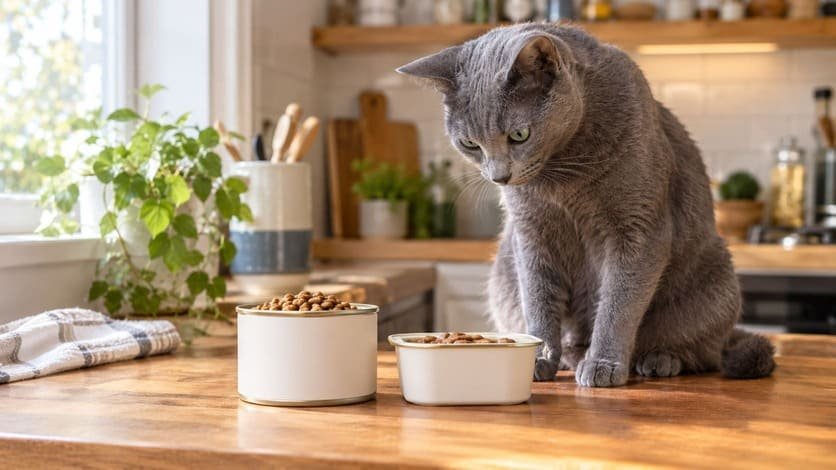
Four of these are available on any pet store shelf. Four are veterinary therapeutic diets that require authorization from your vet, either at the clinic or through an online pet pharmacy. Prices and bag sizes change constantly, so check current listings rather than trusting a number in an article.
- Purina Pro Plan Sensitive Skin & Stomach. Best over-the-counter pick for occasional upset. The dry formula leads with salmon and uses rice and oatmeal rather than the chicken most cats have eaten their whole lives, which matters if chicken is on your suspect list. Wet versions come in small 3 ounce pate cans, including duck and tuna with oatmeal, so you can add moisture without committing to a case of one flavor your cat may refuse.
- Royal Canin Feline Care Nutrition Digestive Care. Best for the cat who inhales dinner and returns it minutes later. This one is built around ring shaped kibble designed to make cats slow down and chew, alongside highly digestible protein and a prebiotic and fiber blend. If your cleanups are tube shaped and barely digested, start here before you spend money on an allergy diet.
- Hill’s Science Diet Sensitive Stomach & Skin. Best when the stomach trouble comes with itchy skin or a dull coat. The chicken and rice dry recipe pairs prebiotic fiber with vitamin E and omega-6 fatty acids. Wet options include 2.9 ounce cans and 2.8 ounce pouches, which is useful for a cat who eats small amounts often.
- Purina Pro Plan Veterinary Diets EN Gastroenteric. Best veterinary diet for chronic vomiting or a diagnosed GI condition. It is formulated for high total digestibility and is energy dense, so a cat can meet her needs in smaller meals. That combination is exactly what a nauseated cat needs. Hill’s Prescription Diet i/d and Royal Canin Veterinary Diet Gastrointestinal fill the same role, and low fat versions of each exist for cats who need them. All require veterinary authorization.
- Hill’s Prescription Diet z/d. Best hydrolyzed protein diet for a suspected food allergy, and available in both dry and canned form. Hydrolyzed means the protein is broken into fragments too small for the immune system to recognize, so a cat can eat a familiar protein without reacting to it. Purina Pro Plan Veterinary Diets HA Hydrolyzed and Royal Canin Veterinary Diet Hydrolyzed Protein HP are the equivalent choices, and a cat who fails one sometimes does well on another.
- Royal Canin Veterinary Diet Feline Ultamino. Best for the cat who still reacts on a hydrolyzed diet. It is built from individual amino acids rather than intact protein, which is about as far as feline nutrition can go in removing the trigger. Expect it to cost more, and expect your vet to reach for it only after a hydrolyzed trial has failed.
- Royal Canin Veterinary Diet Selected Protein. Best novel protein option, sold in rabbit and duck versions, with Hill’s Prescription Diet d/d as the main alternative. Novel protein only works if the protein is genuinely new to your cat, which gets difficult if she has worked through years of variety packs. Retail limited-ingredient foods are a weaker substitute here, because published label analyses have found proteins in them that never appeared on the ingredient list.
- Royal Canin Feline Care Nutrition Hairball Care. Best hairball formula for a cat who is otherwise healthy. It uses a dietary fiber blend to move swallowed hair through the gut instead of letting it collect in the stomach, and it pairs with a thin slices in gravy wet version if your cat wants the moisture. Read the hairball section below before you commit, because a fiber heavy food is not the right answer for every cat who brings up hair.
How these picks were chosen
Nobody at Smart Paw Life ran a feeding trial on these products, and any article claiming otherwise is worth a second look. What these eight have in common is more specific than a star rating.
Each comes from a manufacturer that meets the criteria the World Small Animal Veterinary Association suggests owners ask about: a qualified nutritionist on staff, diets validated through feeding trials or formulation against published profiles, and documented quality control on ingredients and finished product. That standard rules out a great many popular boutique brands, and it is the main reason veterinarians name the same handful of companies over and over.
The picks are then sorted by mechanism. Highly digestible foods for cats who cannot process a rich diet, slower eating for cats who regurgitate, altered protein for cats reacting to protein, fiber for cats swallowing hair. If a food does not have a mechanism that matches your cat’s problem, its ingredient list does not matter much.
Match the pick to what your cat is actually doing
Three different events get filed under “my cat threw up,” and they point at three different picks.
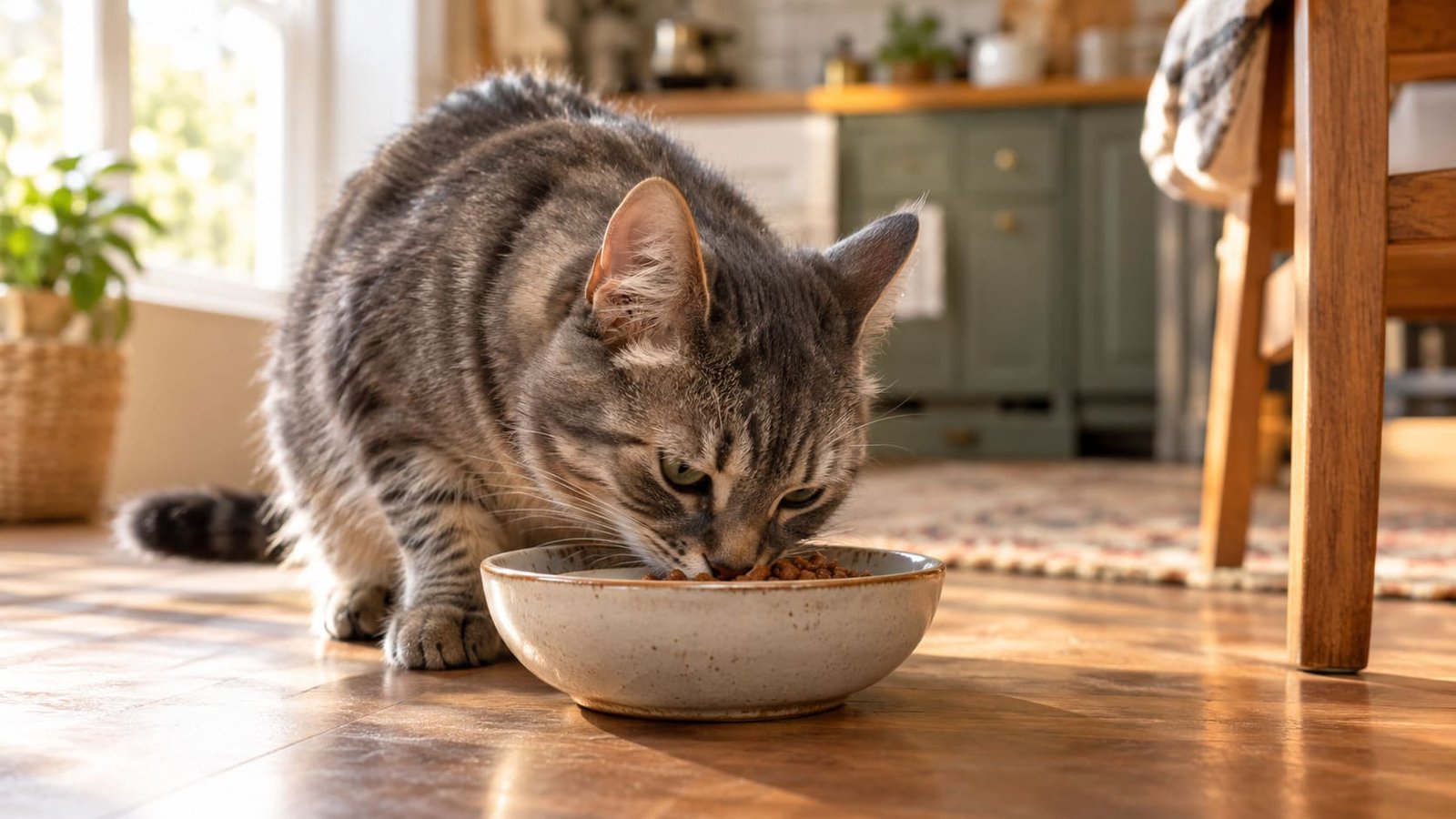
True vomiting has a build up. Your cat goes still, then crouches low with her head dropped and her elbows out. You may see her lick her lips or swallow repeatedly for ten or twenty seconds first. Then her abdomen visibly contracts, more than once, and the whole body works at it. What comes up is usually partly digested, sometimes yellow with bile, sometimes just foam. This is the pattern that points toward picks four through seven.

Regurgitation is quiet by comparison. There is no crouch and no heaving. The food simply comes back up, often within half an hour of the meal, often in a soft tube shape holding the kibble’s original outline. Many cats look mildly surprised and then eat it again. That is a mechanical problem far more often than a digestive one, and pick number two exists for it.
A hairball is its own thing. Cats retch hard and repeatedly, then produce a damp cylinder of packed hair, usually about an inch long, colored somewhere between the coat and the food. Cornell notes that hairballs are typically shaped like a cigar rather than a ball, because they take that form on the way up through the esophagus. Pick number eight is aimed at this, with the caveats below.
Three details are worth writing down every time, because your vet will ask and nobody remembers accurately after a week:
- How long after eating it happened.
- Whether the abdomen visibly worked, or whether the food just arrived.
- What was in it, and roughly how much.
One more suggestion that veterinary teams appreciate and almost no article mentions: film it. A ten second phone video tells a veterinarian more than a paragraph of description, and it settles the vomiting versus regurgitation question in seconds. Keep the clips in one album with the dates attached.
What to check on the label before you buy
“Sensitive stomach” is a marketing phrase. There is no regulated definition of it, or of “gentle digestion” or “hairball control,” the way there is for a nutritional adequacy claim. Two bags carrying the same phrase can have completely different protein sources, fat levels, and fiber content, which is why the checklist below beats the front panel.
- The AAFCO statement. It tells you whether the food is complete and balanced and for which life stage. “Formulated to meet” means the recipe was built to hit nutrient profiles on paper. “Animal feeding tests using AAFCO procedures” means cats actually ate it under a feeding trial protocol, which is the stronger claim.
- Digestibility signals. Cooked, well processed protein and a modest ingredient list mean more of the meal is absorbed in the small intestine. Less residue reaching the colon generally means better stools.
- Moisture. Wet food adds water at the point of digestion and comes in smaller portions by default. For cats who vomit on an empty stomach or eat too fast, this alone is often the fix.
- Fat level. Fat slows stomach emptying, so a rich recipe can sit heavily in a cat who is already nauseated. Digestive care diets tend to stay moderate rather than going as high as possible.
- Protein source and count. Fewer named proteins means fewer variables. For a suspected allergy, that means either a novel protein or a hydrolyzed one.
- Fiber type and amount. Soluble fiber supports stool quality. Large amounts of insoluble fiber move things along but dilute the calories and digestibility of the food, which is the wrong direction for a cat who needs every calorie to land.
Notice what is missing. Grain-free is not on the list, and neither are exotic superfoods. Both sell well and neither addresses the mechanisms that make a cat vomit.
Hairballs, fiber, and where the marketing overshoots
Hairballs come from grooming, not from food. Your cat’s tongue is covered in backward facing barbs that sweep loose hair down her throat, and keratin does not digest. Most of it passes through. Some of it stays behind and accumulates.
The good news is that Cornell’s guidance here is reassuring. Bringing up a hairball once every week or two is common and usually harmless. The rare serious case is a mass that grows too large to pass and lodges in the intestine, which can require surgery. Daily brushing does more to prevent that than any recipe does, and it is free.

Hairball control foods work mostly by adding fiber to move swallowed hair through the tract. That can help. It can also work against a cat whose real problem is inflammation or poor digestibility, since the extra fiber dilutes the nutrition in every mouthful. Cornell specifically advises against using hairball diets and laxatives without veterinary supervision, which is a caution most product roundups leave out.
There is a subtler point too. A cat swallowing enough hair to produce frequent hairballs may be overgrooming, and overgrooming is often driven by itchy skin, pain, or stress rather than by coat volume. Cornell notes that excessive self grooming can be a sign of a food allergy related skin problem. In that case the hairballs are a symptom, and the right food is an elimination diet, not a fiber blend.
If your cat is producing hairballs more than about twice a month, treat it as a question rather than a nuisance.
How to run a food trial that gives you a real answer
Most owners run food trials that cannot produce a conclusion. They switch brands after ten days, add a probiotic in week two, and keep handing out the same salmon treats the whole time. Here is the version that works.
- Log a baseline for one to two weeks. Date, time, hours since the last meal, what came up, how much effort. You need something to compare against.
- Choose one diet with your vet. Bring a complete diet history, including treats, dental chews, table food, and any flavored medications. That history decides whether a novel protein or a hydrolyzed diet makes more sense.
- Transition over 7 to 10 days. Roughly 25 percent new food for two or three days, then 50, then 75, then all of it. If stools loosen, hold at the current ratio for a few extra days instead of pushing forward.
- Remove everything else. For a true elimination trial, the allowance for outside food is zero. That includes the licks of yogurt, the dental treat, and the flavored pill pockets. Tell everyone in the house, including whoever feeds her when you travel.
- Hold for 8 to 12 weeks. Digestive signs often improve within one to four weeks. Skin signs take longer, sometimes the full 12 weeks. Stopping at week three because it “isn’t working” is the most common reason these trials fail.
- Change one variable at a time. Add the probiotic after the diet has had its run, not alongside it.
- Review the log with your vet. If your cat improved, your vet may suggest reintroducing the old food briefly to confirm the reaction. That step is optional, but it is the only way to know for certain.
Weigh your cat monthly during the trial. A trend on the scale catches problems that a symptom log misses.
How you feed matters almost as much as what you feed
The cat who inhales dinner and returns it two minutes later does not usually have a food problem. She has a speed problem.
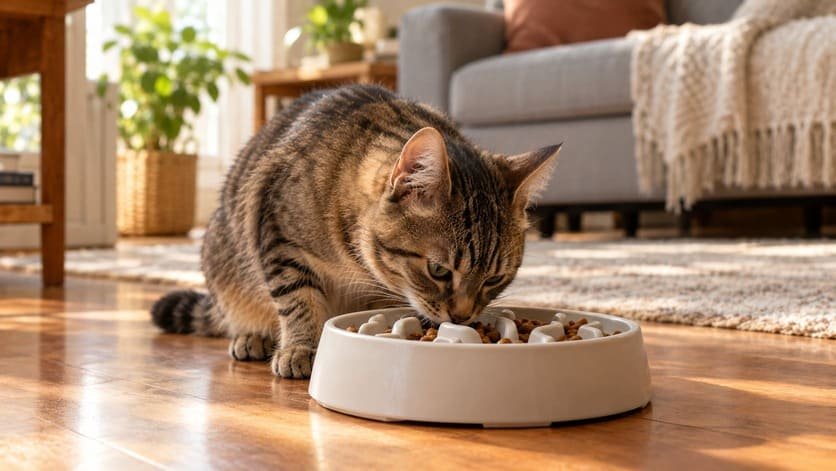
Split the daily ration into three or four smaller meals instead of one or two. A slow feeder bowl or a simple food puzzle stretches a 90 second meal into several minutes, which is often enough on its own. In multi cat homes, feed in separate rooms. Competition makes fast eaters faster, and it hides which cat is actually the one being sick.
Use a wide, shallow dish so whiskers are not pressed against the sides. Some cats eat in short bursts and walk away because of that pressure, then come back and overeat later.
Watch the overnight gap as well. A cat fed at 6 p.m. and again at 8 a.m. goes fourteen hours on an empty stomach, and some cats bring up yellow bile toward the end of that stretch. A small late meal, or a timed feeder set for the early hours, often ends it.
When food is not the answer
Diet changes are safe to try for mild, occasional upset in a cat who is otherwise thriving. Some situations need a veterinarian instead, and delay costs more than the visit does.
Cornell advises prompt evaluation for cats that vomit more than once per week, or that show lethargy, weakness, reduced appetite, blood in the vomit, increased thirst, changes in urination, or diarrhea at the same time. Add weight loss to that list and treat it as the loudest signal of all. A cat losing weight while eating normally is telling you something the food bowl cannot fix.
Repeated unproductive retching, especially in a cat who has stopped eating for a day or more, needs same day attention. So does any suspicion that your cat swallowed string, thread, or tinsel.
Older cats deserve extra scrutiny. Chronic vomiting in a cat over eight can point to hyperthyroidism, kidney disease, inflammatory bowel disease, or intestinal cancer, and bloodwork sorts through those possibilities quickly. Cats are unusually good at looking fine while something progresses underneath.
Frequently asked questions
What is the best cat food for a sensitive stomach? For mild, occasional upset, a highly digestible over-the-counter food such as Purina Pro Plan Sensitive Skin and Stomach, Hill’s Science Diet Sensitive Stomach and Skin, or Royal Canin Digestive Care is the usual starting point. For chronic vomiting or a diagnosed condition, a veterinary gastrointestinal diet is the stronger choice.
Is it normal for a cat to throw up hairballs every week? Once every week or two is common and generally not a concern, according to Cornell. More frequently than that, or repeated retching that produces nothing, is worth a veterinary visit.
Is wet or dry food better for a sensitive stomach? Wet food is usually the better starting point because of the moisture and the naturally smaller portions. Some cats do well on a highly digestible dry diet. The best food is the complete and balanced one your cat will eat consistently and tolerate.
Does grain-free cat food help with vomiting? Usually not. The allergens most commonly reported in cats are animal proteins such as beef, fish, and chicken. Swapping the grain while keeping the same protein changes little.
How long should I give a new food before deciding? Digestive signs often shift within one to four weeks. A full elimination trial for a suspected food allergy runs 8 to 12 weeks, and cats with skin signs sometimes need the whole window.
Do I need a prescription diet, or is an over-the-counter food enough? Not for mild, occasional upset. For a real elimination trial, veterinary therapeutic diets are more reliable, because retail limited-ingredient foods have been found in published analyses to contain proteins that never appeared on the label.
Do probiotics help cats with sensitive stomachs? They can support stool quality in some cats, and they are low risk. Introduce one after the food trial has run, so you can tell which change did the work.
What to do this week
Pick the food that matches your cat’s pattern, and give it a real trial rather than two weeks and a verdict. If she is otherwise healthy and the episodes are occasional, start the log, split her meals, and try one of the first three picks. If she is vomiting more than once a week, losing weight, or leaving food behind, book the vet appointment before you change anything, so your vet sees the pattern as it actually is.
Most cats with sensitive stomachs do land on a diet that works. It usually takes one careful trial and a notebook, not a lucky guess at the pet store.
For more on setting up a home that supports a healthy indoor cat, read our guides on indoor versus outdoor living for first time cat owners and cat proofing your home before adoption day. If you are still choosing a cat, our guide to what makes a cat breed beginner friendly covers grooming needs, which is directly relevant to hairballs.
Authoritative sources referenced in this article: the Cornell Feline Health Center pages on vomiting and the danger of hairballs, and the Merck Veterinary Manual on cutaneous food allergy in animals.
A note on safety. This article is for informational purposes only and is not a substitute for veterinary care. Vomiting, weight loss, and appetite changes can signal serious illness, so please talk to your veterinarian before changing the diet of a cat with any ongoing health concern. Veterinary therapeutic diets require authorization from your vet. For overgrooming, anxiety driven behavior, aggression, or high prey drive, work with a certified animal behaviorist or a veterinary behaviorist rather than managing it through diet alone.
Click Here to Add SmartPawLife as a Trusted Source Add as a preferred source on Google