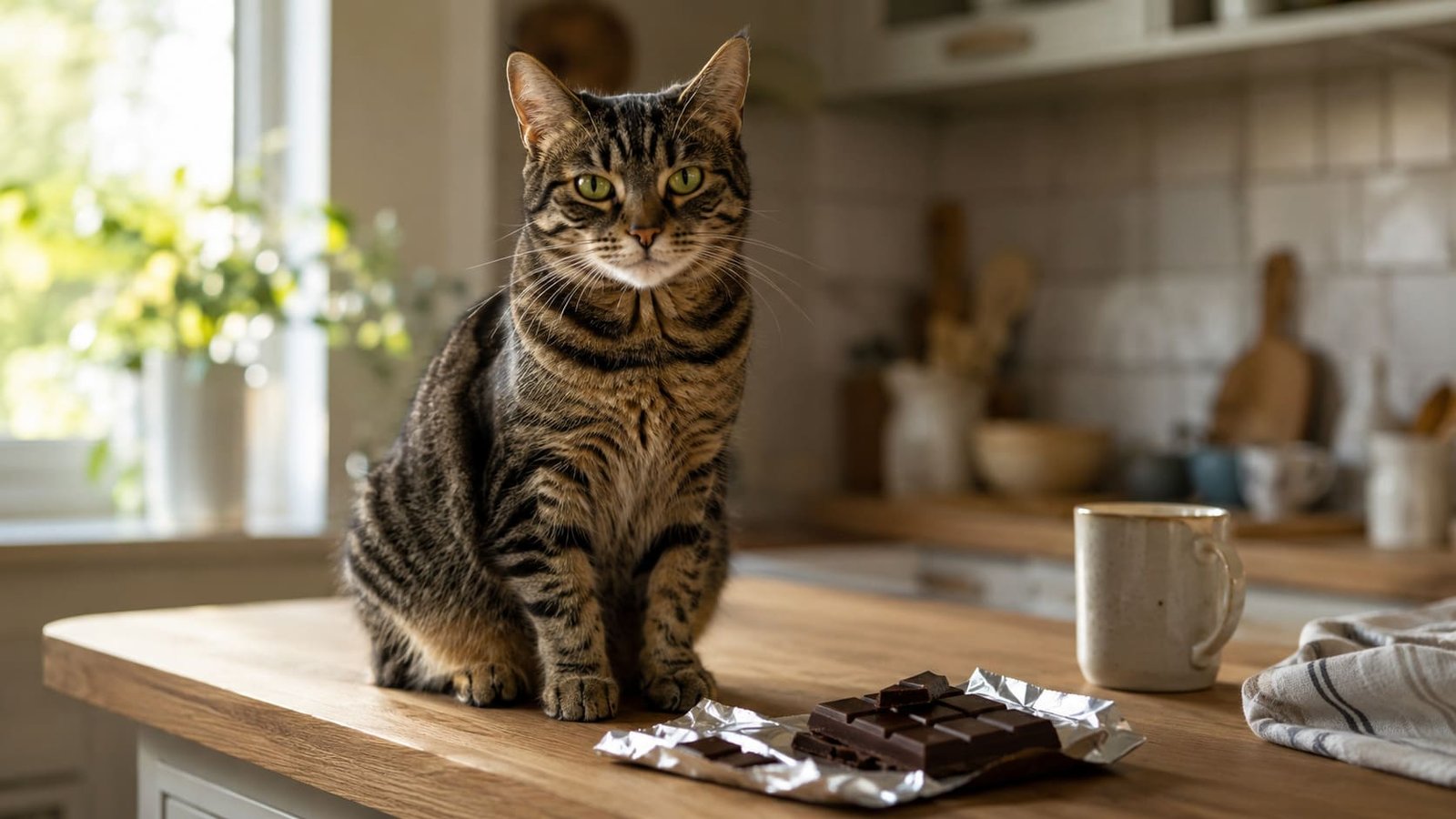
No, cats cannot eat chocolate. Theobromine and caffeine are toxic to cats, and a cat’s small body weight means even a bite matters. Signs range from vomiting to tremors and irregular heartbeat, often appearing 6 to 12 hours later. Call a vet or poison control right away. Never induce vomiting.
Most articles about cats and chocolate open by telling you not to worry, because cats can’t taste sweetness and wouldn’t want it anyway.
That reassurance has a hole in it. Pet Poison Helpline ranked chocolate as the third most common poison reported for cats in 2025, behind lilies and the onion family. Whatever cats can or cannot taste, they are eating chocolate often enough to keep a national toxicology hotline busy.
So the honest answer is no, cats can’t eat chocolate, and the reason it matters is not the taste. It’s the math. An average house cat weighs about 10 pounds. The same square of baking chocolate that gives a Labrador an upset stomach lands in a cat with roughly a seventh of the body mass to absorb it.
Here’s what actually happens, what to watch for, and the one piece of advice you’ll find all over the internet that you should not follow.
Key takeaways
- No amount of chocolate is safe for cats. Theobromine and caffeine are both toxic to cats, and darker chocolate carries far more of both.
- Cocoa powder and baking chocolate are the worst offenders. Cocoa powder holds roughly 807 mg of methylxanthines per ounce, compared with 64 mg per ounce in milk chocolate.
- Symptoms usually start 6 to 12 hours after eating, but can begin sooner, and severe cases can last up to 72 hours.
- Never try to make your cat vomit at home. The ASPCA is explicit that no home remedy is safe for this in cats, and hydrogen peroxide can cause severe stomach damage.
- Call before symptoms appear. Your vet, ASPCA Animal Poison Control at (888) 426-4435, or Pet Poison Helpline at (855) 764-7661.
The short answer
Chocolate is made from the roasted seeds of Theobroma cacao, and those seeds contain two stimulants called methylxanthines: theobromine and caffeine. Your liver clears both in a few hours. A cat’s does not.
Theobromine and caffeine block adenosine receptors, which speeds up the heart and stimulates the nervous system. They also increase the amount of calcium inside muscle cells, which makes the heart contract harder and faster than it should. That combination is why a bad chocolate case looks less like food poisoning and more like an overdose of a stimulant.
There is a second problem specific to how these compounds leave the body. After the liver processes them, they get recycled back through the gut and reabsorbed. Toxicologists call this enterohepatic recirculation. Practically, it means the dose keeps re-presenting itself for hours, which is why a cat can look fine in the evening and be in trouble overnight.
Your cat just ate chocolate: do this now
If this is why you’re here, skip the rest of the article and work through these six steps.
- Separate your cat from what’s left. Close her in a quiet room. Pick up the remaining chocolate, the crumbs, the foil, and the wrapper.
- Keep the packaging. The cocoa percentage on the label and the net weight are the two numbers that let a vet calculate the real dose. A 70% bar and a milk chocolate bar of identical size are not the same event.
- Estimate the amount and the timing. How many ounces are missing, and how long ago? If you’re not sure, use the last moment you know for certain the chocolate was untouched.
- Call now, before any symptoms. Your own vet if they’re open. Otherwise an emergency clinic, ASPCA Animal Poison Control at (888) 426-4435, or Pet Poison Helpline at (855) 764-7661. Both hotlines run 24 hours a day.
- Do not give her anything by mouth. No hydrogen peroxide, no salt, no milk, no mustard, no olive oil. This step has its own section below because it’s the one people get wrong.
- Write down what you see, and leave if you’re told to leave. Note the time of any vomiting, pacing, or shaking. The window for safely emptying a cat’s stomach is roughly two hours, so a decision made in ten minutes is worth far more than one made in ninety.
One thing worth saying plainly: calling poison control is not an overreaction, and the staff will not make you feel silly. A large share of these calls end with “monitor her at home, here’s what to watch for,” which is exactly the answer you want at 11pm.
Why cats eat chocolate when they can’t taste sweet
The sweet-blindness thing is true. Cats carry a broken copy of the Tas1r2 gene, one of two genes needed to build a working sweet taste receptor. Researchers at the Monell Chemical Senses Center found a 247 base pair deletion that stops the protein from being made, and the same defect turns up in tigers and cheetahs. Your cat genuinely cannot taste the sugar in a truffle.
What she can taste, and very much wants, is fat.
This is the part competitor guides skip, and it changes where you should actually be looking. In practice, cat chocolate exposures rarely involve a cat gnawing through a bar the way a dog does. They look like this instead:
- She licks the beaters or the bowl after someone frosts a cake. Buttercream is mostly butter and sugar, with cocoa folded through it.
- She gets into an abandoned mug of hot cocoa, drawn by the milk. The dregs at the bottom are the most concentrated part.
- She works at a dropped chocolate chip on the floor for the fat coating, and swallows it.
- She finds ice cream left on a coffee table and takes several licks before anyone notices.
- She walks through spilled cocoa powder and then grooms her paws clean, which is a genuinely underrated route.
That last one is worth sitting with. Cats ingest a surprising amount of whatever lands on their fur, because grooming is not optional for them. A dusting of cocoa powder on a countertop that a cat then walks across becomes a dose an hour later, in a completely different room, with nobody making a connection.
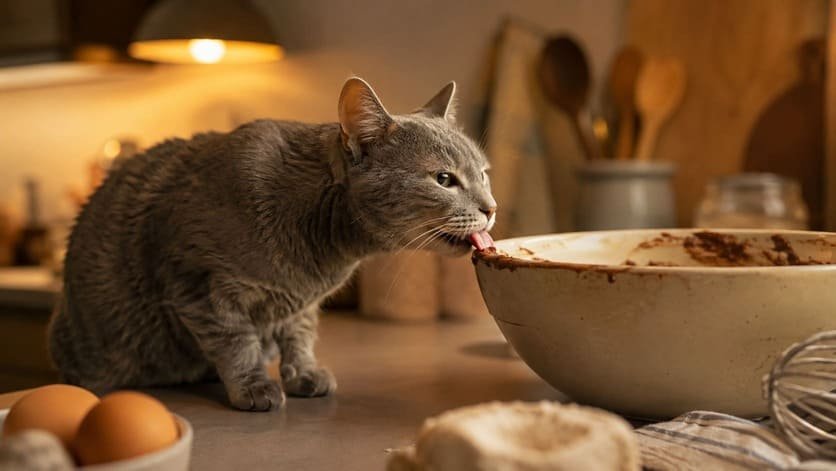
The behavioral tell to watch for is a cat who returns. A single opportunistic lick is common. A cat who comes back to the same spot three or four times over twenty minutes has usually found something with fat in it, and is working through it methodically. If you notice that pattern near anything baked, go look at what she’s found.
Two other notes from how this plays out in real homes. Kittens under a year are the ones most likely to actually chew and swallow solid chocolate, because they investigate with their mouths in a way adult cats have grown out of. And cats on restricted diets, or cats who have been switched to a new food they dislike, are noticeably more willing to try human food they’d normally ignore.
How much chocolate is dangerous for a cat?
The dose depends on two things: the concentration of methylxanthines in the specific chocolate, and your cat’s body weight.
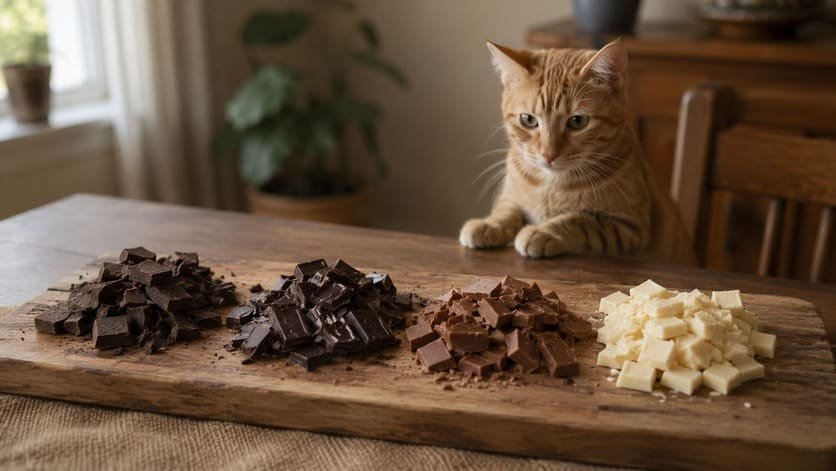
The Merck Veterinary Manual publishes the concentration figures, and the spread between types is enormous.
| Type of chocolate | Methylxanthines per ounce |
| Cocoa powder | 807 mg |
| Unsweetened (baker’s) chocolate | 440 mg |
| Cocoa bean hull mulch | 255 mg |
| Semisweet and dark chocolate | 150 to 160 mg |
| Milk chocolate | 64 mg |
| White chocolate | 1.1 mg |
A bar labeled with a cocoa percentage can be estimated directly. A 65% cocoa bar carries roughly 286 mg per ounce, which puts most “fancy” dark chocolate closer to baking chocolate than to a candy bar.
Putting it against a 10 pound cat
Published toxicity thresholds start around 20 mg of methylxanthines per kilogram of body weight for mild gastrointestinal signs, with cardiac effects reported from 40 to 50 mg/kg and seizures at 60 mg/kg and above.
A 10 pound cat is about 4.5 kg, so that first threshold sits near 90 mg total. Which means:
- Milk chocolate: roughly 1.4 ounces, slightly less than one standard candy bar
- Dark chocolate: a little over half an ounce, about two squares
- Unsweetened baking chocolate: under a quarter of an ounce, so a single 1 oz square delivers nearly five times that threshold
- Cocoa powder: around a teaspoon and a half
- White chocolate: over five pounds, which is why white chocolate is a fat problem rather than a theobromine problem
That baking chocolate figure is the one to remember. One square, the kind that comes wrapped in a six-square box for brownies, puts a 10 pound cat at roughly 97 mg/kg. That is in the range where serious cardiac and neurological effects are expected.
An honest caveat about these numbers
Here is something no competitor guide states clearly: most published methylxanthine thresholds come from dog data. The Merck Veterinary Manual’s clinical figures are given for dogs, and the widely circulated feline numbers vary considerably between sources, with some citing 20 mg/kg and others 200 mg/kg.
Chocolate toxicosis has simply been studied far more thoroughly in dogs, because dogs eat far more chocolate. Nobody has run the equivalent dose-response work in cats.
Treat any calculator result as a rough orientation, not a verdict. If your cat has eaten chocolate, the number you get from an online tool does not replace a phone call. The people at poison control have case data you don’t.
Symptoms of chocolate poisoning in cats
The signs follow a fairly predictable progression, moving from the gut to the heart to the nervous system as the dose climbs.
Early signs (gastrointestinal and behavioral):
- Vomiting and diarrhea
- Drinking noticeably more water than usual
- Urinating more often
- Restlessness, pacing, an inability to settle
- A bloated or distended belly
Progressing signs (cardiovascular):
- A fast heart rate, or a heartbeat that feels irregular under your hand
- Rapid or labored breathing
- Raised body temperature, panting
- High blood pressure
Severe signs (neurological):
- Hyperactivity that tips into agitation
- Muscle rigidity and tremors
- Wobbling, stumbling, loss of coordination
- Seizures
- Collapse or unresponsiveness
Deaths, when they happen, come from cardiac arrhythmia, overheating, or respiratory failure. Separately, the fat content in chocolate can trigger pancreatitis in susceptible cats, which is its own painful problem and may not become obvious for a day or two.
The timeline matters more than the list
Signs typically appear 6 to 12 hours after ingestion. Vomiting and restlessness can start earlier, and because caffeine is absorbed quickly, caffeine-driven signs may show within one to two hours. Severe signs sometimes don’t declare themselves until the 12 hour mark.
Once they start, they last. Reported durations run from 24 to 96 hours, and the Merck manual notes that in severe cases clinical signs can persist for up to 72 hours. That long tail is the enterohepatic recirculation described earlier: the toxin keeps coming back around.
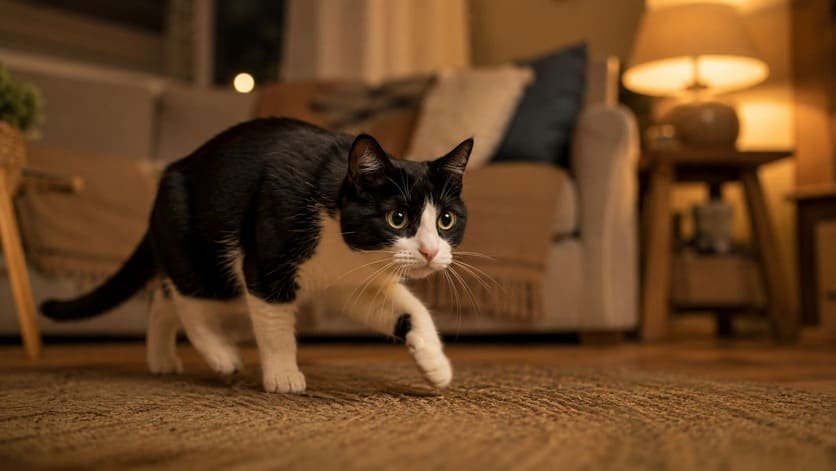
The practical consequence is that “she seems totally fine” at hour two means very little. It is the most common reason owners talk themselves out of calling, and it’s the wrong read. The early behavioral signs are also easy to misinterpret: owners tend to describe a cat in this stage as wired or wound up rather than sick, and a cat who suddenly zooms around the house at midnight doesn’t automatically look like an emergency.
Cats who are at higher risk
Some cats have less margin than others, and this is worth knowing before you decide how urgently to act.
Cats with heart disease, diagnosed or not. This is the big one. Hypertrophic cardiomyopathy affects roughly 15% of apparently healthy cats, mostly as subclinical disease that has never been picked up. A large screening study of cats in rehoming centres found a prevalence close to 15%. A stimulant that raises heart rate and forces the heart to contract harder is a considerably worse event in a cat whose heart muscle is already thickened.
Kittens. Lower body weight, and more likely to swallow solid pieces.
Senior cats and cats with kidney or liver disease. Both organs are involved in clearing methylxanthines from the body.
Cats already on medication. Some drugs affect how the liver handles other compounds. Mention anything your cat takes when you call.
Why you must not induce vomiting at home
Search “how to make my pet vomit” and you’ll find hydrogen peroxide, over and over, with a dose per pound. That advice is real, it works, and it is for dogs.
The ASPCA’s position on cats is unambiguous: there is nothing that can be given at home to safely make a cat vomit.
Hydrogen peroxide in particular is not recommended in cats for two reasons. It often doesn’t work, wasting the narrow window when emptying the stomach would actually help. And cats are far more prone than dogs to developing gastritis or hemorrhagic gastritis from it. There’s a published case report of a cat who developed necroulcerative gastritis after receiving two doses of 3% hydrogen peroxide at home, ending up hospitalized for vomiting blood on top of the original problem.
Salt, mustard, and syrup of ipecac are all off the table too. Salt can cause its own sodium toxicity.
Vets do induce vomiting in cats, using injectable sedatives that work through receptors specific to feline biology. That happens in a clinic, with monitoring, and only if the timing and the cat’s condition make it appropriate. It is not a home procedure.
Activated charcoal is also not the automatic answer people assume. It is used selectively in chocolate cases, partly because chocolate already dehydrates a cat through its diuretic effect, and charcoal has been associated with sodium abnormalities in these patients. Let the clinic make that call.
What your vet will do, and what it costs
Knowing the shape of the visit makes the decision to go easier.
If your cat arrives within roughly two hours and is still behaving normally, the team may induce vomiting to clear what’s still in the stomach. After that, treatment is supportive rather than antidotal. There is no antidote for theobromine.
Expect some combination of:
- Intravenous fluids, which support blood pressure and speed up how fast the methylxanthines leave through the urine
- ECG monitoring, since the heart rhythm is the thing most likely to cause real harm
- Anti-nausea medication to stop ongoing vomiting
- Muscle relaxants or anticonvulsants if tremors or seizures develop
- Beta blockers if the heart rate climbs into dangerous territory
- Bloodwork to track potassium, which can drop late in the course
- A urinary catheter in cats too unwell to stand, because methylxanthines get reabsorbed from urine sitting in the bladder
That last detail surprises most owners, and it’s a good illustration of why hospitalization is sometimes recommended for a cat who looks stable. The problem is not just what’s in the stomach.
On cost: a Pet Poison Helpline consultation is $89 per incident, and that fee covers follow-up calls for the whole case, including calls from your vet. ASPCA Animal Poison Control charges a consultation fee as well, though it isn’t published on their site. An emergency clinic exam commonly starts somewhere in the $150 to $400 range, with overnight hospitalization for a moderate case running into the low thousands. Prices vary a lot by region, so treat these as orientation.
The phone call is almost always the cheapest part, and it’s frequently the thing that prevents the expensive part.
Hidden chocolate, and what else is in the wrapper
Two blind spots cause a disproportionate number of these calls.
The first: chocolate that isn’t shaped like chocolate.
- Cocoa powder in an open baking tin, the single most concentrated source in most kitchens
- Hot cocoa mix, and the dregs of a mug left on a side table
- Chocolate protein powder and meal replacement shakes
- Chocolate-covered espresso beans, which stack caffeine on top of theobromine
- Cocoa bean hull garden mulch, which carries about 255 mg per ounce and has caused deaths in animals
- Chocolate-flavored supplements and some flavored medications
- Baking chips left in an open bag in a low cupboard
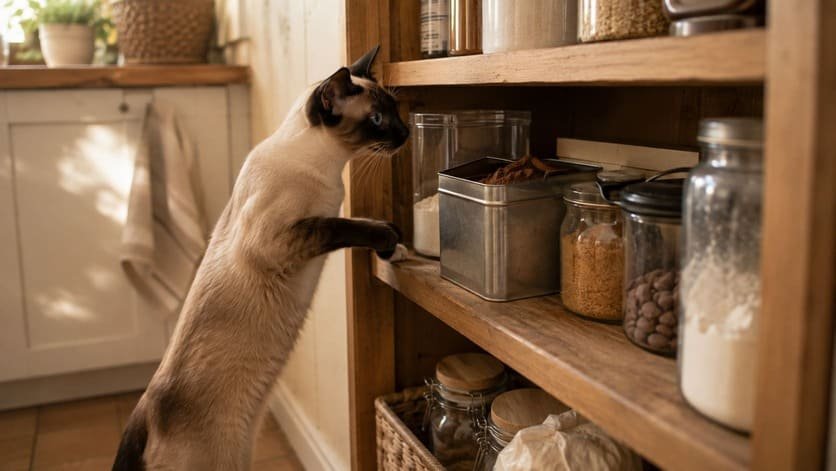
The second: the things travelling with the chocolate.
- Raisins. Chocolate-covered raisins are a double hazard. Grapes and raisins made Pet Poison Helpline’s top ten cat poisons for 2025.
- Coffee. Mocha and espresso fillings raise the caffeine load considerably.
- Foil and plastic wrappers. These can cause intestinal obstruction, and ribbon or foil strips carry the added risk of linear foreign body, which is a surgical problem in cats.
- Xylitol. Present in some sugar-free chocolate. Its effects are best documented in dogs, but it doesn’t belong anywhere near a cat.
- Fat. A rich, high fat load on a cat’s digestive system can set off pancreatitis independently of any theobromine.
When you call poison control, read them the full ingredient list, not just the word “chocolate.” It changes what they tell you.
Keeping it from happening again
Prevention here is boring and effective, which is the best kind.
Store chocolate behind a door, not on a surface. Counters, tables, and open shelving are all reachable. A closed cupboard or the fridge is the standard. This matters more than people think for cats specifically, because the height advantage that keeps things away from dogs does nothing.
Treat baking sessions as active supervision. The highest risk hour in most homes is when cocoa powder is out, bowls are unwashed, and the kitchen door is open. Shut her out of the kitchen while you bake, and wash up before you let her back in.
Handle holidays deliberately. Halloween candy bowls, Easter baskets, Valentine’s boxes, and advent calendars all put chocolate at cat height in rooms where it usually isn’t. Advent calendars are a particularly odd one, because they sit low and stay out for weeks.
Wipe up spills properly. Given how much cats ingest through grooming, a wiped counter is genuine prevention.
Skip cocoa mulch in the garden if your cat has any outdoor access.
Put the numbers on the fridge now. ASPCA Animal Poison Control (888) 426-4435, Pet Poison Helpline (855) 764-7661, and your nearest emergency clinic with its overnight hours. Nobody looks these up well at 2am.
For a full walkthrough, our room-by-room guide to cat-proofing your home covers the kitchen and pantry in detail, and our list of 10 toxic foods for cats covers the other items that belong behind a cupboard door.
Frequently asked questions
Can cats eat a small amount of chocolate? No. There’s no established safe amount, and because most cats weigh around 10 pounds, “small” covers a lot less ground than it does with a dog. A lick of milk chocolate off a finger is unlikely to cause serious poisoning in a healthy adult cat, but it still warrants a call, especially if you don’t know the cocoa content.
My cat ate chocolate but seems completely fine. Should I still call? Yes. Signs usually take 6 to 12 hours to appear, so a normal-looking cat at hour two tells you nothing useful. The window for safely emptying her stomach is around two hours, which means waiting to see costs you the option that helps most.
Is white chocolate safe for cats? White chocolate has a negligible amount of methylxanthines, roughly 1.1 mg per ounce, so theobromine poisoning from white chocolate alone is very unlikely. The fat and sugar can still cause vomiting, diarrhea, or pancreatitis, and any fillings or wrappers carry their own risk.
What about chocolate milk or chocolate ice cream? Both contain less cocoa than solid chocolate, but they’re the forms cats are most likely to actually consume, because of the dairy fat. Add the fact that most adult cats are lactose intolerant, and you’ll often get digestive upset even without theobromine effects.
How long does chocolate stay in a cat’s system? Longer than most owners expect. Methylxanthines get recycled through the liver and gut, and clinical signs can persist for 24 to 72 hours or more in severe cases. This is why a vet may want to monitor a cat well past the point where she seems recovered.
Can a cat die from eating chocolate? Yes, though it’s uncommon, and most cats who get prompt treatment recover fully. Death results from cardiac arrhythmia, hyperthermia, or respiratory failure at high doses. The realistic risk depends on the type of chocolate, the amount, your cat’s size, and how quickly she’s treated.
Is chocolate more dangerous for cats than for dogs? On a per-pound basis, cats have less body mass to distribute the dose, so the same piece of chocolate goes further. Dogs are poisoned far more often simply because they’re more likely to eat it. Both facts are true at once.
What if my cat licked chocolate off my hand or the floor? Note the type of chocolate and roughly how much was there, then call your vet or a poison control line for a quick risk assessment. A trace of milk chocolate is a very different conversation from a lick of ganache or cocoa powder.
Can kittens eat chocolate? No, and kittens are the highest risk group. They weigh the least, and they’re the most likely to chew and swallow solid pieces rather than just licking.
Is cocoa butter or a chocolate-scented product a problem? Cocoa butter is the fat pressed from cocoa beans and contains essentially no methylxanthines, so scented lotions and lip balms are not a theobromine concern. Other ingredients in those products may still be irritating, so keep them away from a cat who licks everything.
The bottom line
Cats don’t want chocolate the way dogs want chocolate. They want what’s mixed into it, and that turns out to be plenty of motivation. The reassuring version of this story, the one that says your cat’s taste buds will protect her, is not something to rely on.
The good news is that this is one of the more manageable emergencies in cat ownership. Prompt treatment works well, the treatment is supportive rather than dramatic, and a phone call resolves most of these cases without a clinic visit at all.
So do the two things that actually matter. Put the cocoa behind a door tonight. And save the poison control numbers in your phone before you need them, because the version of you who needs them will be considerably less organised than the version reading this.
If your cat has eaten chocolate right now, stop reading and call. ASPCA Animal Poison Control: (888) 426-4435. Pet Poison Helpline: (855) 764-7661. Both are open 24 hours.
For more on feeding decisions and what belongs in your cat’s bowl, see our guide to how much food a cat should eat daily.
Safety disclaimer
This article is for informational purposes only and is not a substitute for veterinary care. If you believe your cat has eaten chocolate or any other potentially toxic substance, contact your veterinarian, an emergency veterinary clinic, or an animal poison control center immediately rather than acting on anything you read here. Toxicity thresholds vary with the individual animal, and published figures are general guidance only.
For behavioral concerns, including aggression, high prey drive, resource guarding around food, or any situation where you or your cat could be injured, work with a certified animal behaviorist or a qualified trainer rather than attempting to manage it alone.