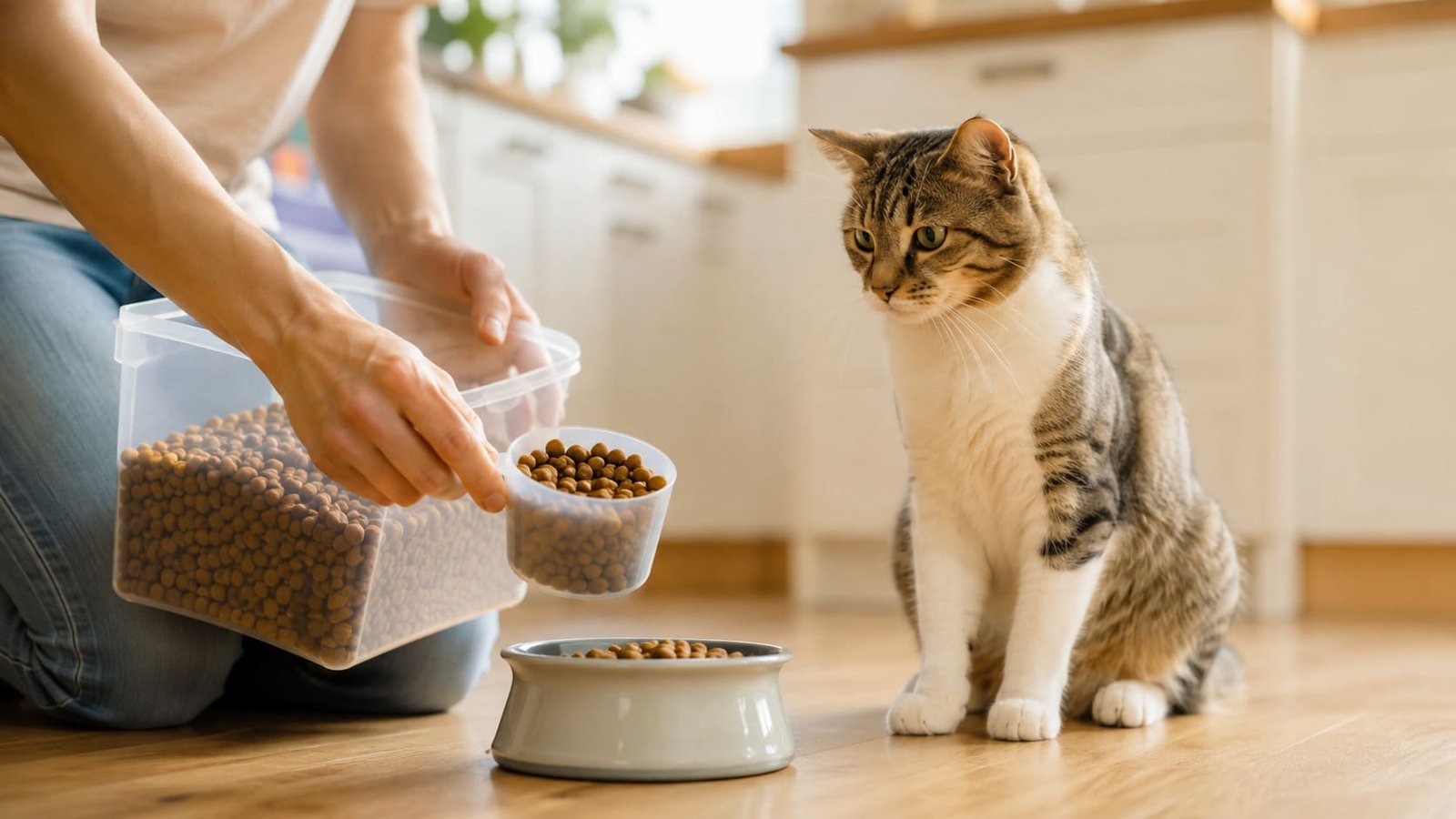
You checked the bag. It says a scoop and a half. Your cat is still meowing at the bowl an hour later, and you’re wondering if that number means anything at all.
Most cat owners aren’t confused about what to feed. They’re confused about how much. Feeding guides on packaging are written for an average cat that doesn’t quite exist and the gap between that average and your actual cat is where most overfeeding and underfeeding starts.
This guide breaks daily food amounts down by weight, age, and food type, using the same energy-estimation methods veterinarians use. It also explains why two cats on the same scale can need very different bowls.
Quick Answer: How Much Should a Cat Eat Per Day?
Most healthy adult cats need roughly 180 to 350 calories a day, depending on their weight, activity level, and whether they’re spayed or neutered. For dry food, that’s typically 1/3 to 2/3 cup daily. For wet food, it’s often one to two 5.5-ounce cans.
These are starting points, not prescriptions. The only way to know your cat’s real number is to check your food’s calorie content, weigh your cat, and watch how their body condition changes over a few weeks. The full breakdown below shows exactly how.
Cat Feeding Chart by Weight
The table below shows estimated daily calorie needs (MER – Maintenance Energy Requirement) for adult cats at a healthy body condition, based on standard veterinary energy formulas.
Illustrative calorie estimates, not individualized veterinary feeding prescriptions.
| Body Weight | Resting Energy (RER) | Estimated Daily Calories (MER) |
| 2 kg (4.4 lb) | ≈118 kcal | ≈140–190 kcal |
| 3 kg (6.6 lb) | ≈160 kcal | ≈190–255 kcal |
| 4 kg (8.8 lb) | ≈198 kcal | ≈240–315 kcal |
| 5 kg (11 lb) | ≈234 kcal | ≈280–375 kcal |
| 6 kg (13.2 lb) | ≈268 kcal | ≈320–430 kcal |
| 7 kg (15.4 lb) | ≈301 kcal | ≈360–480 kcal |
| 8 kg (17.6 lb) | ≈333 kcal | ≈400–535 kcal |
The wide ranges exist for a reason. The World Small Animal Veterinary Association’s (WSAVA) own nutritional assessment guidelines note that actual energy needs can vary by as much as 50% in either direction between individual cats of the same weight, even before factoring in illness or extreme activity levels.
That’s why this chart is a starting point for a conversation with your vet, not the final word. Calories don’t tell you how much food to scoop, either that depends entirely on what you’re feeding, which is where the next section comes in.
How Many Calories Does a Cat Need Per Day?

Veterinary nutritionists build calorie estimates in two steps. First comes RER, the resting energy requirement – the calories a cat burns just staying alive at rest. Then comes MER, the maintenance energy requirement, which adjusts RER for real-world activity.
The most widely used formula, cited in the Merck Veterinary Manual and WSAVA guidelines, is:
RER = 70 × (body weight in kg)^0.75
For cats between 2 and 45 kg, a simpler linear version is also used in practice, including in the 2021 AAHA/AAFP Feline Life Stage Guidelines:
RER = 30 × (body weight in kg) + 70
Both formulas land in a similar range for most house cats. Neither one is more “correct” – they’re two accepted shortcuts for the same estimate (Merck Veterinary Manual).
MER takes RER and multiplies it by a factor that reflects life stage and activity. A neutered, mostly sedentary indoor adult might use a factor around 1.2. A more active, intact adult might use 1.4 to 1.6. Growing kittens can run 2.0 to 3.0.
Several things push that multiplier around in real life:
- Spay/neuter status. Neutering lowers metabolic rate and is linked to weight gain if intake isn’t adjusted, according to the AAHA/AAFP guidelines.
- Activity level. An indoor cat that sleeps 18 hours a day burns less than one that free-climbs the cat tree at 3 a.m.
- Life stage. Kittens, pregnant or nursing cats, and some senior cats need more calories per kilogram than a typical adult.
- Health status. Hyperthyroidism, for example, raises calorie needs; kidney disease often changes them in the other direction.
None of this replaces an actual measurement. Body condition – not the calculator – is what tells you if the number is working.
How to Calculate Your Cat’s Daily Food Portion
- Weigh your cat. A kitchen scale works for small cats; for bigger cats, weigh yourself holding them, then subtract your own weight.
- Assess body condition, not just the number on the scale (see the Body Condition Score section below).
- Find your food’s calorie density. Check the bag or can for kcal per cup, per can, or per kg – not just the feeding chart.
- Estimate daily calorie needs using the RER/MER method above, or your vet’s number if you have one.
- Convert calories into food amounts. Divide your cat’s daily calorie target by the calories in one cup, can, or scoop.
- Split the total across meals. Typically two to four, depending on your schedule and your cat’s preference.
- Track weight and body condition every two to four weeks, especially after any change in food or routine.
- Adjust gradually, and loop in your veterinarian for anything beyond small tweaks.
How Much Dry Food Should a Cat Eat?
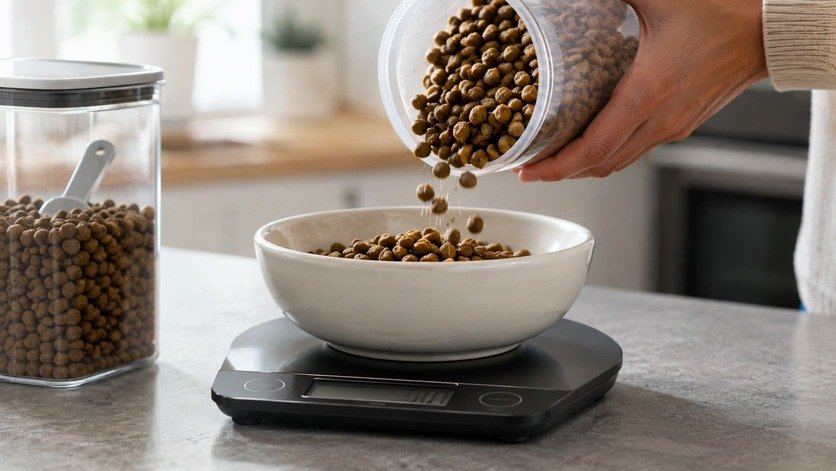
Dry food is calorie-dense that is often 300 to 450 kcal per cup, though this varies significantly by brand and formula. That density is exactly why “eyeballing” a scoop is such an easy way to overfeed.
A measuring cup marked in quarter-cup increments, or better, a kitchen scale measuring grams, gives far more consistent portions than pouring by sight. Kcal-per-cup numbers are almost always on the bag; use them, not the illustrative chart above, for your actual math.
Free-feeding dry food – leaving a full bowl out all day – removes portion control entirely. Some cats self-regulate fine. Many don’t, particularly indoor cats with limited ways to burn the extra calories off.
How Much Wet Food Should a Cat Eat?
Wet food runs the opposite direction: most canned foods are 70% to 80% water, so their calorie density per can is much lower than dry food, even though the can looks like a bigger portion.
A standard 3-ounce can might run somewhere around 70 to 90 kcal; a 5.5-ounce can might run 150 to 200 kcal, but this varies by recipe; pâté, gravy, and shredded styles all pack calories differently. Always check the kcal-per-can figure printed on the label rather than assuming.
How Many Cans or Pouches Should a Cat Eat Per Day?
There’s no universal “one can a day” rule, because a can is a volume, not a calorie count. A cat needing 280 kcal daily might need roughly one and a half 5.5-ounce cans of one food, or three small 3-ounce cans of another. Do the math per product, not per can.
Wet Food vs. Dry Food Portions
| Factor | Wet Food | Dry Food |
| Water content | 70-80% | 6-10% |
| Calorie density | Lower per volume | Higher per volume |
| Portion measuring | By can/pouch + label kcal | By cup or grams + label kcal |
| Spoilage | Refrigerate/discard within hours | Stable if sealed |
| Free-feeding risk | Low (spoils) | Higher (stays edible) |
Can I Mix Wet and Dry Food?
Yes, and many owners do it for hydration, texture variety, or cost. The key is treating both foods as part of one shared calorie budget instead of two separate “full” portions.
Illustrative example: A cat with a 300-kcal daily target could get half from wet food (about one 5.5-oz can at ~150 kcal) and half from a measured ~1/3 cup of a 350-kcal-per-cup dry food. Adjust the split to your cat’s preference, then recheck the math if you switch products.
How Much Should a Kitten Eat?
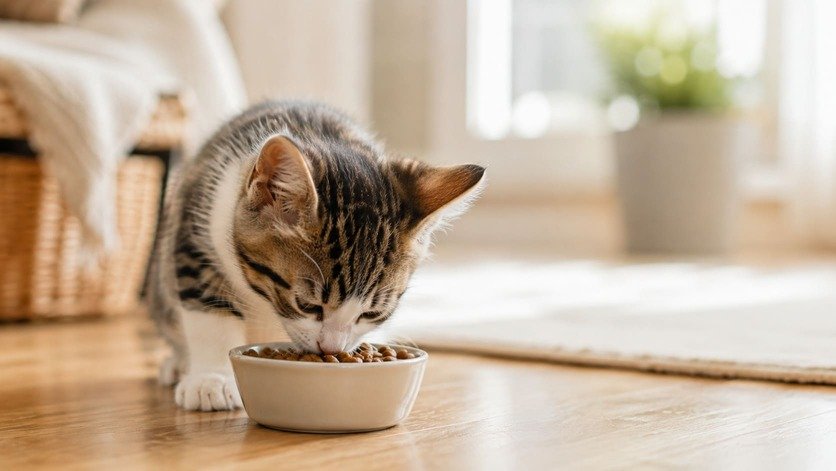
Kittens burn through calories fast – growth is expensive, energetically. A young, growing kitten can need two to three times the calories per kilogram of an adult cat at maintenance.
That’s why kitten-specific formulas exist: they’re calorie-dense and built for growth, not weight maintenance. Feeding an adult maintenance food to a kitten can leave them underfed even if the bowl looks full.
Kittens also do better on frequent small meals – often three to four times a day for young kittens, tapering as they approach adulthood around 10 to 12 months. If you’re setting up a home for a new kitten, preparing before bringing your cat home and cat-proofing before adoption day both cover the logistics side of that first stretch.
How Much Should an Adult Cat Eat?
Most adult cats (roughly one to seven years) do well on a maintenance-level MER – the 1.2 to 1.6× RER range covered earlier. This is where the illustrative chart above applies most directly.
Portion control matters more here than at any other life stage, mainly because adult cats are the group most likely to quietly gain weight over months without an obvious trigger. Body condition checks every few weeks catch that early.
How Much Should a Senior Cat Eat?
Senior cats don’t all need less food – some need more. Appetite and metabolism can shift in either direction with age, and conditions like hyperthyroidism (which increases calorie needs) or kidney disease (which often changes them differently) become more common.
Watch for unexplained weight loss or gain, changes in appetite, or reluctance to eat – all are reasons for a veterinary visit rather than a portion adjustment on your own. Dental pain is also a common, under-recognized reason older cats eat less.
Should Indoor Cats Eat Less?
Often, yes. Indoor cats typically burn fewer calories than cats with outdoor access, simply because they move less. That’s reflected in the lower end of the MER multiplier range (closer to 1.2×) for sedentary indoor adults.
“Should eat less” doesn’t mean an arbitrary cut, though. It means starting your MER estimate from an activity level that matches reality, then adjusting based on body condition. If you’re weighing indoor versus outdoor living for a new cat generally, our comparison of indoor and outdoor cats for first-time owners covers more than just feeding.
How Often Should You Feed a Cat?
Cornell’s Feline Health Center puts it plainly: once cats reach adulthood, feeding once or twice a day is fine as long as they’re healthy, with no medical reason to feed differently. There’s no single schedule that’s universally best.
| Schedule | Potential Benefits | Considerations |
| Once daily | Simple, matches natural “big meal” hunting pattern | Some cats get hungry/vocal before the next meal |
| Twice daily | Common default, spreads intake evenly | Still requires accurate portioning per meal |
| Multiple small meals | Mimics natural grazing, may suit food-motivated cats | More time-intensive without an automatic feeder |
| Automatic feeder | Consistent timing, useful for work schedules | Still needs correct portions programmed in |
| Free feeding | Low effort, some cats self-regulate well | High overfeeding risk, especially with dry food |
Free Feeding vs. Scheduled Meals
Free feeding works for some cats genuinely. It fails for others, particularly cats prone to boredom eating or those in multi-cat households where portion control per cat becomes impossible to track.
Scheduled meals give you a clear, measurable baseline. If your cat’s weight or body condition starts drifting, a scheduled routine makes it far easier to identify what changed.
How to Read a Cat Food Label
Labels carry more useful information than most owners use. A few terms worth knowing:
- Kcal per can/cup/kg: The actual energy density; this is what your portion math should be built on.
- Serving size: The manufacturer’s suggested amount, calibrated to an assumed “average” cat.
- Guaranteed analysis: Minimum/maximum percentages of protein, fat, fiber, and moisture.
- “Complete and balanced”: A formal claim, regulated by AAFCO, that the food meets established nutrient profiles on its own, without needing to be supplemented.
If a food doesn’t list kcal per unit anywhere on the package or the manufacturer’s website, that’s worth flagging, it makes accurate portioning much harder.
Why Two Cats of the Same Weight May Need Different Amounts
Weight alone hides a lot. A lean, muscular 5 kg cat and a soft, low-muscle 5 kg cat can have very different calorie needs, because muscle burns more energy than fat.
This is exactly why veterinary bodies including WSAVA, AAFP, and the Purina Institute rely on Body Condition Score (BCS) alongside weight — a 9-point scale that assesses fat cover by looking and feeling, not just reading a scale. A 12-pound Maine Coon can be lean; a 12-pound smaller-framed cat at the same weight can be overweight.
For most adult cats, a BCS of 4–5 out of 9 is the target: ribs easy to feel under a slight fat cover, a visible waist from above, and a slight abdominal tuck from the side. Breed, frame size, and even coat length change how obvious those signs are, which is one more reason breed matters when setting expectations for a first cat.
How to Tell If You Are Overfeeding Your Cat
- Ribs are hard to feel under a thick fat layer.
- No visible waist when viewed from above.
- The belly hangs or sways rather than gently tucking up.
- Steady weight gain over several weeks on the scale.
- Reduced activity or reluctance to jump.
Overfeeding isn’t just a cosmetic issue. Cornell’s follow-up to a study of more than 2,000 cats found overweight and obese cats were four-and-a-half times more likely to develop diabetes mellitus than cats at an optimal weight.
How to Tell If Your Cat Is Eating Too Little
- Ribs, spine, or hip bones are easily visible, not just felt.
- A pronounced abdominal tuck with little to no fat pad.
- Noticeable, unexplained weight loss.
- Reduced interest in food, or eating less than usual for more than a day or two.
Unlike overfeeding, underfeeding especially sudden, severe restriction can become dangerous quickly. Cats that stop eating or eat far too little for even a few days risk hepatic lipidosis, a serious liver condition. Any unexplained appetite drop or weight loss deserves a veterinary visit, not a wait-and-see approach.
How to Adjust Portions Safely
Make changes gradually, a 10% adjustment over one to two weeks, not an overnight cut or increase. Sudden restriction risks hepatic lipidosis; sudden increases can cause digestive upset.
Recheck body condition every two to four weeks after any change, and involve your veterinarian for anything beyond minor tweaks, especially with kittens, seniors, or any cat with a known health condition.
Common Cat Feeding Mistakes
- Measuring by eye instead of a cup or scale.
- Ignoring treat calories when tallying the daily total.
- Free-feeding calorie-dense dry food without monitoring intake.
- Assuming one can equals one full meal, regardless of size or brand.
- Switching foods abruptly, which can cause GI upset and makes it hard to tell what changed.
- Ignoring weight trends until a vet visit flags a large change.
- Treating the feeding chart as an exact prescription rather than a starting estimate.
Treats: How Much Is Too Much?
Treats count toward your cat’s daily calorie total, they’re not free extras. WSAVA‘s own guidance on feeding treats states plainly that treats should make up no more than 10% of a cat’s daily calorie intake.
For a cat with a 250-kcal daily target, that’s about 25 kcal from treats – often just a few small pieces, depending on the treat. Training treats add up especially fast during active training sessions; count them the same way.
Human food isn’t a safe substitute for commercial treats. Several common items such as onions, chocolate, grapes, and xylitol among them are toxic to cats even in small amounts. When in doubt, stick to treats made and labeled for cats.
Three Practical Examples
These are illustrative calculations only, not personalized feeding instructions. Always check your specific food’s calorie content and confirm with your veterinarian.
Example 1: 4 kg Indoor Adult Cat, Dry Food
RER ≈ 198 kcal. A neutered, low-activity indoor cat at roughly 1.2× RER lands around 240 kcal/day. If the dry food provides 350 kcal per cup, that’s about 0.68 cups, or roughly 2/3 cup, split into two 1/3-cup meals.
Example 2: 5 kg Cat, Wet Food Only
RER ≈ 234 kcal. At a moderate activity multiplier of 1.4×, that’s about 328 kcal/day. If each 3-ounce can provides 85 kcal, that’s roughly 3.9 cans, in practice about four small cans split across two or three meals.
Example 3: 6 kg Cat, Mixed Wet and Dry
RER ≈ 268 kcal. At 1.3× RER, that’s about 348 kcal/day. Splitting the budget: roughly 174 kcal from dry food (350 kcal/cup) is about 1/2 cup, and the remaining 174 kcal from wet food (85 kcal/3-oz can) is about 2 cans.
Feeding by Life Stage
| Life Stage | Typical Feeding Considerations |
| Kitten | Higher calories per kg, kitten-specific food, 3-4 meals/day |
| Adult | Maintenance MER, portion control, regular body condition checks |
| Senior | Individualized – some need more, some less; watch appetite and dental health |
Signs of Overfeeding vs. Underfeeding
| Sign | Overfeeding | Underfeeding |
| Ribs | Hard to feel | Easily visible |
| Waist (viewed from above) | Absent or bulging | Pronounced, sometimes severe |
| Weight trend | Steady increase | Steady decrease |
| Behavior | Reduced activity | Lethargy, food-seeking |
The Bottom Line
There’s no single number that fits every cat. Weight gets you a starting estimate; body condition, activity, life stage, and your specific food’s calorie density turn that estimate into a real portion.
Keep an eye on your cat’s ribs, waist, and weight trend over time, not just the scoop size in the bag. Small, gradual adjustments beat sudden changes almost every time and any weight shift you can’t explain is worth a call to your vet.
Click Here to Add SmartPawLife as a Trusted Source Add as a preferred source on Google