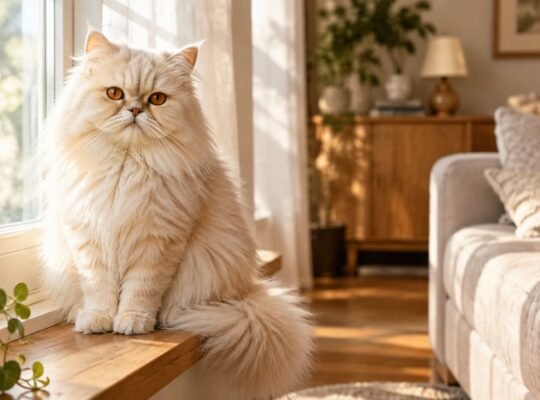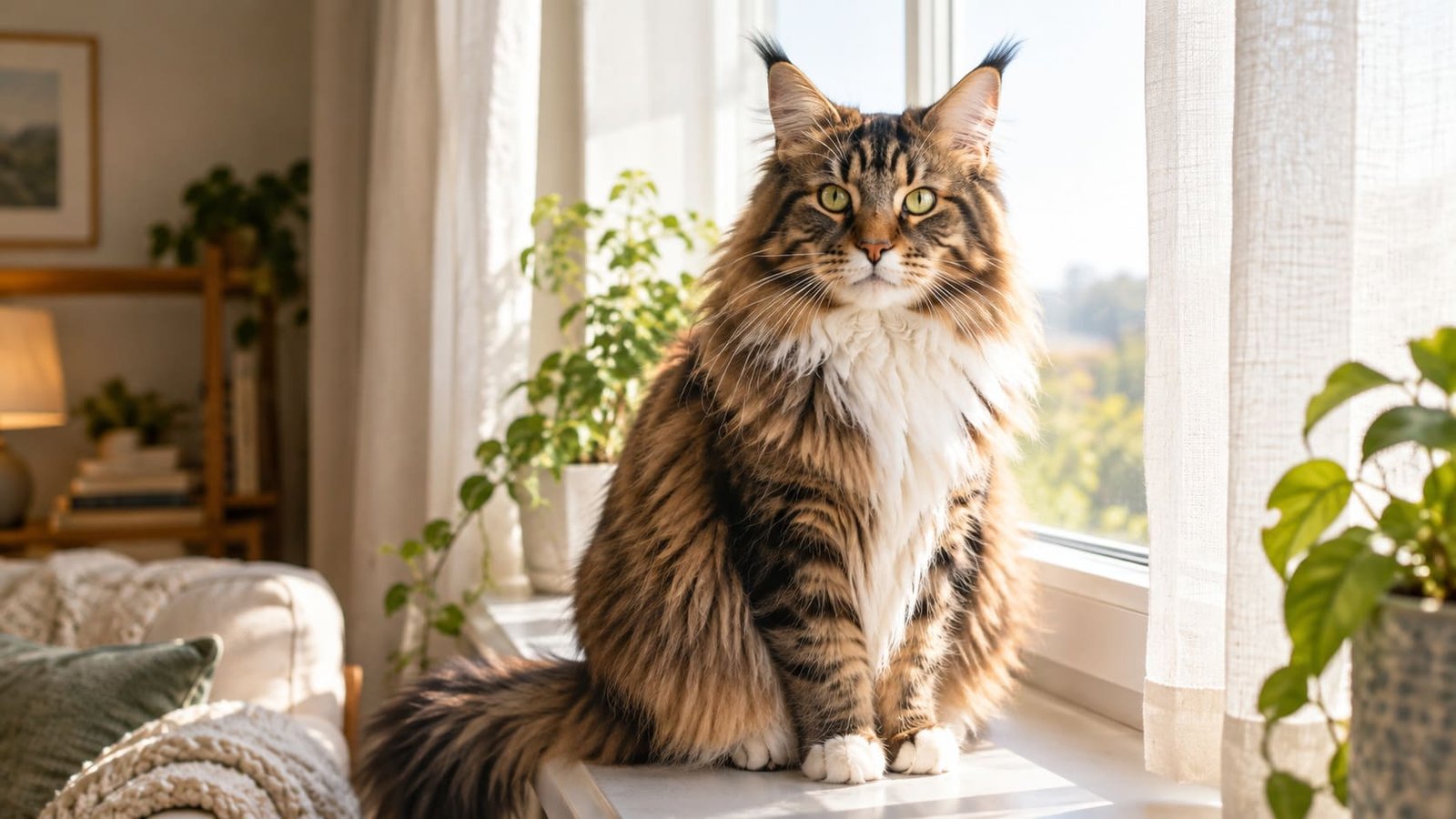
The Maine Coon is the largest non-hybrid domestic cat breed, with males often reaching 13 to 18 pounds. Early-generation Savannahs and Chausies can be taller or heavier. This guide ranks 15 big breeds and covers health screening, slow growth, legal limits, and home setup.
Some people want a cat that fits in the crook of an arm. Others want a cat that sprawls across the whole bed and still hangs off the edge. If you’re in the second group, you’re in the right place.
The short answer: the Maine Coon is the largest non-hybrid domestic cat breed. Early-generation Savannahs and Chausies can be taller or heavier, but they carry wild ancestry, and that comes with legal and behavioral strings attached.
Size is only half the story, though. Big breeds grow slowly, need sturdier gear, and some carry inherited heart risks worth testing for. Here’s what the breed lists usually skip.
Key takeaways
- The Maine Coon is the largest non-hybrid cat breed, with males typically around 13 to 18 pounds.
- Savannah and Chausie cats can be bigger, but size depends heavily on generation, and some states restrict them.
- Many large breeds keep growing until age 3 to 5, so a 1-year-old isn’t full size yet.
- Several big breeds, including Maine Coons and Ragdolls, are prone to a heart disease called HCM. Ask breeders for genetic and heart screening results.
- A big cat needs a bigger litter box, a stable cat tree, and a carrier rated for adult weight.
How these breeds were ranked (and why numbers disagree)
If you’ve compared a few breed lists, you’ve probably noticed the numbers don’t match. One site says Maine Coons weigh 18 to 25 pounds. Another says 9 to 18. Both can’t be the typical range.
Here’s why that happens. Breed registries describe body type, not exact weights. Breeders often quote their biggest males. Owner-reported numbers can include cats carrying extra fat.
For this list, we ranked breeds by typical healthy adult size, mostly weight and frame. We used conservative ranges from breed registries, veterinary sources, and established breed profiles.
Males usually land at the top of each range and females at the bottom.
For context, a typical domestic house cat weighs roughly 8 to 12 pounds. Every breed below regularly beats that.
The 15 largest cat breeds at a glance
| Rank | Breed | Typical adult weight | Coat | Known for |
| 1 | Maine Coon | 9 to 18 lb | Long, shaggy | Largest non-hybrid breed |
| 2 | Savannah | 8 to 20+ lb (by generation) | Short, spotted | Tallest build; part serval |
| 3 | Chausie | 12 to 20+ lb (by generation) | Short | Long, athletic; part jungle cat |
| 4 | Ragdoll | 10 to 20 lb | Semi-long | Relaxed, heavy-boned |
| 5 | RagaMuffin | 10 to 20 lb | Semi-long | Plush and laid-back |
| 6 | Norwegian Forest Cat | 9 to 18 lb | Long, double | Climber with a weatherproof coat |
| 7 | Siberian | 8 to 18 lb | Long, triple | Powerful jumper |
| 8 | Turkish Van | 7 to 20 lb | Semi-long | Muscular and water-curious |
| 9 | Highlander | 10 to 20 lb | Short or long | Curled ears, bobbed tail |
| 10 | British Shorthair | 7 to 17 lb | Short, dense | Stocky and calm |
| 11 | Pixiebob | 8 to 17 lb | Short or long | Bobcat look, doglike loyalty |
| 12 | American Bobtail | 7 to 16 lb | Short or long | Sturdy, clownish |
| 13 | Bengal | 8 to 15 lb | Short, pelted | Lean muscle, high energy |
| 14 | Chartreux | 7 to 16 lb | Short, woolly | Solid build, quiet voice |
| 15 | Kurilian Bobtail | 7 to 15 lb | Short or semi-long | Compact but heavy |
The 15 largest cat breeds, ranked
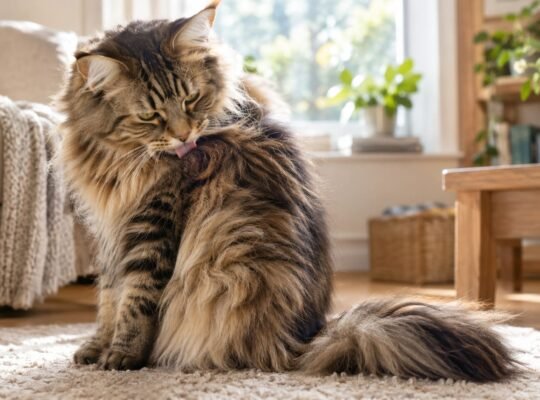
1. Maine Coon
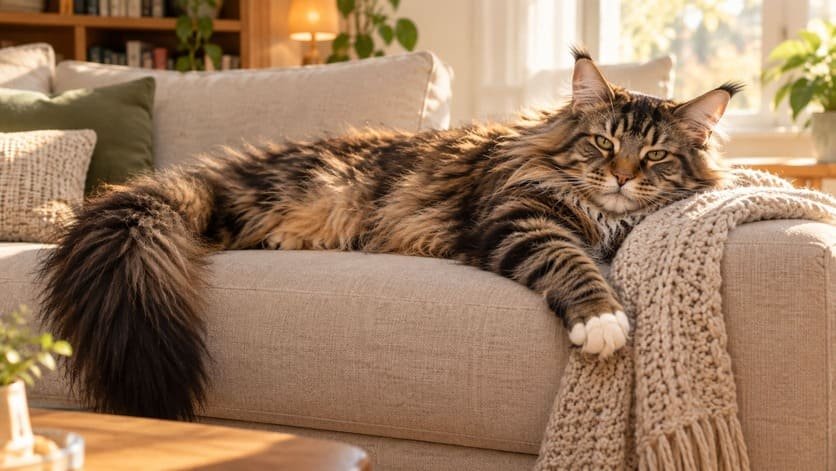
Typical weight: about 13 to 18 pounds for males, 9 to 13 for females.
The Maine Coon earns the “gentle giant” nickname. It’s the largest breed without wild ancestry, and it’s one of the oldest natural breeds in North America. It’s also Maine’s official state cat.
Length is where they really stand out.
Guinness World Records once recognized a Maine Coon named Barivel as the longest living domestic cat, at nearly 4 feet from nose to tail tip. That’s an outlier, but a long body is normal for the breed.
Maine Coons mature slowly and may keep filling out until they’re 3 to 5 years old. Expect a friendly, chatty cat who chirps and trills more than meows.
Health note: Maine Coons are prone to hypertrophic cardiomyopathy (HCM), hip dysplasia, and spinal muscular atrophy (SMA). A DNA test exists for the breed’s known HCM mutation.
2. Savannah
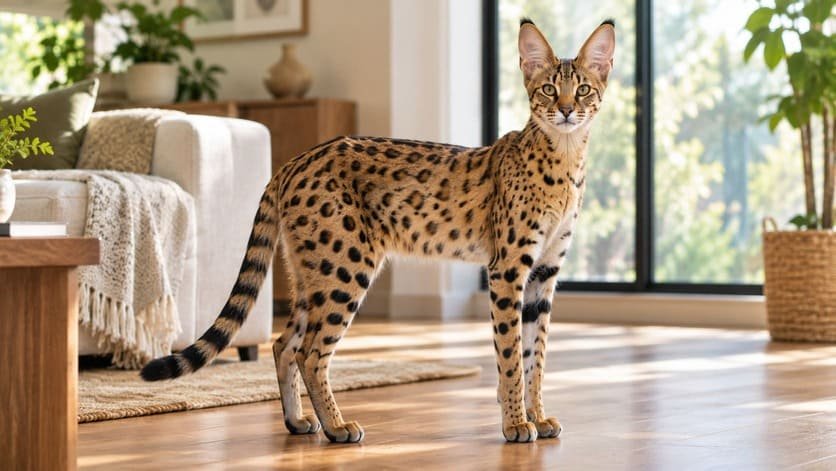
Typical weight: roughly 8 to 20+ pounds, depending on generation.
Savannahs are a cross between domestic cats and the African serval. An F1 Savannah has a serval parent. An F2 has a serval grandparent, and so on. The higher the number, the more domestic the size and temperament.
Early generations are tall, lean, and very active. They often stand noticeably taller than other breeds, even if they weigh less than a Maine Coon.
Before you fall for one, check the law. Some states, including Georgia and Hawaii, ban Savannahs outright, and several others allow only F4 and later generations. City and county rules can be stricter still.
Savannahs need a lot of activity and climbing space. They’re a better fit for experienced cat parents than first-timers.
3. Chausie
Typical weight: roughly 12 to 20+ pounds, larger in early generations.
The Chausie comes from crosses between domestic cats and the jungle cat, a wild species native to parts of Asia and the Middle East. Abyssinians were commonly used in the breed’s development.
Chausies are long-legged and deep-chested, built more like a small cougar than a fluffy house cat. Later generations are the ones typically kept as pets and shown.
Like Savannahs, Chausies can fall under exotic animal rules in some areas. They’re smart and busy, so plan on daily interactive play.
4. Ragdoll
Typical weight: about 10 to 20 pounds, with males on the higher end.
Ragdolls are famous for going limp and relaxed when picked up. They’re heavy-boned and substantial, so a full-grown male can feel far heavier than he looks.
Most Ragdolls are pointed, meaning darker color on the face, ears, paws, and tail, with blue eyes. They mature slowly, often taking about four years to reach full size.
These are true lap cats that tend to follow you from room to room. That easygoing nature makes them a common pick for families.
Health note: Ragdolls have their own known HCM mutation, and a genetic test is available. Ask breeders for results on both parents.
5. RagaMuffin
Typical weight: about 10 to 20 pounds.
RagaMuffins developed from Ragdoll lines, so they share that plush, heavy build and gentle temperament. The big difference is color. RagaMuffins come in nearly every coat color and pattern, not just pointed.
They’re soft, round-faced cats who tend to enjoy being handled. Because of their Ragdoll roots, it’s reasonable to ask breeders about heart screening.
6. Norwegian Forest Cat
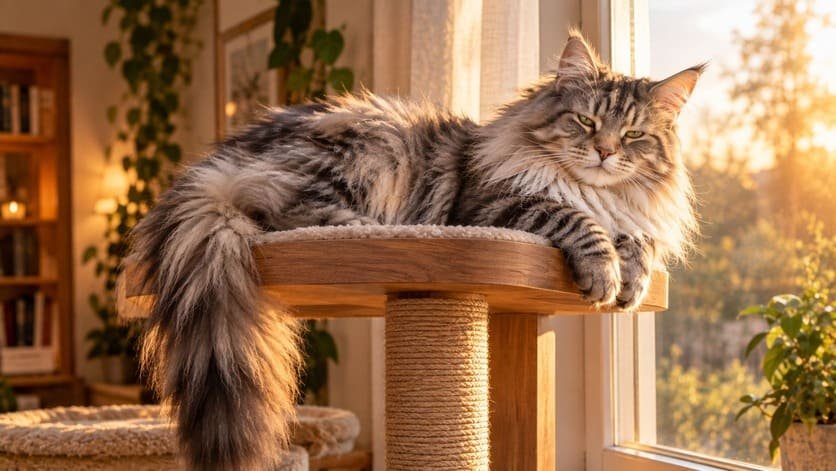
Typical weight: about 9 to 18 pounds.
The “Wegie” developed in Scandinavia’s harsh climate, and it shows. Expect a thick, water-resistant double coat, a full ruff around the neck, and tufted paws.
Norwegian Forest Cats are strong climbers. If you have tall bookshelves, assume they’ll get explored. Their growth can come in spurts, and some keep filling out until around age 5.
Health note: The breed can carry glycogen storage disease type IV, and a DNA test exists for it. HCM also appears in the breed.
7. Siberian
Typical weight: about 8 to 18 pounds, with some males heavier.
Siberians come from Russia and carry a dense, triple-layered coat. They’re powerful jumpers thanks to muscular hindquarters, and they’re known for being playful well into adulthood.
Like other cold-climate breeds, they mature slowly and may take up to 5 years to reach full size. You’ll often hear that Siberians are good for allergy sufferers. No cat is truly hypoallergenic, so spend time with one before committing.
8. Turkish Van
Typical weight: about 7 to 20 pounds, with males much larger than females.
The Turkish Van is mostly white, with color on the head and tail. Its coat has a water-resistant texture, and many Vans are curious about water in a way most cats aren’t.
Vans are muscular, energetic, and strong-willed. They’re not typically cuddle-on-command cats, but they bond closely with their people.
9. Highlander
Typical weight: about 10 to 20 pounds.
The Highlander is a newer breed developed in North America to look wild while staying fully domestic. Curled ears and a short, bobbed tail give it a lynx-like look.
Despite the tough appearance, Highlanders are known for being social and playful. They’re still rare in the U.S., so expect waitlists and do extra homework on any breeder.
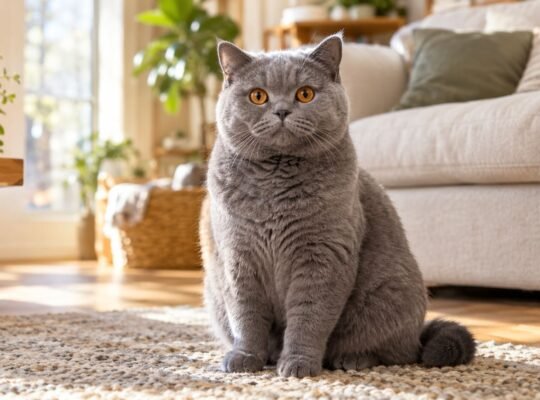
10. British Shorthair
Typical weight: about 7 to 17 pounds.
British Shorthairs are stocky, round-faced, and dense-coated. The classic blue-gray color is the best known, but they come in many colors.
They mature by around age 3 and tend to be calm and independent. Plenty of British Shorthairs prefer sitting next to you over sitting on you.
Health note: The breed is prone to weight gain, and HCM appears in the breed. Keep portions measured, because their stocky frame can hide extra fat.
11. Pixiebob
Typical weight: about 12 to 17 pounds for males, 8 to 12 for females.
Pixiebobs were bred to resemble the North American bobcat, with a short tail, heavy build, and wild-looking spotted coat. They’re domestic cats, not hybrids.
Pixiebobs are often described as doglike. Many learn to walk on a harness and follow their people around the house. Extra toes (polydactyly) are accepted in the breed.
12. American Bobtail
Typical weight: about 12 to 16 pounds for males, 7 to 11 for females.
The American Bobtail has a naturally short tail, usually 1 to 4 inches long, and a sturdy, athletic frame. They don’t reach full adulthood until 2 or 3 years old.
Bobtails are playful and tend to adapt well to kids, other pets, and car trips. Many enjoy puzzle toys and games of fetch.
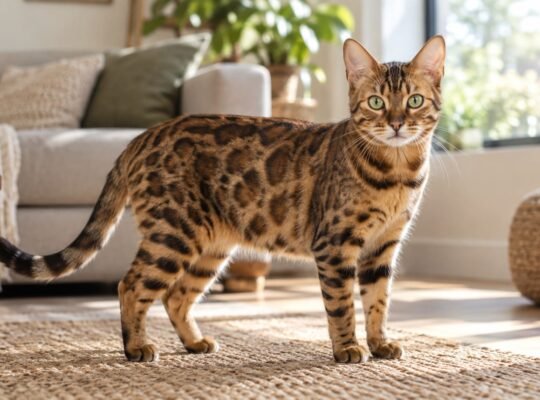
13. Bengal
Typical weight: about 8 to 15 pounds.
Bengals descend from crosses with the Asian leopard cat, but pet Bengals are many generations removed from wild ancestors. They’re medium-large, lean, and heavily muscled, so they often feel heavier than they look.
Their energy is the bigger commitment. A bored Bengal will invent its own activities, and you probably won’t like them. Daily play and climbing space are non-negotiable.
Health note: Bengals can be affected by HCM, and genetic tests exist for pyruvate kinase deficiency and a form of progressive retinal atrophy in the breed.
14. Chartreux
Typical weight: about 7 to 16 pounds, with males on the larger end.
The Chartreux is a French breed with a woolly blue-gray coat and copper or orange eyes. It’s solidly built with fairly fine legs, which makes it look heavier on top.
Chartreux cats are quiet, observant, and devoted. Some breeders screen for patellar luxation (a kneecap problem), so it’s worth asking about.
15. Kurilian Bobtail
Typical weight: about 7 to 15 pounds.
This natural breed comes from the Kuril Islands, between Russia and Japan. It’s compact but surprisingly heavy for its size, with a short, pom-pom tail.
Kurilian Bobtails are uncommon in the U.S. They’re known for being gentle, clever, and good with other pets.
Big-boned or overweight? How to tell
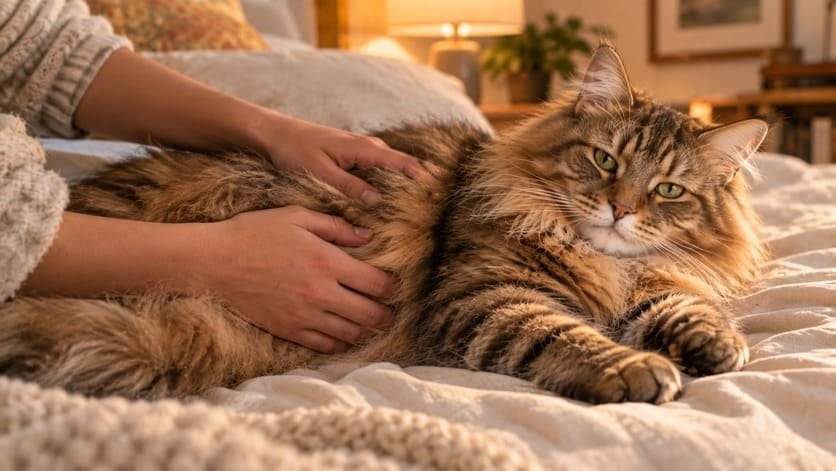
Plenty of cats get called “big-boned” when they’re carrying fat. A large frame and a healthy weight can go together, but you need to check. Here’s how to assess your cat at home:
- Feel the ribs. Run your flat palms along your cat’s sides. You should feel ribs under a thin layer of fat, similar to feeling the back of your hand.
- Look down from above. A healthy cat has a visible waist behind the ribs, even under a long coat. Wet the fur slightly if the coat hides the shape.
- Check the belly from the side. A slight tuck is ideal. A low, swinging pouch between the back legs (the primordial pouch) is normal in many cats and doesn’t count as fat by itself.
- Feel the spine and hips. You should feel bone with light pressure. If you have to press hard, there’s likely extra fat.
- Ask your vet for a body condition score at each visit. Vets typically use a 9-point scale, where 5 is ideal.
For longhaired giants like Maine Coons and Siberians, the coat can hide 2 or 3 extra pounds easily. Your hands tell you more than your eyes do.
For more on portion control, see our guide to How much should I feed my cat?
What living with a big cat is really like
Breed profiles talk about temperament. They rarely talk about the small daily details that change when your cat weighs 17 pounds instead of 9. These are the things large-breed owners tend to notice first.
You’ll hear them coming. A big cat jumping off the bed at 3 a.m. lands with a real thud.
Many heavy adults stop leaping down from high spots and start climbing down in stages, using a chair or dresser as a step.
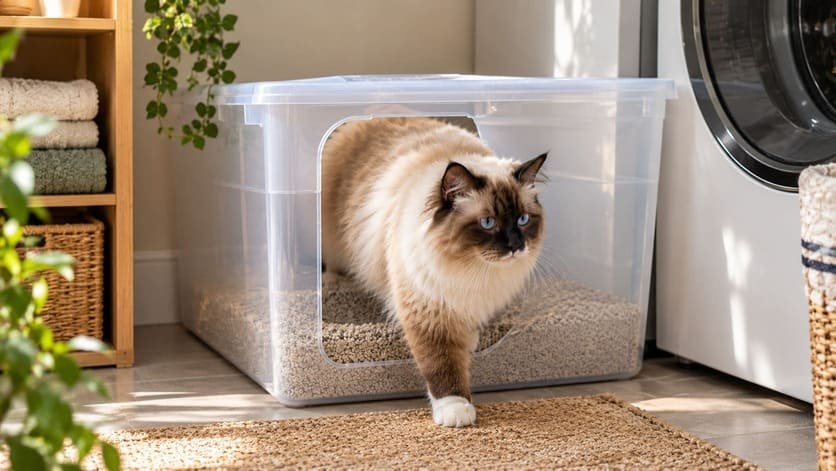
Litter box habits change too. When the box is too small, a big cat often perches with back paws on the rim, and urine ends up over the edge. People blame the cat. The box is usually the problem.
Cat trees wobble. A 15-pound cat launching onto the top platform of a lightweight tree can tip it. The telltale sign is a cat who approaches a tree, pauses, then walks away. They’ve learned it isn’t stable.
Lifting takes technique. Pick up a heavy cat with one hand under the chest and the other supporting the back legs and rump. Letting those back legs dangle is uncomfortable for them and a common reason big cats squirm free.
Growth can fool you. A Maine Coon kitten at 12 months may look like a full adult but still be filling out through age 3 to 5.
Talk to your vet about when to switch from kitten food, rather than switching on a fixed birthday.
Grooming shifts with the seasons. Longhaired breeds like Norwegian Forest Cats and Siberians tend to shed heavily in spring as the winter coat comes out.
Mats show up first behind the ears, in the armpits, and on the “britches” of the back legs.
Health issues that matter more in large breeds
Big cats aren’t automatically less healthy. But a few problems show up more often in certain large breeds, and extra body weight adds strain on joints.
Hypertrophic cardiomyopathy (HCM)
HCM is the most common heart disease in cats. It thickens the heart muscle so the heart pumps less efficiently. The Cornell Feline Health Center lists the Maine Coon and Ragdoll among the breeds predisposed to it.
Genetic tests exist for the specific HCM mutations found in Maine Coons and Ragdolls. UC Davis Veterinary Genetics Laboratory offers a cheek-swab test for Maine Coons that you can order directly.
A negative gene test doesn’t rule out HCM entirely, because other unknown mutations can cause it. Responsible breeders often pair DNA testing with heart ultrasounds (echocardiograms) done by a veterinary cardiologist.
Many cats with HCM show no signs for years. Watch for these:
- Fast or labored breathing while resting
- Open-mouth breathing, which is never normal in a calm cat
- Hiding, low energy, or appetite loss
- Sudden weakness or pain in the back legs, which is an emergency
Your vet may ask you to count your cat’s resting breathing rate at home while they sleep. Count each rise of the chest for 30 seconds and double it. Ask your vet what number should prompt a call.
Joints and weight
Hip dysplasia is known in Maine Coons, and heavy cats of any breed put more load on their joints. Early signs are subtle: hesitating before jumps, using the stairs one at a time, or grooming less over the lower back.
Keeping your cat lean is one of the most helpful things you can do for their joints. If you notice stiffness, your vet can discuss pain management and joint support options.
How to prepare your home for a large cat
Most standard cat gear is sized for an average 10-pound cat. Here’s how to set up for one that may be much bigger:
- Size up the litter box. Aim for a box at least one and a half times your cat’s body length, not counting the tail. A large plastic storage tote with a doorway cut into one side works well and costs less than many “jumbo” boxes.
- Buy or anchor a sturdy cat tree. Look for a wide, heavy base and thick posts. Anchor tall trees to the wall with a furniture strap.
- Pick a carrier rated for adult weight. Buy for the expected adult size, not the kitten. A carrier with a top opening and a rigid base makes vet visits much easier with a heavy cat.
- Feed by measured portions. Ask your vet for a daily calorie target and measure every meal. Recheck the amount every few months while your cat is still growing.
- Add low landing spots. Place a step, stool, or sturdy ottoman near high perches so your cat can climb down instead of jumping.
- Set up a grooming routine early. Brush longhaired breeds two to three times a week, more during shedding season. Start in kittenhood so it feels normal.
Where to find a large breed cat
Reputable breeders are the best route if you want a specific breed and predictable size. Look for breeders registered with the Cat Fanciers’ Association (CFA) or The International Cat Association (TICA).
Ask to see health testing results for both parents, and expect to meet the cats or see them on video.
Walk away if a breeder won’t share test results, always has kittens available, or pressures you to decide fast.
Breed-specific rescues exist for Maine Coons, Ragdolls, Bengals, and other popular breeds. They’re a good fit if you’d like an adult cat whose size and personality are already known.
Local shelters are worth a look too. Many big, fluffy mixed-breed cats have long coats, ear tufts, and a large frame. They may not have papers, but they need homes just as much.
Only a DNA test can tell you what’s in their family tree.
New to adoption? Our guide to : What to know before adopting a cat walks you through the first weeks at home.
Is a big cat right for you?
A large breed cat can be a wonderful companion. You get more cat to cuddle, and often a friendly, steady personality to go with it.
You also sign up for bigger gear, slower growth, and a few health checks worth taking seriously.
If you have the space and patience, start by meeting a few adult cats of the breed that interests you. Ask breeders and rescues hard questions about health testing. Then set up your home before your new cat arrives.
Disclaimer: This article is for informational purposes only and isn’t a substitute for professional veterinary advice. Talk to your veterinarian about any health concerns, including heart screening, weight, or joint problems. For aggression, intense prey drive, or other high-risk behavior, especially in hybrid breeds, work with a certified animal behaviorist or a qualified cat behavior consultant. Exotic and hybrid cat laws change, so confirm current rules with your state and local authorities.
Click Here to Add SmartPawLife as a Trusted Source Add as a preferred source on Google