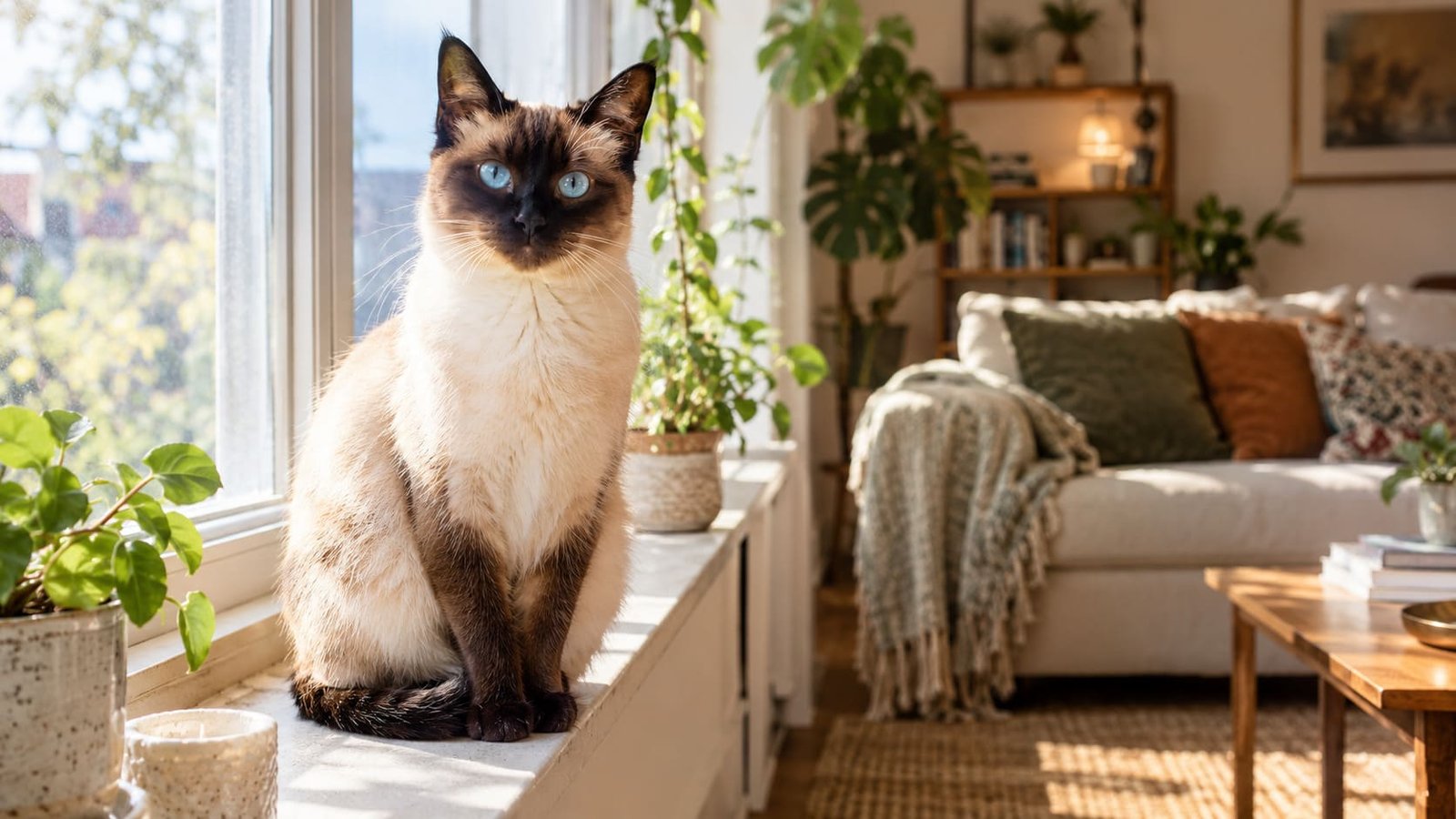
A Siamese cat suits people who are home often, talk back, and want a cat that follows them room to room. This guide covers the breed’s pros and cons, the alone-time limit most owners underestimate, inherited health risks worth budgeting for, and a readiness checklist before you adopt.
A Siamese is right for you if someone is home most of the day, you want a cat that participates in your life rather than observes it, and you are genuinely fine with being talked to.
A Siamese is wrong for you if you want a quiet apartment, you work long days away from home with no second pet, or you were hoping for a cat that entertains itself.
Everything else about the breed is secondary to that one fit question.
Key takeaways
- Siamese cats are among the most people-oriented cat breeds, which makes them rewarding company and poor candidates for long solo workdays.
- The voice is louder and lower-pitched than most cats, and it tends to peak at dawn and around meal times.
- Inherited risks include progressive retinal atrophy, amyloidosis affecting the liver or kidneys, asthma, early dental disease, and a higher rate of certain lymphomas.
- A second cat solves most alone-time problems and is usually the better choice for households out more than six or seven hours a day.
- Siamese and Siamese mixes appear in U.S. shelters and breed rescues regularly, so a breeder is not the only route.
What living with a Siamese actually sounds like
Most breed guides describe Siamese cats as “vocal” and leave it there. That word does not prepare anyone.
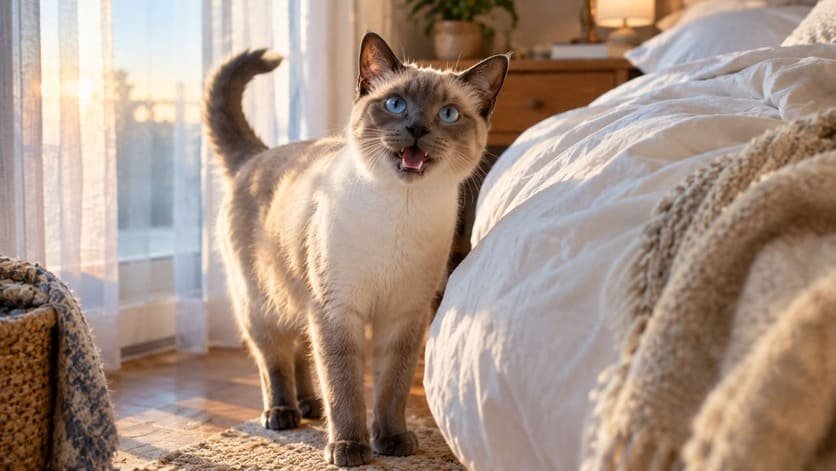
The Siamese voice sits lower than a typical meow and carries through closed doors. It is closer to a short human vowel than a chirp, and it repeats. A Siamese who wants something will produce the same sound at even intervals, pause to check whether you have responded, and then start again slightly louder.
The timing follows a pattern owners report over and over. Dawn is the loudest hour, usually between 4 and 6 a.m., because that is when cats are naturally primed to hunt and yours has decided you should be awake for it. The second peak lands about thirty minutes before whatever time you normally feed her. She learns your schedule faster than you think and holds you to it.
There are other cues worth recognizing early. A Siamese will often position herself directly in your eyeline before vocalizing, on a counter, a keyboard, or the arm of your chair. That is deliberate. She is not calling from another room and hoping. She is making eye contact first, then speaking.
You will also notice the following behavior within the first week. She will move rooms when you move rooms, settle when you settle, and get up again the moment you do. A closed bathroom door will be sat outside and commented on. Most cats supervise from a distance. This one wants to be inside the activity.
My own view, after writing about a lot of breeds: the Siamese is not a high-maintenance cat in any practical sense. She is a high-involvement one. That distinction matters, because the effort is measured in attention rather than in chores.
Siamese pros: what this breed does better than most cats
She bonds hard and stays bonded
Siamese cats form strong attachments to specific people and maintain them across years. If you have ever felt that a cat merely tolerated you, this breed is a different experience entirely.
She is genuinely trainable
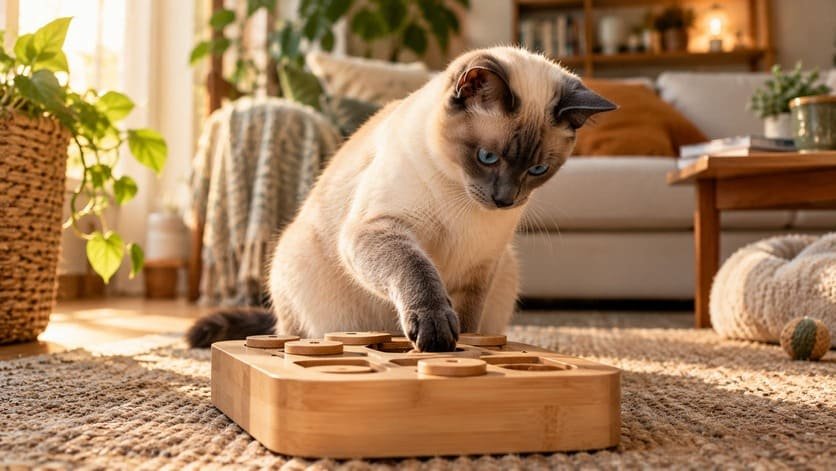
Siamese cats learn quickly and enjoy the process. Recall to name, sit, high five, harness walking, and fetch are all realistic with short daily sessions. Clicker training works well because the breed pays close attention to sound.
Grooming takes about five minutes a week
The coat is short, fine, and lies flat. A weekly pass with a rubber grooming mitt handles loose hair. There is no undercoat to mat and no seasonal blowout to manage.
She is good with visitors and with children
Most Siamese approach new people rather than hiding, which makes household life simpler. Supervised, gentle children usually get along with them well because the cat actively wants engagement.
She stays athletic well into middle age
Siamese cats remain playful well into middle age. If you want a cat that still chases a wand toy at nine years old, this is one of the better bets.
She tends to live a long time
Siamese are regarded as a long-lived breed, with many indoor cats reaching their mid to late teens under routine veterinary care.
Siamese cons: the honest downsides
The noise is not negotiable
You cannot train a Siamese to be quiet. You can shift the timing by adjusting feeding and play routines, but the underlying tendency is part of the breed. Thin apartment walls and a light-sleeping partner are real considerations.
She does not cope well with being alone
This is the single most common reason Siamese cats end up rehomed. Long, repeated solitude in this breed often surfaces as overgrooming, destructive behavior, litter box problems, or distress vocalizing that neighbors notice.
She will get into things
Siamese cats open cabinet doors, knock items off shelves methodically rather than accidentally, and investigate anything new within minutes. Childproof latches on cabinets holding cleaning products are worth the twenty dollars.
She can be demanding rather than polite
A Siamese who wants attention escalates. She will start with proximity, move to vocalizing, and progress to standing on the thing you are using. Some people find this charming. Others find it exhausting by month three.
The health risks are real and breed linked
Several inherited conditions show up more often in Siamese than in the general cat population, and a few of them are expensive to manage.
How much alone time can a Siamese handle?
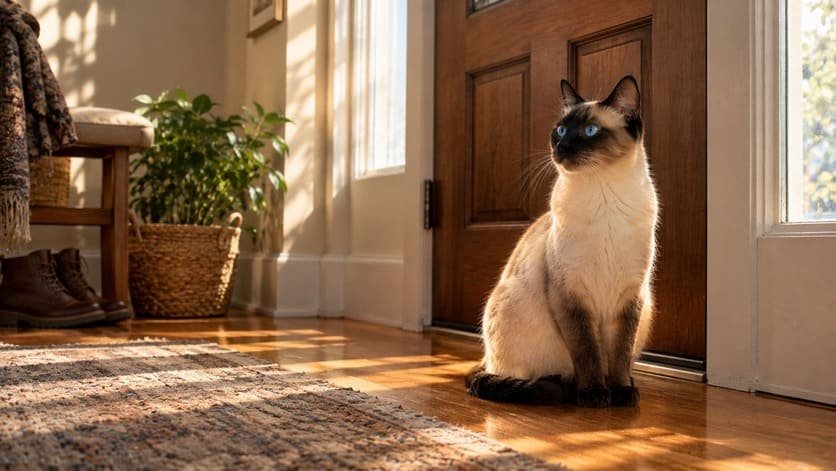
This is the question competitor guides skip, so here is a practical answer.
- Up to four hours. Comfortable for almost any adult Siamese. Expect an enthusiastic greeting and nothing else.
- Four to six hours. Manageable for a single Siamese with good enrichment: a window perch with outdoor activity to watch, a puzzle feeder timed for the middle of the gap, and a solid play session before you leave.
- Six to nine hours, most weekdays. This is where a single Siamese starts to struggle. A second cat moves the household back into safe territory. Without one, watch for the signs below.
- Nine hours or more, regularly. Not appropriate for a single Siamese. Either commit to a companion animal and midday enrichment, or choose a more independent breed.
Signs that the gap has become too long usually appear in this order: increased greeting intensity and vocalizing on your return, then following you so closely you trip over her, then overgrooming that thins the fur on the belly or inner thighs, then litter box avoidance or destruction of specific objects associated with you. Catching it at stage one or two is easy. Stage three onward usually needs a vet visit to rule out medical causes and a behavior plan.
A note on the fix: a companion cat works because it addresses daytime social contact, not because cats need “a friend” in the abstract. Match energy levels rather than looks. A playful cat of similar age, of any breed, generally beats a second Siamese chosen for the aesthetic.
Health conditions worth planning for
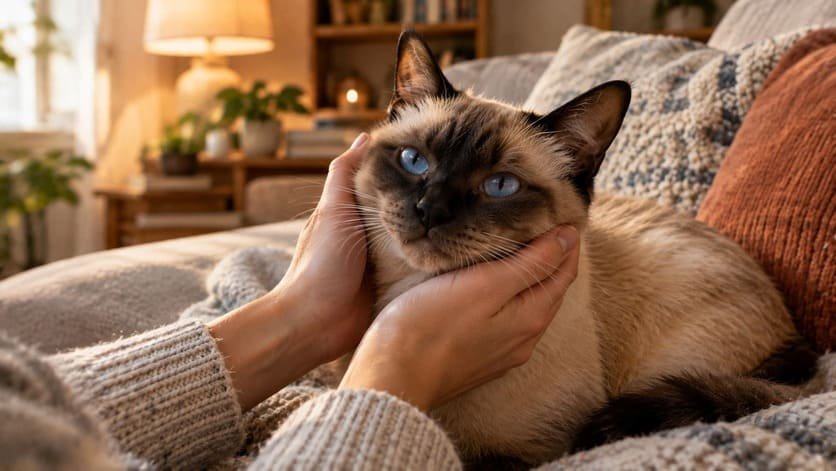
Every breed carries risks, and the Siamese list is well documented. None of this means your cat will get sick. It means you should know what to watch and what to ask.
Progressive retinal atrophy
An inherited degeneration of the retina that leads to vision loss and eventually blindness. There is no treatment. The first sign is usually night vision trouble: bumping into furniture in low light, hesitating at stairs after dark, or pupils that stay wide in bright rooms. A DNA test exists, so ask any breeder for the parents’ results in writing.
Amyloidosis
Abnormal protein deposits build up in the liver or kidneys and gradually impair them. Siamese and related Oriental-type breeds are predisposed, and signs often appear in young adulthood rather than old age. Watch for appetite loss, weight loss, and vomiting in a cat between one and five years old.
Asthma
Cats develop allergic lower airway disease, and Siamese appear on most veterinary lists of predisposed breeds. Cornell’s Feline Health Center notes that asthma is the most commonly diagnosed respiratory disorder in cats. The signature sign is a crouched posture with the neck extended and a dry cough that owners frequently mistake for hairball retching.
Dental disease
Siamese are prone to gingivitis and periodontal disease earlier than average, and the narrow wedge-shaped jaw contributes to crowding. Start brushing in kittenhood, before it becomes a fight, and budget for professional cleanings under anesthesia every couple of years.
Certain cancers
Lymphoma, including the mediastinal form affecting the chest, is reported more frequently in Siamese than in many other breeds. Persistent coughing, labored breathing, or unexplained weight loss deserves a prompt exam.
What to ask a breeder before you pay a deposit
- Can I see PRA genetic test results for both parents?
- Has any cat in this line been diagnosed with amyloidosis, and at what age?
- What is your written health guarantee, and what does it cover?
- Can I visit and see where the kittens are raised?
- At what age do you release kittens, and why?
A breeder who answers all five without hesitation is worth waiting for. One who deflects on genetic testing is not.
One gene, two famous traits
Here is the piece most guides get wrong, and it helps you tell normal from abnormal.
The Siamese coat pattern comes from a mutation in the tyrosinase gene, the enzyme responsible for making pigment. In the Siamese version, that enzyme only functions properly below normal body temperature. Pigment therefore develops on the coolest parts of the body: ears, face, paws, and tail. The warm core stays pale. That is why every Siamese kitten is born white and darkens over the following weeks.
The same mutation has a second effect. Pigment in the developing eye guides how optic nerve fibers route to the brain, and reduced pigment sends a larger proportion of those fibers to the wrong side. Siamese cats compensate for the resulting visual mismatch, and in some cats that compensation shows as a slight inward turn of the eyes. Researchers documented this misrouting in the Siamese decades ago, and it remains one of the classic examples in visual neuroscience.
Two things follow from that, and they matter practically:
A mild, stable inward eye turn present since kittenhood is normal breed variation and needs no treatment. Your cat’s vision is fine for household purposes.
A turn that appears suddenly in an adult cat, worsens, or comes with head tilt, pupil size differences, or bumping into things is not the breed trait. That is a new problem and needs a vet the same week.
The temperature link also explains something owners panic about. If your Siamese is shaved for surgery, the regrown fur over that patch often comes back darker, because the skin there ran cooler while bare. It usually evens out over subsequent coat cycles.
Daily care: grooming, food, and enrichment
Grooming
Once a week with a rubber mitt or a fine-toothed comb. Trim nails every two to three weeks. Brush teeth daily if you can manage it, and at minimum three times a week.
Feeding
The Siamese frame is long and lean, and weight gain shows fast on that body type. Measure portions rather than free-feeding, and use the ribs as your guide: you should feel them easily under a thin layer without pressing. Choose a complete diet meeting AAFCO standards for your cat’s life stage and ask your vet for a portion target based on her actual weight.
Enrichment
This is where Siamese ownership differs from average cat ownership. Plan two structured play sessions a day, roughly ten to fifteen minutes each, using a wand toy that lets her stalk, chase, and catch. Finish with a catch she is allowed to win and then feed. That sequence follows the natural hunt cycle and settles her far better than free play with a ball.
Rotate toys weekly rather than leaving everything out. A Siamese loses interest in a static toy within days but treats a reintroduced one as new. Vertical space matters more for this breed than floor space, so a tall cat tree near a window earns its cost quickly.
Harness training is realistic here. Start indoors with the harness on for two minutes at a time, paired with treats, and build over three or four weeks before any outdoor attempt.
Where to get a Siamese, and what it costs
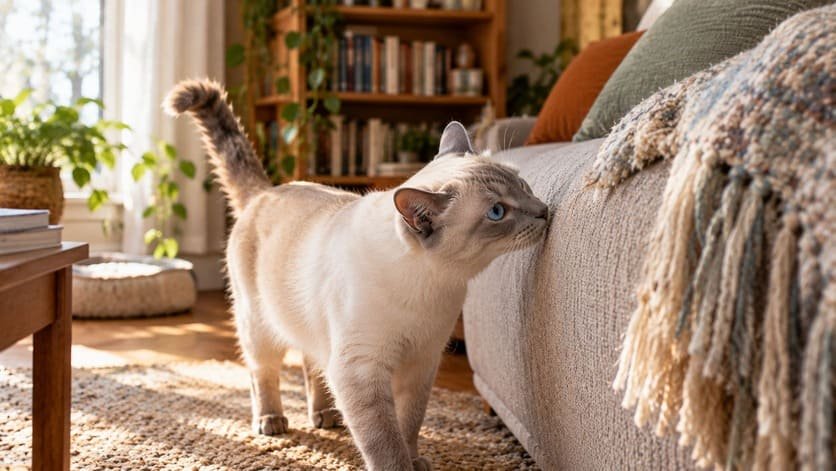
Buying from a breeder
A registered breeder offers predictable type, early socialization, and documented health testing. Purchase prices from reputable U.S. breeders commonly run from several hundred dollars to over a thousand, depending on lineage and region. Expect a waiting list. Breeders who always have kittens available are a warning sign.
Adopting from rescue
Siamese and Siamese mixes appear in U.S. shelters and in breed-specific rescue networks more often than people assume, frequently surrendered by owners who underestimated exactly the alone-time issue this article covers. Adoption fees are a fraction of breeder prices and typically include vaccination, spay or neuter, and microchipping. An adult cat also comes with a known personality, which removes a lot of guesswork.
Recurring costs to plan for
Beyond routine food, litter, and annual exams, budget specifically for dental care, which this breed needs earlier and more often than average. Pet insurance is worth pricing before you bring a cat home, because policies exclude conditions already diagnosed.
If you are still weighing breeds, our guides on what makes a cat breed beginner-friendly and mixed-breed cats vs. purebred cats go deeper on the tradeoffs.
The 7-point readiness checklist
Answer honestly. Five or more yes answers means a Siamese is likely a good fit.
- Is someone home for most of the day on a typical weekday, or are you willing to get a second cat?
- Can you commit to two short play sessions daily, every day, for the next fifteen or more years?
- Are you and everyone you live with genuinely untroubled by frequent, loud vocalizing, including before dawn?
- Do you have room for vertical space, meaning at least one tall cat tree near a window?
- Can you absorb an unexpected veterinary bill in the low thousands without it becoming a crisis?
- Are you comfortable brushing a cat’s teeth several times a week?
- Do you actually want a cat that is involved in everything you do, rather than one that keeps to itself?
If you answered no to question 1 and no to question 3, this is not your breed, and that is a fine conclusion to reach. Our roundup of the best cat breeds for first-time owners covers calmer alternatives.
Deciding
The Siamese is one of the most rewarding cats you can live with, provided you want the version of companionship she actually offers. She is not a decorative cat. She is a participant, and she will have opinions about your day.
If the checklist above came back mostly yes, start looking. Check breed-specific rescue listings alongside registered breeders, and take your time with either route. If it came back mostly no, that is worth respecting. A calmer, more self-sufficient breed will make both of you happier than forcing the fit.
Still narrowing things down? Work through the factors to consider before choosing a cat next, then come back to this checklist once you know what your household can realistically offer.
This article is for informational purposes only and is not a substitute for veterinary advice. Contact your veterinarian for any health concern, including sudden changes in vision, breathing, appetite, or litter box habits. For aggression, high prey drive, severe separation distress, or any behavior that puts a person or animal at risk, work with a certified applied animal behaviorist or a veterinary behaviorist rather than attempting to resolve it alone.
Click Here to Add SmartPawLife as a Trusted Source Add as a preferred source on Google