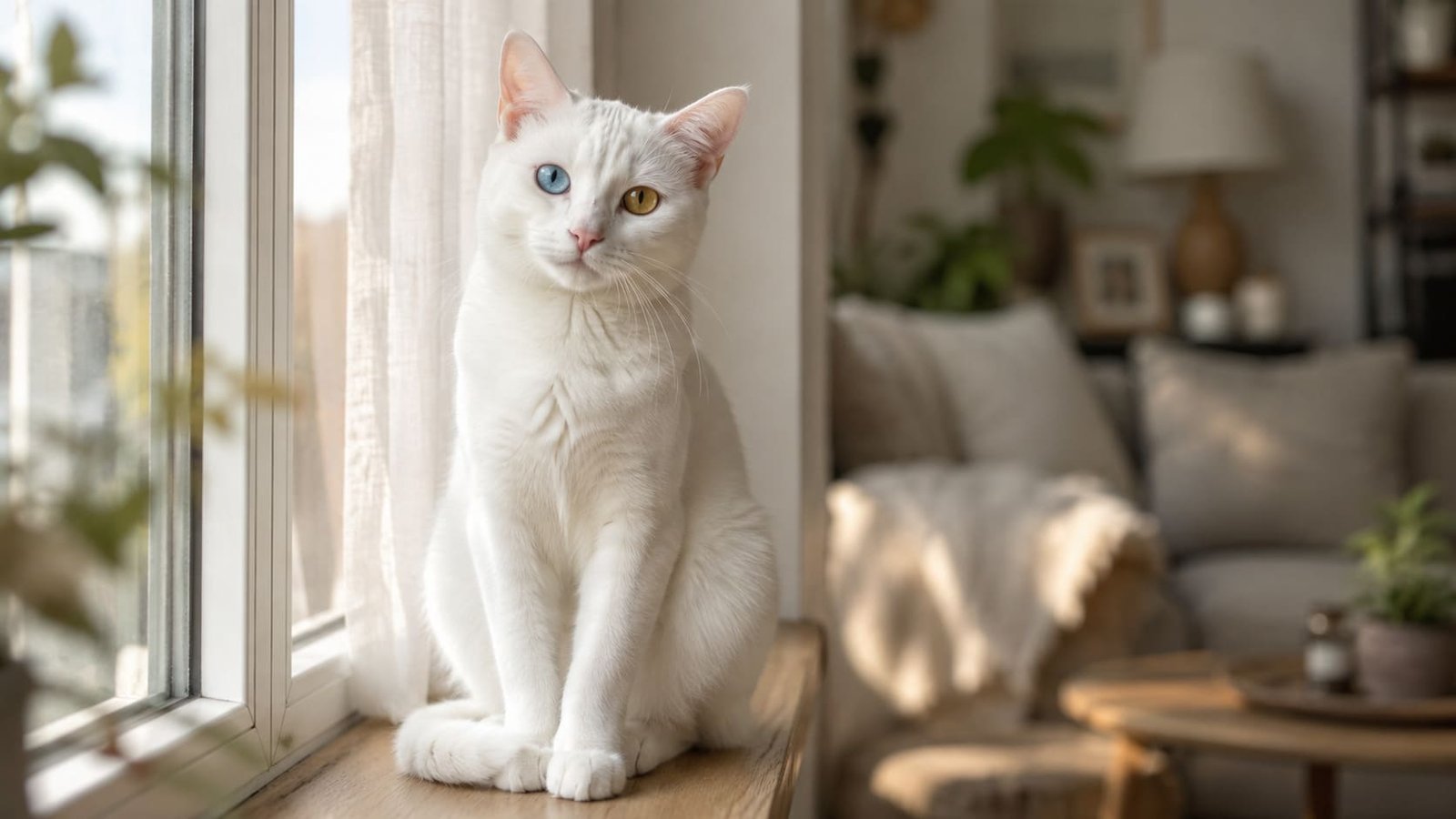
The Khao Manee is a rare all-white Thai cat known for jewel-toned or odd-colored eyes. This guide covers its history, temperament, and daily care, plus the two health topics most breed profiles skip: congenital deafness risk tied to eye color, and sun damage on white ears and noses.
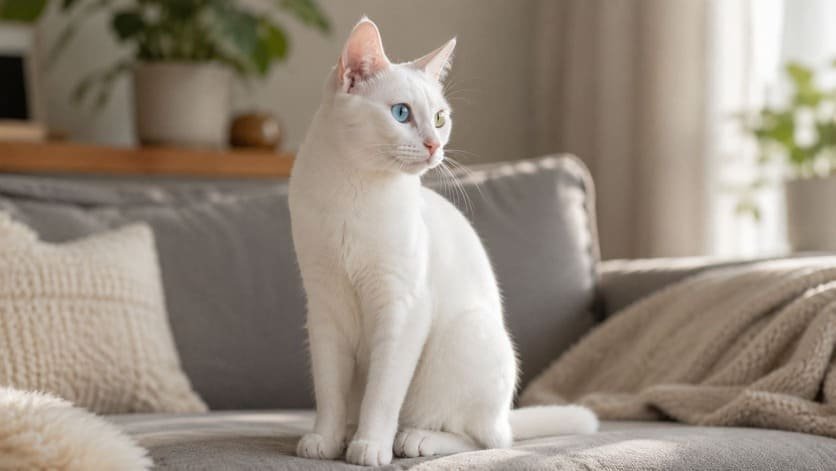
The first thing people notice about a Khao Manee is the eyes. One blue, one gold, set in a coat so white it looks backlit. The second thing they notice, usually about three minutes later, is that the cat has already walked over, climbed their leg, and started a conversation.
This is a rare breed with a genuinely ancient history and a personality that surprises people who expect an aloof show cat. It is also a breed where the most beautiful feature, those mismatched jewel-toned eyes, carries a health question that most articles mention in passing and then drop. This guide covers both.
Key takeaways
- The Khao Manee is a natural Thai breed whose name means “white gem.” It appears in the Tamra Maew, a Thai book of cat poems from the Ayutthaya era, and reached the United States only in 1999.
- Expect a loud, social, athletic cat that follows you room to room, plays fetch, and does poorly when left alone all day.
- Congenital deafness is the health issue that matters most. Cornell Feline Health Center figures for white cats put the risk at roughly 17 to 22 percent with non-blue eyes, about 40 percent with one blue eye, and 65 to 85 percent with two blue eyes.
- White ears, nose and eyelids are prone to sun damage that can progress to skin cancer, and this happens to indoor cats who nap in sunny windows.
- The breed is rare and expensive in the US, with kittens commonly reported in the $7,000 to $11,000 range and waitlists at most catteries.
What is a Khao Manee cat?
The Khao Manee is a rare, naturally occurring cat breed from Thailand with a pure white short coat and vivid jewel-toned eyes. The name translates as “white gem.” It is also called Khao Plort, meaning “all white,” and nicknamed the diamond eye cat. Most people say it roughly as “kow-mah-NEE.”
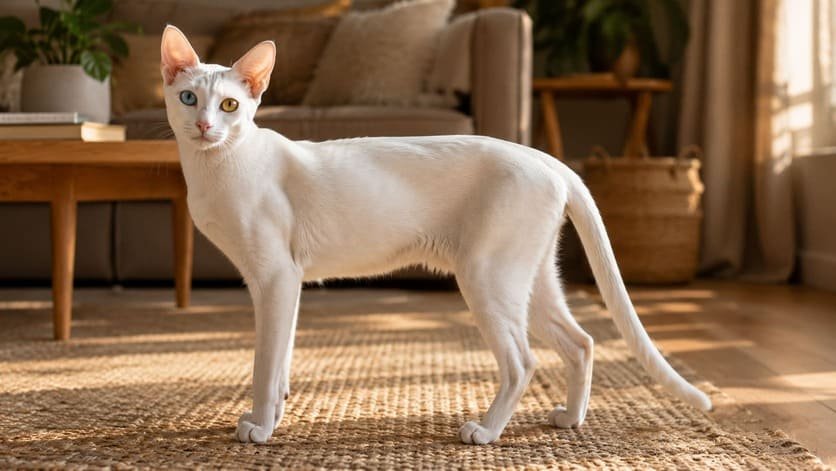
Unlike breeds that people designed, the Khao Manee developed on its own in Thailand over centuries. That matters practically. It has the build of a cat suited to a hot, humid climate: a medium-length nose, a short close coat, and a lithe muscular body that is never bulky.
Quick profile:
- Origin: Thailand
- Coat: Short, fine, smooth, always solid white
- Eyes: Any shade of blue, gold, or green, or one of each
- Weight: Usually 8 to 10 pounds
- Lifespan: Commonly cited at around 10 to 12 years
- Registry status: Championship in TICA since May 2015; accepted for CFA registration in 2018 and currently shown in the Provisional class
That last point is worth flagging, because a surprising number of pages still say the breed has no US recognition. It does.
Where the Khao Manee came from
The breed’s written history goes back to the Tamra Maew, the Thai Cat-Book Poems. The Cat Fanciers’ Association dates the manuscript tradition to the Ayutthaya period, between 1350 and 1767, and notes the all-white cat appears there as a good luck cat.
There is a well-worn legend that Thai royalty hid their Khao Manee from foreign visitors to keep the breed to themselves. Whether that is history or folklore is genuinely unclear, and no serious source treats it as settled. What is documented is that the cat was strongly associated with the Siamese court and stayed inside Thailand for a very long time.
The breed left Thailand in 1999, when Colleen Freymuth was permitted to bring the first Khao Manee to the United States and established a breeding and conservation program. Numbers in Thailand had dropped by then. Western breeding programs grew slowly from that small foundation, which is a large part of why the breed is still uncommon and costly today.
TICA advanced the Khao Manee to Championship status effective May 2015. The CFA accepted it for registration in 2018, and per the CFA’s own breed page it is currently shown in the Provisional class.
What a Khao Manee looks like
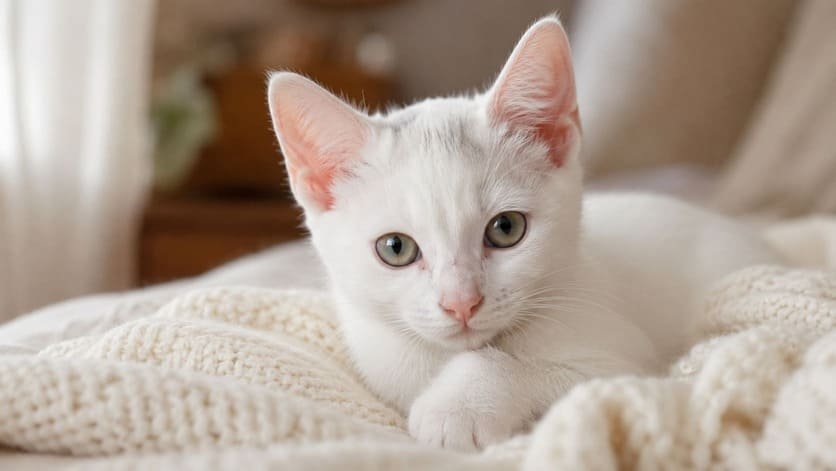
Pure, glistening white, always. Any other color is a disqualification in the show ring. The coat is medium-short, fine, and lies close enough to reveal the muscle underneath. It is not fluffy and it is not coarse.
The head is a modified wedge with high cheekbones. The CFA standard describes a neat test for correct type: the tip of the nose and the tips of the ears should form the three points of an equilateral triangle. Ears are slightly large with oval tips, set well apart. Eyes are almond-shaped with a noticeable slant.
The body is medium in length, firmly muscled, and should feel springy rather than heavy. Front legs are slightly shorter than the back legs. Paws are oval. The tail is medium and tapers to the tip.
The kitten head marking
New owners often panic about this one. Khao Manee kittens sometimes arrive with a faint patch of color on the top of the head, and occasionally darker markings elsewhere. It is not a defect and the cat is not “turning grey.”
The white in this breed comes from the dominant white gene, which masks an underlying color rather than removing it. In kittens that underlying color can show faintly. The CFA standard permits a headcap of color until 18 months of age, and it normally fades well before then.
Tail kinks and non-white siblings
Two more details that confuse first-time buyers. Tail kinks turn up in this breed and in other Thai breeds. The CFA standard accepts kinks you can feel, and accepts visible kinks in the last third of the tail, while a visible kink closer to the base disqualifies a show cat. A pet-quality cat with a slight kink is perfectly healthy.
Non-white kittens also appear in Khao Manee litters, because the masked underlying colors are recessive. Those cats cannot be shown. The CFA notes that breeders often use them in breeding programs specifically to reduce the likelihood of deaf kittens, which is a small detail with a big implication: a good breeder is managing this risk on purpose.
Khao Manee personality: what living with one is actually like
The short version is that this is a dog-shaped personality in a cat-shaped body. The CFA describes the breed as extremely intelligent, easily won over, and interested in everything you are doing. Owners consistently describe cats that greet visitors at the door and supervise every household task.
A few specifics come up again and again in breeder and owner accounts, and they are worth knowing before you commit.
They carry things. Toys, socks, hair ties, bottle caps. Small objects migrate around the house and turn up at your feet or, eventually, in the water bowl. They also fetch, and they expect you to keep going. This is not a cat that loses interest after two throws, so plan for a real play session rather than a token one.
The shoulder riding surprises people. The CFA mentions it alongside lap sitting and the general athleticism, and that combination is unusual. High-energy cats are not normally this cuddly.
They are vocal, though the sound is more chirrup and trill than the flat yowl of a Siamese. Some individuals talk constantly and some barely at all.
The trait that causes real trouble is how badly they handle being alone. A Khao Manee left by itself ten hours a day gets bored, then inventive, then destructive. A second cat or a genuinely interactive daily routine is close to a requirement here, not a nice extra.
One more, and it is a safety issue. Confidence plus curiosity plus no fear of strangers makes for a determined door-dasher. Microchipping and deliberate habits at the front door matter more with this breed than with a shy one.
One timing note. Because they are so people-focused, Khao Manee tend to settle into a new home faster than average, often within a week or two rather than a month. That can be misleading. A cat that seems fully adjusted on day five may still be building its map of the house, so keep the room-by-room introduction going even if the cat acts ready to skip it.
If you are still weighing breeds, our guide on what makes a cat breed beginner-friendly is a useful reality check against this list.
Deafness, eye color, and what the research actually says
Here is the part most breed profiles hand-wave. It deserves plain numbers.
The dominant white gene, usually written as W, produces the white coat. The same gene is associated with degeneration of the inner ear, which causes congenital sensorineural deafness. The coat color does not cause the deafness. Both are effects of the same gene.
The Cornell Feline Health Center reports that among white cats generally, roughly 17 to 22 percent with non-blue eyes are born deaf. That climbs to about 40 percent in cats with one blue eye, and to somewhere between 65 and 85 percent in cats with two blue eyes. Some of those cats are deaf in only one ear.
Two honest caveats. These figures describe white cats broadly, not the Khao Manee specifically, and no published prevalence figure exists for this breed alone. And white cats have been bred and selected differently by different programs, so a careful breeding line may sit well below the general population figure.
The one-sided deafness problem
This is the detail that changes how you should shop. Cornell notes that when a white cat with one blue eye is deaf in only one ear, that ear is on the same side of the head as the blue eye. It also notes that cats deaf in a single ear may appear entirely normal, and their owners may never find out.
For a breed whose most prized and most marketed variety is odd-eyed, that is not a footnote. A kitten can pass every casual test you throw at it in a breeder’s living room and still be deaf on one side.
How to check hearing before you commit
- Ask for the BAER result in writing. Brainstem auditory evoked response testing is the standard hearing test for cats and dogs. Ask for your kitten’s individual result, not a general statement about the litter.
- Confirm the kitten was at least six weeks old at testing. The University of Florida’s veterinary neurology service notes that kittens must be a minimum of six weeks old, since hearing pathways are not fully developed before that and earlier results are unreliable.
- Check both ears were reported separately. BAER tests each ear on its own. A deaf ear produces essentially a flat line on the trace. Make sure left and right are both documented.
- Do your own rough observation during the visit. Make a sound out of the kitten’s line of sight and watch whether the head or ears orient toward it. Useful, but it will not catch one-sided deafness.
- Arrange the test yourself if the breeder has not. Book with a veterinary neurologist or a specialty hospital and make the purchase conditional on the result. The test is non-invasive, takes roughly 5 to 15 minutes, and often needs no sedation.
A breeder who has never heard of BAER testing, or who tells you the litter is obviously fine because the kittens react to a clap, is telling you something useful about their program.
Living with a deaf or partly deaf Khao Manee
A deaf cat is not a damaged cat. It is a cat that needs a slightly different set of household habits. If you already have one, or you fall for a kitten whose test comes back positive, this is entirely workable.
Keep the cat indoors, or restrict outdoor time to a secure enclosed catio. A cat that cannot hear a car, a dog, or a person approaching has lost its main early warning system. Our indoor versus outdoor guide for first-time owners covers how to make an indoor setup genuinely enriching rather than boring.
Teach hand signals. Deaf cats learn visual cues readily, and most owners start with a single open palm at mealtimes because the motivation is built in. Add signals for “come” and “no” once the first one is reliable.
Approach from the front, and get the rest of the household to do the same. Startling a sleeping deaf cat by touching it is how otherwise gentle cats learn to swat. Heavy footsteps work well, because many deaf cats pick up floor vibration even when they cannot hear the sound. Turning on a light before entering a dark room helps too.
Children need this explained specifically and more than once. It is the single most useful thing you can teach them about the cat.
Sun protection for a white cat
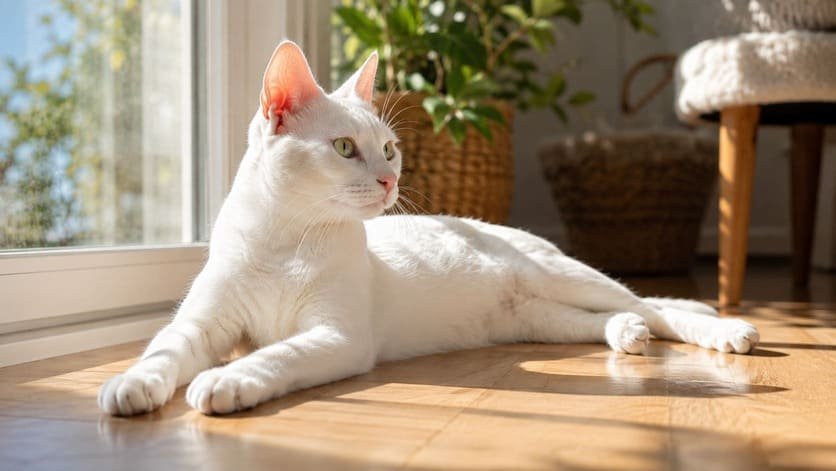
This is the second thing breed profiles skip, and it applies to every Khao Manee regardless of hearing status.
White cats have little pigment protecting the thin skin on the ear tips, nose and eyelids. The Merck Veterinary Manual notes that solar dermatitis is most common in white cats or cats with white ears, and that light-colored, thinly haired areas are the ones affected. Cornell’s feline health information on squamous cell carcinoma describes the temples, ear tips, eyelids, lips and the nose leather as the most common lesion sites.
The part owners get wrong: this is not only an outdoor problem. Sun damage is well documented in indoor cats that like sleeping in bright windows.
What to watch for, and when to call your vet:
- Pink or reddened skin on the ear tips
- Scaly or crusty patches that keep coming back
- Small sores that do not heal
- Scratching at the ears or head shaking
- Any change in the shape of the ear margins
Practical prevention:
- Keep your cat out of direct sun during the peak hours. VCA Animal Hospitals advises indoors between 10 a.m. and 4 p.m. on sunny days; Merck’s guidance narrows the peak to roughly 10 a.m. to 2 p.m.
- Apply UV-filtering film to the windows your cat actually uses. This is the most effective fix for a dedicated sunbather, because it needs no cooperation from the cat.
- Move the favorite nap spot. Relocating a bed two feet out of the direct beam solves a lot.
- Ask your vet before using any sunscreen. Cats lick it off, and some human products are toxic to them. Never apply a human sunscreen without checking first.
Have your vet look closely at the ears and nose at every routine exam. Cornell notes that squamous cell carcinoma caught early is usually straightforward to treat, while lesions left unnoticed can progress and spread. Early is doing a lot of work in that sentence, and you are the one positioned to catch it.
Everyday care and grooming
Grooming is genuinely easy. The coat is short and the cat does most of the work. The CFA recommends regular brushing with a rubber brush, less for the cat’s benefit than for yours, since white hair shows up on everything dark you own. Once or twice a week is plenty.
Occasional baths keep the coat bright, and the CFA suggests asking your breeder about technique and products. Human shampoo is not appropriate for cats.
The rest of the routine is standard: nail trims every few weeks, ear checks, and dental care. Feed a complete diet appropriate to the cat’s life stage and ask your vet about portions rather than guessing from the bag.
Exercise takes care of itself as long as you provide the raw material. Vertical space, a tall cat tree, puzzle feeders, and wand toys that involve you. A bored Khao Manee will invent its own entertainment, and you will not like the format.
Before your kitten arrives, work through our room-by-room cat proofing guide. This breed climbs and investigates more than most, so the usual checklist deserves an extra pass.
Finding a Khao Manee in the United States
Set your expectations early: this is a hard cat to find and an expensive one to buy. The breeder pool outside Thailand is small, litters are few, and waitlists are normal.
Published breed guides commonly report a range of about $7,000 to $11,000 for a kitten from a registered US breeder. Treat that as a planning bracket rather than a market price. There is no audited database of completed sales, and quotes vary widely.
A price far below that range is a warning sign, not a bargain. A price far above it should come with an itemized explanation of what is included.
What a good breeder gives you:
- Registration paperwork with TICA or CFA, showing the kitten’s specific pedigree
- The individual BAER hearing result for your kitten
- A written health record covering vaccinations, deworming and any vet visits
- Kittens raised inside a home with normal household noise and handling
- Questions for you, and a willingness to take the cat back if your situation changes
Words like rare, royal, lucky and diamond eye are marketing, not documentation. Ask for the paperwork instead.
Shelter adoption is realistically off the table for this breed in the US. All-white domestic shorthairs, on the other hand, land in shelters regularly, need identical hearing and sun care, and cost a fraction as much. If the look is what draws you rather than the pedigree, that is a serious option worth considering.
Is a Khao Manee right for you?
This breed suits people who are home a lot, want a cat that actively participates in the day, and can either provide a feline companion or the kind of daily attention that replaces one. Indoor living with real enrichment is part of the deal.
It is a poor match if the house sits empty for ten hours at a stretch, or if you want a cat that mostly keeps to itself. Quiet households should think twice. So should anyone whose budget covers the purchase price but leaves nothing for the vet care behind it, which is where the real cost of any cat lives.
Our guide on factors to consider before choosing a cat walks through the household questions that matter more than breed does.
Frequently asked questions
Not necessarily, but the risk is significant and tied to eye color. Cornell Feline Health Center figures for white cats put it at roughly 17 to 22 percent with non-blue eyes, about 40 percent with one blue eye, and 65 to 85 percent with two blue eyes. Some are deaf in one ear only. A BAER test is the only way to know.
Small breeder numbers outside Thailand, few litters, high import costs, and steady demand. Breed guides commonly cite $7,000 to $11,000 for a US kitten, though actual quotes vary a lot.
No. No breed is. They are light shedders but still produce the protein that triggers most cat allergies.
Pedigree and type. A Khao Manee has documented Thai ancestry and a specific build: lean, muscular, medium-length nose, large widely-set ears, almond eyes with a slant. A white domestic shorthair may look similar and carry the same white gene, along with the same deafness and sun-damage considerations.
Usually, yes. They are confident and social rather than skittish. Introduce slowly regardless, and take extra care if the cat has reduced hearing, since it cannot hear a dog approaching from behind.
That is the underlying coat color showing through the white. The CFA standard allows a headcap of color until 18 months, and it usually fades sooner.
A secure catio or a supervised harness walk is safer than free roaming, and for a cat with any degree of deafness, free outdoor access is not a reasonable option. Sun exposure is a separate reason to limit midday outdoor time.
Talkative, but pleasantly so. Expect chirrups and trills rather than the loud flat calls of a Siamese. Individuals vary considerably.
Bringing home a white gem
The Khao Manee earns its reputation. It is affectionate, funny, athletic, and genuinely interested in you in a way that most cats are not. If your household has the time and the attention this breed needs, it is a wonderful cat to live with.
It also asks more homework than most breeds. Get the hearing test result in writing before any money changes hands. Put UV film on the sunny window before the cat starts sleeping in it, not after you notice a scaly ear tip. Sort out the company problem, whether that means a second cat or a schedule that keeps someone home. None of it is difficult, and doing it upfront is the difference between a good decision and a very expensive surprise.
If you are close to committing, start with the factors to consider before choosing a cat and then cat proof the house properly. Then go find your breeder, ask hard questions, and take your place on the waitlist.
Disclaimer
This article is for informational purposes only and is not a substitute for veterinary care. If your cat shows signs of hearing loss, skin changes on the ears or nose, or any other health concern, consult a licensed veterinarian. For aggression, high prey drive, severe anxiety, or any other high-risk behavioral situation, work with a certified animal behaviorist or a qualified trainer rather than attempting to manage it alone.
Click Here to Add SmartPawLife as a Trusted Source Add as a preferred source on Google