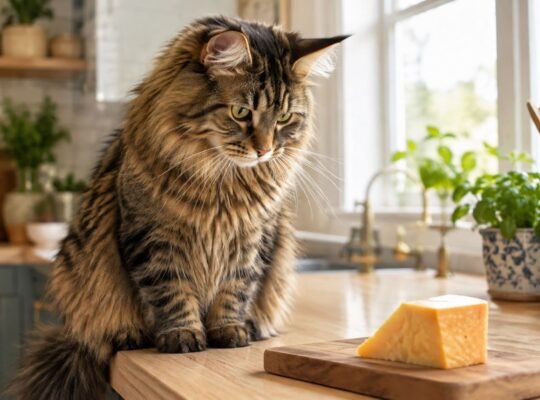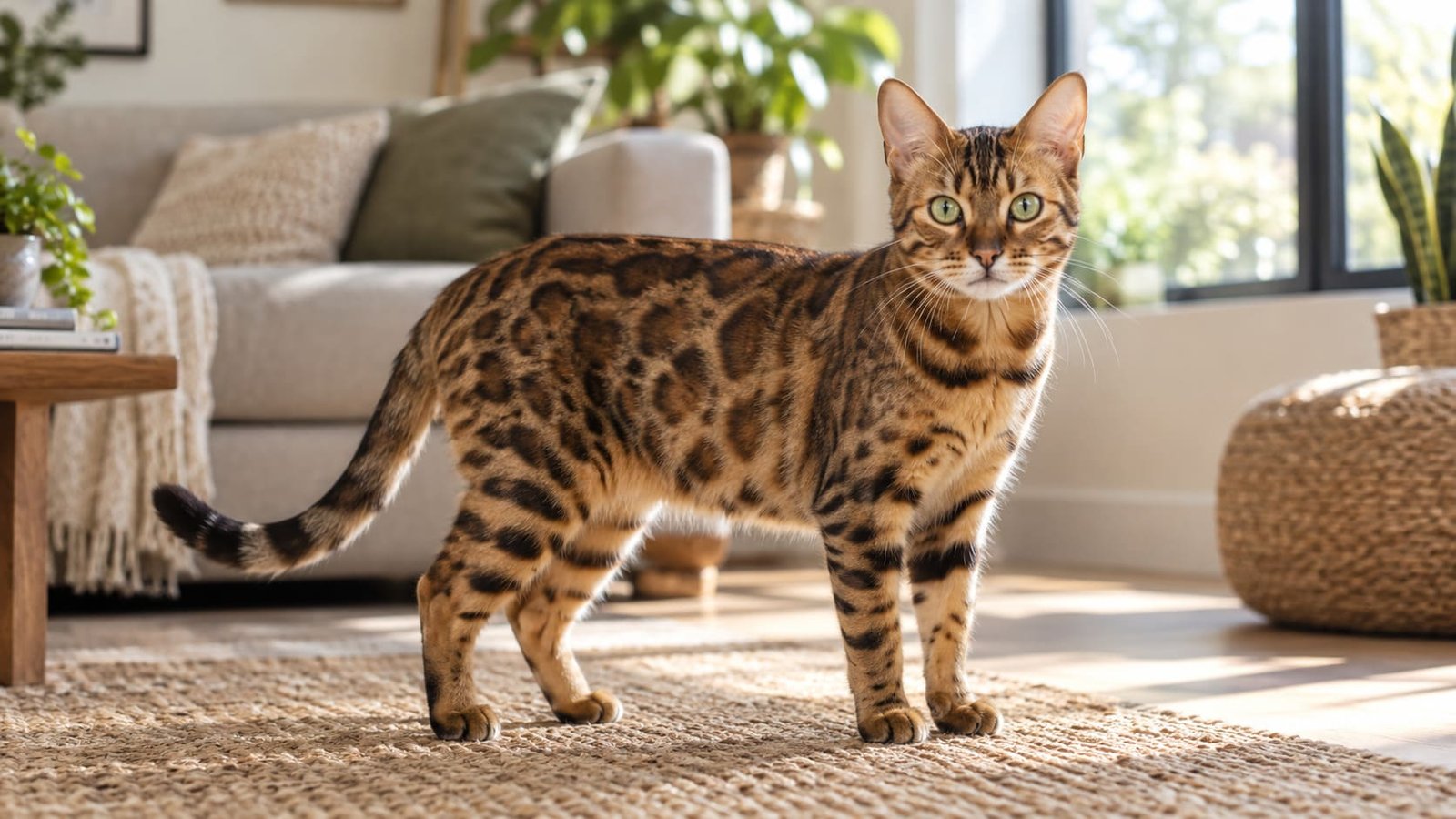
Bengals are athletic, vocal, water-loving cats that need far more engagement than the average house cat. This guide covers the breed’s real pros and cons, generation rules and state bans, daily care, health screening for HCM, PRA-b and PK deficiency, true costs, and how to vet a breeder.
Most people meet a Bengal in a photo. Rosettes, green gold eyes, a coat that looks lit from underneath. Then they search the breed and read a dozen pages that all say the same reassuring things about energy and intelligence.
Here is what those pages tend to leave out. The Bengal is one of the few cat breeds where a mismatch between cat and household shows up fast, loudly, and sometimes expensively. That is worth knowing before you put down a deposit, not after.
Key takeaways
- Bengals are athletic, vocal, water-curious cats bred from Asian leopard cat crosses, and they need daily interactive play rather than passive company.
- Generation matters legally and behaviorally. Later-generation Bengals, usually F4 and beyond with SBT pedigree status, are the ones sold as pets in the United States.
- Hawaii bans Bengals statewide, several states set generation or registration rules, and cities including New York City and Seattle have their own bans. Check both before buying.
- Ask any breeder for PK deficiency and PRA-b results marked N/N on both parents, plus recent echocardiogram dates from a veterinary cardiologist.
- Bengals are not hypoallergenic, and no reliable evidence supports the claim that they are easier on allergy sufferers.
The short answer: who a Bengal fits, and who it does not
A Bengal is a good match if you are home during the cat’s active hours, you want a pet that interacts rather than decorates, and you will actually run two play sessions a day for the next fifteen years.
A Bengal is a poor match if you work long days away from home, you keep a quiet household, you live with a frail senior cat, or you want a cat that sleeps eighteen hours and asks for nothing.
That is the whole decision in two paragraphs. Everything below explains why.
What a Bengal actually is: generations explained
The Bengal descends from crosses between domestic cats and the Asian leopard cat, a small wild species native to Asia. Breeders then bred those hybrids back to domestic cats over successive generations.
Generation labels count that distance. F1 means one parent was an Asian leopard cat. F2 is the next generation out, F3 the next, and so on. The commonly printed percentages of wild ancestry are a rounding convention rather than a measured genetic figure.
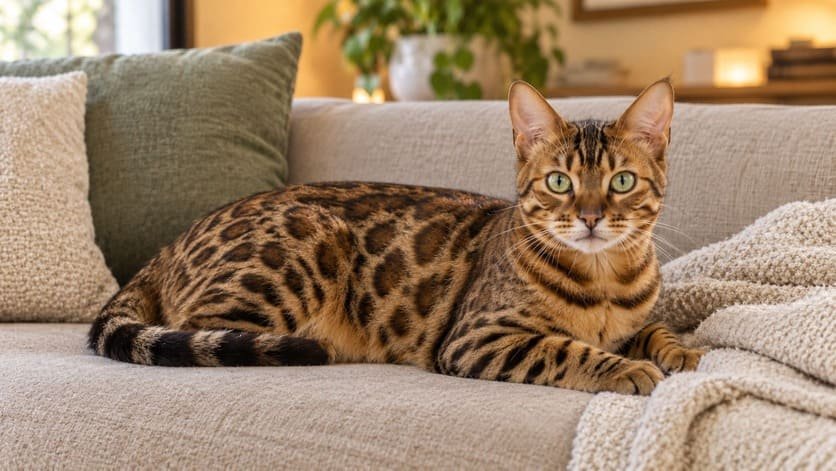
SBT is a separate thing, and this is where most breed guides blur the picture. SBT is a pedigree status from The International Cat Association, awarded when a cat comes from at least three consecutive Bengal to Bengal generations with no outcross.
A cat can sit at F4 on a chart and still not qualify.
Why you should care: early generation Bengals, roughly F1 through F3, are more likely to show wild type behavior. Litter box reliability can be poor. Handling tolerance can be low.
Those cats are not what a pet home wants, and in much of the country they are not legal either.
When someone says “Bengal cat” in a U.S. pet context, they almost always mean a later generation SBT cat several steps removed from any wild parent.
Check whether Bengals are legal where you live
Do this before you browse kittens. It takes ten minutes and it has ended more than a few purchases at the deposit stage.
The rules stack in three layers:
- State law. Hawaii prohibits Bengal ownership statewide regardless of generation. Several states, including Alaska, Delaware, Georgia, Iowa, and Massachusetts, restrict ownership by generation distance or require registered pedigree documentation. New York State sets a generation threshold of its own.
- City or county ordinance. This is the layer people miss. New York City bans Bengals outright, Seattle prohibits hybrid cats under municipal code, and Denver restricts early generation hybrids. A cat that is legal under state law can be illegal at your street address.
- Your building or HOA. Landlords and associations sometimes exclude hybrid breeds separately from their general pet policy.
These laws change, and reporting on them is inconsistent across pet sites. Call your state agriculture or wildlife agency and your city animal control before you commit, and keep your cat’s registered pedigree somewhere you can reach it.
If you live in a restricted area, that is not the end of the search. Our guide to what makes a cat breed beginner-friendly covers breeds with similar energy and none of the legal friction.
Bengal cat pros
The appeal is genuine, and it is not only about the coat.
Bengals engage with people in a way most cats do not. They follow you between rooms, sit in on whatever you are doing, and treat a closed door as a puzzle rather than a boundary. Owners describe the relationship as closer to a dog’s in its demands on attention.
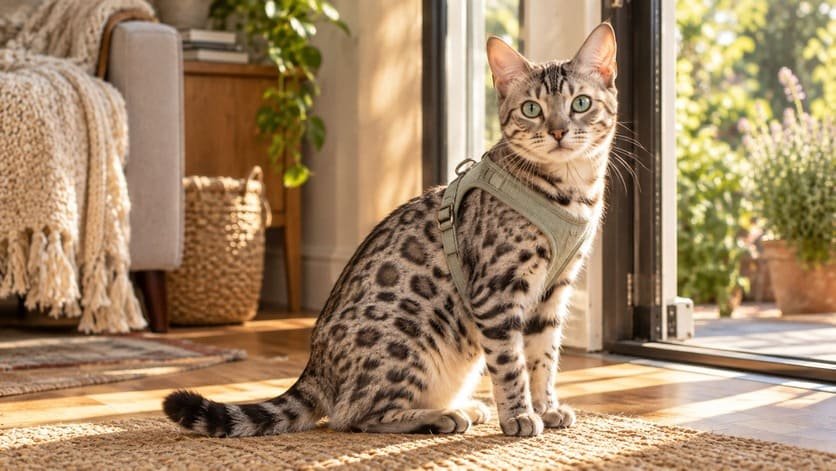
They train well. Clicker work, recall, fetch, harness walking, and target training all land faster with a Bengal than with an average domestic shorthair, because the cat is genuinely motivated to work for food and interaction.
Grooming is easy. The coat is short, dense, and low maintenance. A weekly brush keeps shedding manageable, and most Bengals need nothing beyond nail trims and dental care.
They stay playful into adulthood. Many cats taper off around three or four years old. Bengals often keep a kitten’s appetite for play well into middle age, which is either the best or worst news in this article depending on your schedule.
They are physically striking, and honestly, that matters to people. There is nothing wrong with wanting a beautiful cat. It just should not be the deciding factor.
Bengal cat cons
Now the part that gets softened elsewhere.
The energy is not optional. An under-exercised Bengal does not sulk quietly. She redirects, and the redirect usually involves height, speed, and whatever you left on a shelf.
Vocalization is constant in some lines. Bengals chirp, trill, and yowl, and many learn that noise produces a human. If you work from home on calls, factor that in.
They can be territorial with other cats. A Bengal introduced to a calm senior cat frequently overwhelms her, not from aggression but from play intensity the older cat cannot match or escape.
Counter surfing is close to a breed feature. Vertical restriction rarely works. Redirection to legal climbing surfaces works better, and it takes months.
Cost runs above the sticker price. More on that below.
Breed rescues exist for a reason. There are Bengal-specific rescue groups across the United States, and most of their intakes are surrendered adults rather than strays. Owners underestimated the breed. That pattern is the single most honest argument for thinking this through slowly.
What a day with a Bengal actually looks like
This is the section I wish someone had written for me when I first started covering the breed, because “high energy” tells you nothing about timing.
The first demand usually arrives before sunrise. Not at breakfast. Roughly forty to sixty minutes before the household normally stirs, which tracks the crepuscular activity pattern most cats keep.
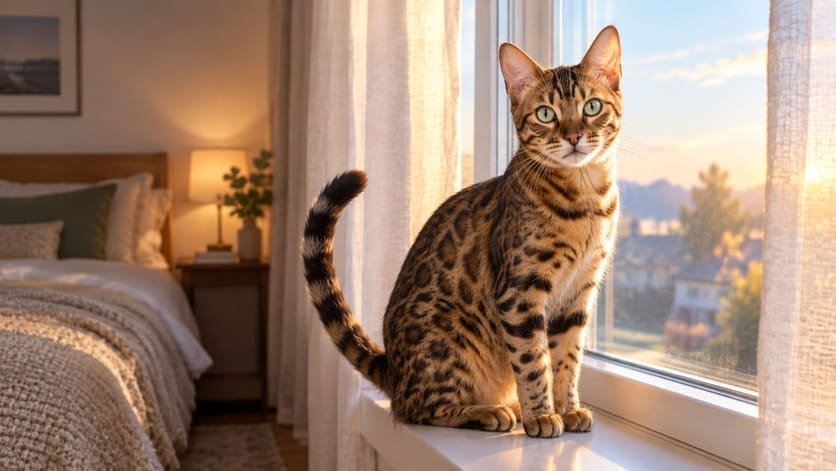
Watch the sequence, because it is consistent enough to intervene in. The tail moves first, a slow twitch from a seated position. Then the ears pivot toward you while she stays still.
Then comes contact: a paw at the blanket, usually at the edge nearest your face. Vocalization is the fourth step, not the first.
That ordering is useful. If you get up at the vocalization, you have trained the vocalization. A timed feeder that runs before your alarm breaks the chain better than any correction will.
Mid morning is usually quiet. Most Bengals sleep hard between roughly nine and noon, and that is the window for calls, focused work, or anything you need uninterrupted.
The second spike lands in the late afternoon and runs into early evening. This one is longer and more physical. Expect fifteen to twenty-five minutes of genuine sprinting, climbing, and object relocation if it has no outlet.
Here is the pattern that surprises people. A Bengal who has had a hard fifteen-minute wand session at 5pm is usually calm by 8pm. A Bengal who was left with a food puzzle instead is often still cycling at 11pm.
Physical output and mental output are not interchangeable in this breed, whatever the enrichment articles suggest. You need both, and the physical one has to come first.
Night settles, in a well-exercised cat, somewhere between nine and eleven. In an under-exercised one, it does not.
Daily care that keeps a Bengal settled
Work backward from that clock and the care routine writes itself.
Two structured play sessions, ten to twenty minutes each, one in the morning and one in the late afternoon. Use a wand toy that mimics bird or rodent movement, let her catch it repeatedly, and finish with a small meal so the sequence ends the way hunting does.
Vertical space beats floor space. A tall cat tree near a window, wall shelves, or a window perch gives her somewhere to be that is not your countertop. Height also lowers stress in multi-pet homes.
Rotate toys weekly rather than leaving everything out. Novelty does most of the work.
Feed a high protein, meat-first diet appropriate for an active adult cat, and split it across several small meals or a puzzle feeder. Some Bengals have sensitive digestion, so change foods gradually over seven to ten days.
Keep litter boxes generous. The usual guidance of one box per cat plus one applies, and Bengals tend to prefer large, uncovered boxes with unscented clumping litter.
If you are setting up before the cat arrives, our room-by-room guide to cat-proofing your home is worth a read, and it is more relevant for this breed than for most.
The water thing is real
Bengals are unusual among cats in their interest in moving water. Many will sit at a running tap, paw at a full bowl until it tips, or step into a shower without hesitation.
Treat that as enrichment and a hazard at once. A circulating water fountain satisfies the interest and improves hydration. Toilet lids stay closed, full bathtubs stay supervised, and a covered fish tank is not optional. One practical note: some Bengals learn to operate lever-style faucets. If yours starts investigating handles, a simple faucet lock is cheaper than a flooded kitchen.
Health screening: what to ask for and when
Bengals are generally robust, but three inherited conditions shape how you buy and how you monitor.
Hypertrophic cardiomyopathy, or HCM, thickens the wall of the heart’s left ventricle. Cornell’s Feline Health Center lists the Bengal among breeds with higher prevalence, and notes that echocardiography is the diagnostic standard. There is no DNA test for the form affecting Bengals, so screening means repeat heart ultrasounds by a veterinary cardiologist.
Progressive retinal atrophy, Bengal type, is a recessive condition that destroys retinal cells and leads to vision loss in early adulthood. It has a clean DNA test.
So does pyruvate kinase deficiency, an inherited enzyme disorder that can cause anemia. Both are offered through the UC Davis Veterinary Genetics Laboratory from a cheek swab.
What that means in practice. Because PRA-b and PK deficiency are recessive, a kitten only develops either condition when both parents carry the variant. Certificates showing both parents clear removes the risk entirely, and no responsible breeder will hesitate to send them.
HCM is different. It can appear years after purchase, and no certificate rules it out permanently. Ask your veterinarian about a baseline echocardiogram in early adulthood, then periodic rechecks.
Signs of trouble include labored or open-mouth breathing, sudden hind limb weakness, and lethargy after mild activity. Any of those is an emergency.
Also watch for gastrointestinal sensitivity, which appears more often in this breed than in the general cat population. Chronic soft stool or intermittent vomiting deserves a workup rather than another food switch.
What a Bengal really costs
Purchase price for a registered Bengal kitten commonly falls between roughly $1,000 and $3,500, with fully health-tested lines sitting at the upper end. A price well below that range is a warning sign rather than a bargain.
Then there is everything else. Sturdy vertical furniture, a rotating toy budget, a water fountain, and a large litter setup are front-loaded costs in the first month. Food volume runs higher than for a sedentary cat of the same weight.
Cardiac screening is the recurring line item most buyers do not anticipate. An echocardiogram with a board-certified cardiologist is a specialty appointment, and pricing varies widely by region. Call a local specialty hospital for a current quote before you budget.
Pet insurance is worth pricing early, because most policies exclude conditions that appear before enrollment. Enrolling a healthy kitten costs less and covers more than enrolling a five-year-old with a new murmur.
How to vet a Bengal breeder
Ask these seven questions, in this order. A good breeder answers all of them without defensiveness.
- Can you send PK deficiency results for both parents? You want N/N on each certificate.
- Can you send PRA-b results for both parents? Either both clear, or documentation that two carriers were never paired.
- When did each parent last have an echocardiogram, and which cardiologist performed it? A date within the last year or two is reasonable. “We have never had a problem in our lines” is not an answer.
- Can I see the registered pedigree showing generation and SBT status? Match it against your local rules.
- Can I see the kittens with their mother on a video call? Watch how the mother behaves around a stranger’s voice.
- What have the kittens been socialized around? Ask about handling, household noise, children, and other animals specifically.
- What happens if the placement does not work out? Serious breeders take their cats back, in writing, for life.
If you would rather adopt, Bengal-specific rescues place surrendered adults regularly, and an adult cat’s temperament is already visible rather than predicted. That is an advantage, not a compromise.
Bengal, Savannah, or an active shelter cat?
Three different answers to the same impulse.
A Bengal gives you the exotic coat with a domestic temperament in later generations, plus the legal patchwork described above.
A Savannah is larger, taller, and derived from serval crosses, with its own generation rules and a steeper legal landscape. Our Savannah cat guide breaks that breed down by generation.
An active young shelter cat gives you most of the play drive, none of the paperwork, and a known adult temperament. If what you actually want is an engaged, athletic cat rather than a specific coat pattern, this is the option worth considering first.
Our roundup of the most popular cat breeds in the USA shows how many common breeds land in the same energy bracket.
Two myths worth correcting
Bengals are not hypoallergenic. Cat allergy is driven largely by proteins produced in saliva and skin that transfer to the coat during grooming. A short coat does not change the protein.
If someone in your household reacts to cats, spend real time around adult Bengals before committing, and involve an allergist rather than a breed chart.
Bengals are not immune to feline leukemia virus. This claim circulates because of research interest in resistance among the wild ancestor species. It does not transfer to pet Bengals. Vaccinate and test on the same schedule your veterinarian recommends for any cat.
The honest bottom line
A Bengal is not a difficult cat. She is a demanding one, and the difference is whether your daily routine has room for her.
If you read the day-in-the-life section and thought “that sounds fun,” this breed will probably be the best cat you have ever lived with. If you read it and thought “that sounds exhausting,” believe that reaction. It is the most accurate piece of information you have.
Before you contact a breeder, do two things this week. Check your state and city rules. Then track your own schedule for three days and mark the hours you are home and awake between 5am and 8am, and between 4pm and 8pm.
If those windows are mostly empty, look at a calmer breed or an adult rescue with a known temperament.
Still deciding? Start with our guide to factors to consider before choosing a cat, then come back to this page when you know what your household can actually offer.
This article is for informational purposes only and is not a substitute for veterinary care. Consult a licensed veterinarian about any health concern, including cardiac screening and inherited disease testing. For aggression, high prey drive, litter box avoidance, or any behavior that puts a person or another animal at risk, work with a certified animal behaviorist or a qualified feline trainer rather than relying on general guidance.
Click Here to Add SmartPawLife as a Trusted Source Add as a preferred source on Google