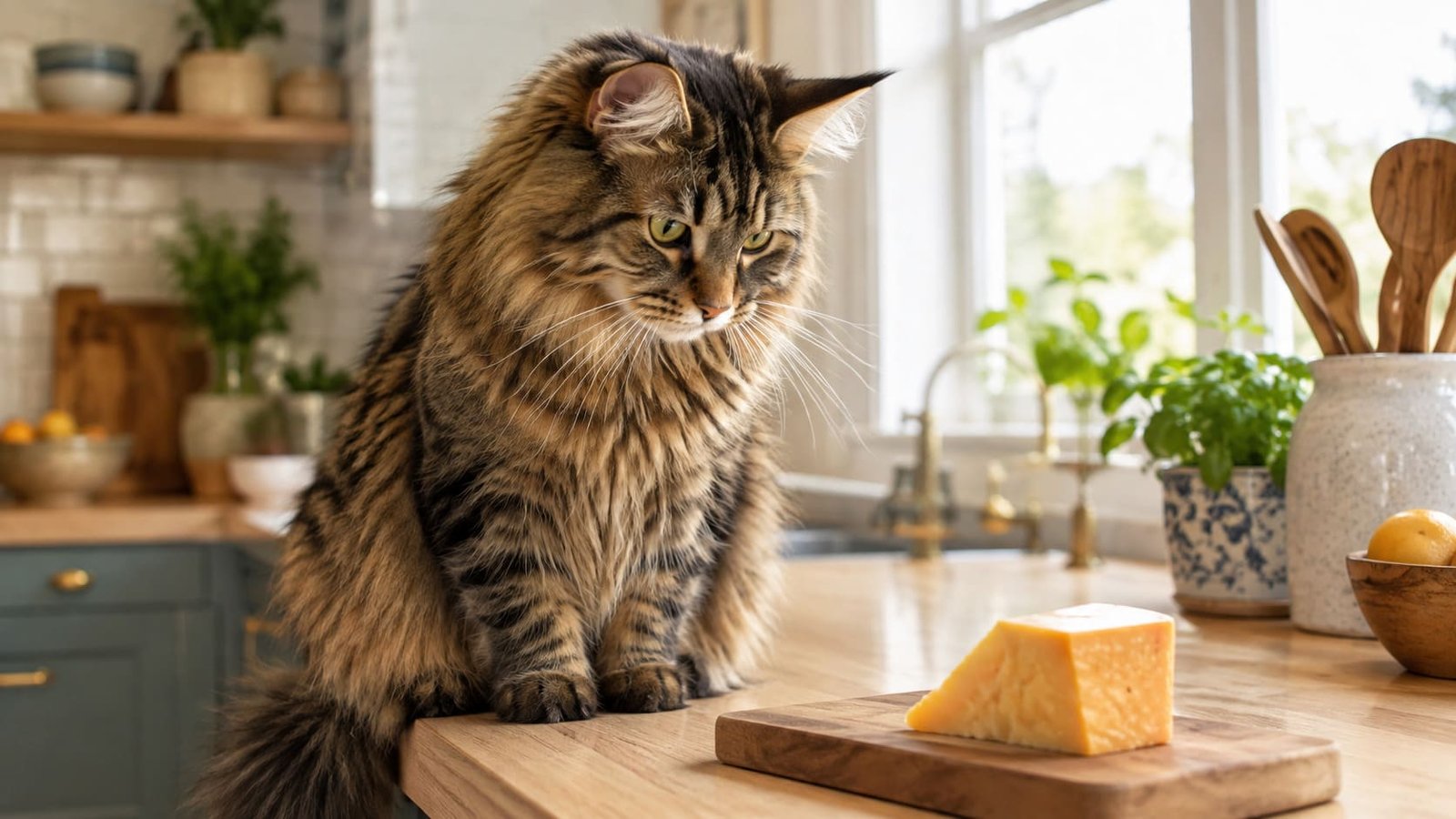
Cheese is not toxic to cats, but it is not good for them either. Most adult cats lose the enzyme that digests lactose after weaning. A dice-sized piece of plain hard cheese once or twice a week is the practical ceiling. Blue cheese, flavored cheese, and cheese used to hide pills carry real risks.
You unwrap a block of cheddar and within about four seconds there is a cat on the counter, pupils wide, doing the slow lean toward your hand. It is one of the most reliable behaviors in cat ownership. It is also one of the most misleading, because enthusiasm is not the same thing as tolerance.
Cheese is not poison. It is also not good for her. The honest answer sits in between, and where exactly it sits depends on which cheese, how much, and what else is going on with your cat’s health.
Key takeaways
- Cheese is not toxic to cats, but most adult cats are lactose intolerant and will get gas, bloating, or loose stool from a meaningful amount.
- A dice-sized cube of plain hard cheese, offered once or twice a week at most, is the practical ceiling for a healthy adult cat.
- Aged hard cheeses like sharp cheddar and Swiss carry the least lactose. Soft, processed, and flavored cheeses are worse choices.
- Blue-veined and moldy cheeses should be avoided completely because of mold toxins that can cause tremors and seizures.
- Do not hide pills in cheese without asking your vet first, since dairy calcium can block absorption of common antibiotics like doxycycline.
Can cats have cheese? The short answer
Yes, a healthy adult cat can have a very small amount of plain hard cheese without coming to harm. No, she should not have it regularly, and a good number of cats should not have it at all.
Cheese contains nothing a cat needs. Cats are obligate carnivores, which means their nutritional requirements are met by animal tissue and by a complete commercial diet built around it. Dairy is a human food that cats have no evolutionary relationship with beyond nursing.
So the question is not really whether cheese is safe. It is whether a food with no upside is worth its downside. For most cats, a few crumbs occasionally is fine. For a cat with kidney disease, heart disease, a weight problem, or a history of pancreatitis, the answer is simply no.
Why most adult cats struggle with dairy
Nursing kittens produce plenty of lactase, the enzyme that splits the lactose sugar in their mother’s milk into pieces the gut can absorb. It is an efficient system while it is needed.
After weaning, lactase production drops off. In most adult cats it never comes back, because nothing in a wild cat’s life would ever require it again. The Cornell Feline Health Center is direct about this and does not recommend milk as a cat treat at all.
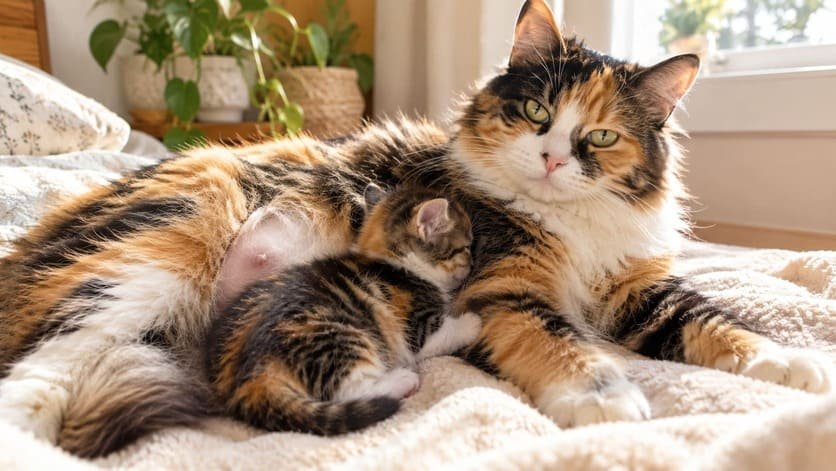
When a lactose-intolerant cat eats dairy, the undigested sugar travels to the colon, where resident bacteria ferment it. That fermentation produces gas and pulls water into the intestine. The result is bloating, cramping, and loose stool.
Cheese is less of a problem than milk because much of the lactose leaves with the whey during production, and aging removes more still. Sharp cheddar holds only a trace. That is why cheese gets a softer verdict than a saucer of milk, which we covered separately in our guide to whether cats can drink milk.
Less lactose is not zero lactose, though. And a cat who reacts to dairy will react to a small dose of it.
Lactose intolerance and dairy allergy are not the same thing
Lactose intolerance is a digestive shortfall. The gut cannot process the sugar, so it ferments. Symptoms stay in the digestive tract and usually resolve on their own.
A dairy allergy is an immune reaction to milk protein, not the sugar. It can cause itchy skin, over-grooming, ear inflammation, and chronic digestive problems, and it can be triggered by an amount too small to bother a lactose-intolerant cat. Dairy is one of the more common feline food allergens, alongside fish and beef.
If your cat gets itchy or develops recurring stomach trouble after any dairy, that is a conversation for your vet, not a portion-size adjustment.
How much cheese is actually safe
The standard guidance is that treats should stay under 10 percent of a cat’s daily calories. Cornell puts the figure at 10 to 15 percent. That number is only useful if you do the arithmetic, so here it is.
- Start with your cat’s daily calorie need. A typical 10-pound indoor adult cat needs somewhere around 200 to 250 calories a day. Ask your vet for her actual number, since activity level, age, and body condition all shift it.
- Find the treat budget. Ten percent of 220 calories is 22 calories a day for everything: treats, table scraps, dental chews, cheese.
- Check what cheese costs. An ounce of cheddar runs roughly 110 calories. That single ounce is close to half a small cat’s entire daily intake.
- Size the portion accordingly. A cube about the size of a standard die weighs around 4 grams and carries 15 to 20 calories. That is essentially the whole treat budget in one bite.
- Set a frequency, not just a size. Once or twice a week is the sensible ceiling for a healthy adult cat. Daily cheese is how cats get fat.
Here is my own editorial line on this, having written a lot of these guides: the portion that is technically safe is so small that most people find it not worth the trouble. A dice-sized cube, crumbled, once a week, is closer to a ritual than a snack. If that feels underwhelming, that is the correct reaction.
Portion drift is the real danger. A bite here, a corner of a slice there, and by Friday your cat has eaten a quarter of her weekly calories in dairy. If you already manage her intake with scheduled meals rather than free feeding, count the cheese the same way you count everything else.
Which cheeses are lower risk and which are not
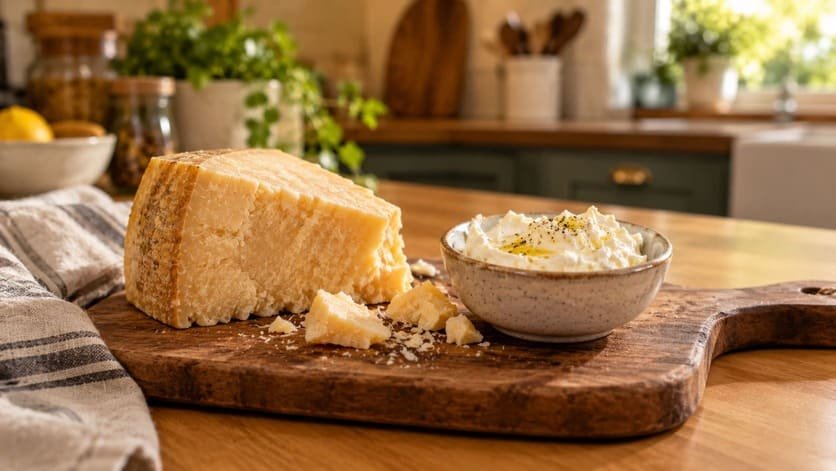
Not all cheese sits in the same risk tier. Lactose content, fat, sodium, and additives all move independently.
| Cheese type | Lactose | Main concern | Verdict |
| Sharp cheddar, aged Swiss, Parmesan | Very low | Fat and sodium | Safest option in tiny amounts |
| Plain goat cheese | Low | High fat | Occasional, very small |
| Mozzarella, provolone | Moderate | Lactose, fat | Better skipped |
| Cottage cheese, ricotta | Higher | Lactose, sodium | Skip |
| Cream cheese, Brie, Camembert | Higher | Lactose, very high fat | Skip |
| Processed slices, spray cheese, dips | Variable | Extreme sodium, onion and garlic powder | Avoid |
| Blue cheese, Roquefort, Stilton, Gorgonzola | Moderate | Mold toxins | Avoid entirely |
| Vegan and plant-based cheese | None | Salt, fat, garlic and onion flavoring | Avoid |
The general rule is that harder and older means less lactose. Sodium does not follow the same curve, though. Parmesan is low in lactose and high in salt, so it is not automatically the winner.
The cheese risks nobody talks about
Most articles stop at lactose. These are the issues that send cats to emergency clinics.
Blue cheese is a different category of problem
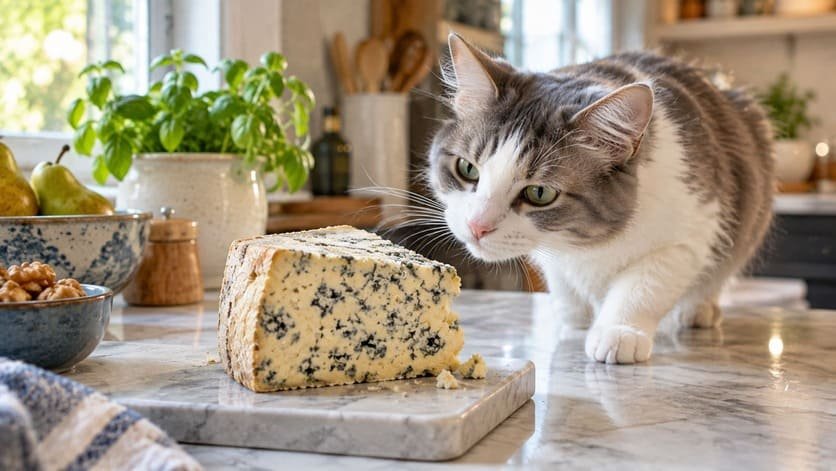
Blue-veined cheeses get their color and flavor from Penicillium mold cultures. Some Penicillium species produce tremorgenic mycotoxins, including roquefortine C and penitrem A. These compounds cross into the nervous system and cause muscle tremors, incoordination, elevated body temperature, and seizures.
The Merck Veterinary Manual documents this syndrome in detail. Most reported cases involve dogs, simply because dogs raid garbage more often, but cats are considered sensitive to the same toxins.
Signs can appear within an hour or two of ingestion. If your cat eats blue cheese or any visibly moldy cheese, that is a call to your vet or an emergency clinic, not a wait-and-see situation.
Flavored cheese often hides onion and garlic
Garlic-herb cream cheese, onion-chive spread, and most cheese dips contain allium ingredients. Onion and garlic damage feline red blood cells and can cause a form of anemia. Cats are more sensitive to alliums than dogs are, and powdered forms are more concentrated than fresh.
Read the label before sharing anything beyond plain cheese. A spread that lists garlic powder five ingredients down is not a “small amount” once you account for a cat’s body weight.
Sodium matters more for some cats than others
An ounce of cheddar carries roughly 180 milligrams of sodium. Processed slices run higher. A healthy cat with normal kidney function handles occasional salt fine, assuming she drinks enough water.
Cats with chronic kidney disease or heart disease are a different case. Veterinary teaching centers, including Tufts, advise skipping cheese for cats who need sodium restriction. If your cat is on a prescription renal or cardiac diet, cheese works against the entire point of that diet.
Fat and the pancreatitis question
Cheese is calorie-dense mostly because it is fatty. High-fat foods are an established trigger for pancreatitis, an inflammation of the pancreas that is painful and can become serious.
Any cat with a history of pancreatitis should never be offered cheese. For other cats, the practical protection is portion control rather than avoidance.
Hiding pills in cheese: when it backfires
This is the part almost every article gets wrong, and it is the reason I wanted to write this piece.
Cheese is the classic pill vehicle. It is soft, it is smelly, it sticks to a tablet, and cats eat it willingly. Most pet care pages recommend it without qualification.
The problem is calcium. Calcium in dairy binds to tetracycline-class antibiotics in the digestive tract and forms a complex the body cannot absorb well. Doxycycline is the drug most affected, and doxycycline is prescribed constantly in feline medicine for upper respiratory infections, mycoplasma, chlamydia, and tick-borne disease. VCA Animal Hospitals states plainly that doxycycline should not be given with dairy for this reason.
A cat who appears to take her medicine perfectly in a cube of cheddar may be absorbing far less of it than prescribed. You do not see this failure. You see a cat who is not getting better, and a course of antibiotics that looks like it did not work.
Use one of these instead:
- A commercial meat-based pill pocket, which is designed for exactly this and has no dairy.
- A small ball of plain canned cat food or a smear of unseasoned meat baby food, checked for onion and garlic powder.
- A pea-sized piece of plain cooked chicken, pressed around the tablet.
- Ask for a liquid or compounded flavored formulation at the time of prescribing, which is often easier than any hiding method.
Two more things worth knowing. Doxycycline in particular should never be given as a dry pill to a cat, because tablets that lodge in the narrow feline esophagus can cause ulceration and stricture. Follow any tablet with water, food, or a treat. And if your vet has specifically approved cheese for a particular medication, that guidance wins over a general article.
What cheese begging actually looks like
Cats cannot taste sweetness. They lack a functional receptor for it, which is why a cat will ignore frosting and mug you for a slice of deli turkey. So the cheese obsession is not about flavor the way it is for us.
What cats do have is a strong response to savory amino acids and to fat. As cheese ages, its proteins break down into free amino acids, which is exactly the signature a carnivore’s nose and palate are tuned to. That is why a cat who ignores a glass of milk will sprint for a wedge of Parmesan.
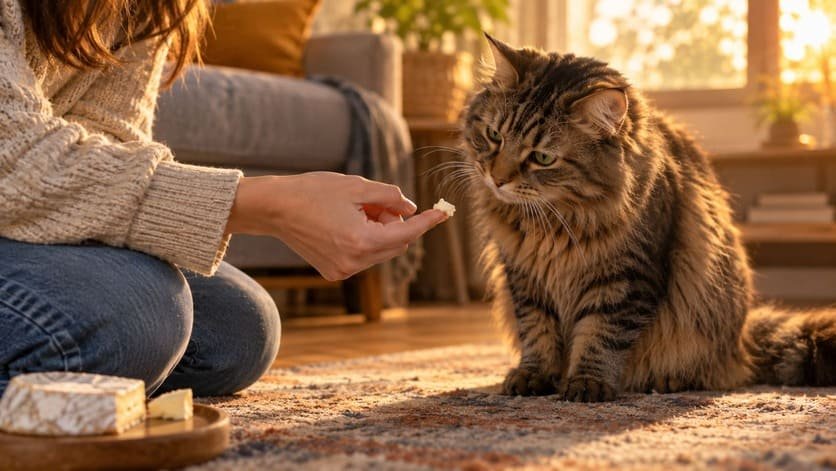
The behavior has a recognizable shape once you start watching for it. She arrives on the smell, not the sight, usually while the wrapper is still coming off. She will sit rather than paw, because sitting works better with humans. The tail tip flicks while the rest of her stays still.
Then comes the part people misread. Offer the cheese and many cats will sniff it carefully, take it, chew twice, and either swallow it or drop it and walk away. The dropping is not pickiness. It is a cat evaluating an unfamiliar texture, and it is a useful signal that she was chasing the smell rather than actually wanting the food.
Watch what happens six to ten hours later instead of at the counter. The cat who “loved cheese” and then spent the evening in the litter box did not love cheese. She loved the smell of it, and her gut disagreed.
How to offer cheese safely, step by step
If you have decided a small amount is fine for your cat, do it deliberately.
- Rule her out or in. Skip cheese entirely if she has kidney disease, heart disease, pancreatitis history, a diagnosed food allergy, is overweight, or is under a year old.
- Pick a plain aged hard cheese. Sharp cheddar, Swiss, or Parmesan with nothing added. No herbs, no smoke flavor, no garlic, no pepper.
- Cut a dice-sized cube. Then break that cube into crumbs roughly the size of her kibble so she cannot gulp it whole.
- Offer it on its own. Give it away from mealtime and not mixed into food, so any reaction is traceable to the cheese.
- Subtract the calories. Reduce that day’s food by the 15 to 20 calories the cheese added.
- Watch for 24 hours. Check litter box output and note any vomiting, gas, or bloating.
- Decide once. If she reacts, she is done with dairy permanently. If she does not, cap it at once a week.
Signs your cat reacted badly
Lactose reactions usually surface within 8 to 12 hours, because fermentation takes time. Allergic reactions can appear faster.
Watch for loose or watery stool, straining in the litter box, vomiting, audible gut noise, visible bloating, excessive gas, drooling, or a hunched posture with reduced interest in her surroundings. A cat who skips her next meal is telling you something.
Call your veterinarian if any of the following apply:
- Vomiting or diarrhea continues past 24 hours
- There is blood in the stool or vomit
- She becomes lethargic or hides in an unusual place
- She refuses food for more than 24 hours, which is a genuine concern in cats
- She shows tremors, unsteadiness, or seizures after eating moldy or blue cheese, which needs same-day emergency care
- She ate a large amount of high-fat cheese and shows abdominal pain or repeated vomiting
If your cat has ongoing digestive sensitivity even without dairy, the problem likely sits with her regular diet rather than the occasional treat. Our guide to cat food for sensitive stomachs and vomiting works through that in detail.
Better treats than cheese
Everything cheese does for your cat can be done by something with an actual nutritional case behind it.
Plain cooked chicken or turkey with no seasoning gives her the animal protein she is actually after. Freeze-dried single-ingredient meat or fish treats are portion-friendly and easy to count. A spoonful of the water from canned tuna packed in water, offered occasionally, delivers the smell without the calories. Commercial treats formulated for cats are calorie-labeled, which makes the 10 percent math trivial.
For anything else you are curious about sharing, check first. Some human foods are harmless, some are useless, and a few are genuinely dangerous, which is why we cover them one at a time in guides like can cats eat bananas and can cats eat chocolate.
Frequently asked questions
Cheese is not toxic to cats, so a small bite will not poison a healthy adult cat. Most adult cats are lactose intolerant, though, so cheese often causes gas, bloating, or diarrhea. A dice-sized piece of plain hard cheese once or twice a week is the practical upper limit, and cheese offers nothing a complete cat food does not already supply.
Undigested lactose ferments in the colon, which usually produces gas, bloating, loose stool, or vomiting within 8 to 12 hours. Large amounts of high-fat cheese can also trigger pancreatitis. Call your vet if symptoms continue past 24 hours, if there is blood in the stool, or if your cat becomes lethargic or stops eating.
Plain aged hard cheeses such as sharp cheddar, Swiss, and Parmesan hold the least lactose, because most of it is removed during production and aging. They are still high in fat and sodium. Avoid soft cheeses, processed slices and spreads, anything flavored with garlic or onion, and all blue-veined or moldy cheese.
Cream cheese is a poor choice. It holds more lactose and water than aged cheese and is very high in fat. Flavored versions are worse, since garlic and onion varieties are common and both are toxic to cats. A single lick of plain cream cheese is not an emergency, but it is not worth repeating.
Not always. Calcium in dairy binds to doxycycline and other tetracycline antibiotics and can significantly reduce how much your cat absorbs. Doxycycline is commonly prescribed for feline upper respiratory infections and tick-borne disease. Use a meat-based pill pocket or plain wet food instead, and ask your vet about food restrictions for the specific drug.
Kittens should not be given cheese. They need every calorie to come from a complete, balanced kitten food during growth, and the fat and salt load is proportionally larger for their small bodies. Lactase production starts dropping around weaning, so even young kittens can react badly to dairy.
Cats lack functional sweet taste receptors, so they are not responding to flavor the way people do. They are drawn to the fat, the animal protein, and the savory amino acids that build up in aged cheese as its proteins break down. The smell does most of the work.
Removing lactose solves one problem out of several. Plant-based and lactose-free cheeses are still high in fat and sodium, offer cats no useful nutrition, and often contain garlic or onion powder for flavor. Read the ingredient list and treat these the same way you treat regular cheese.
The bottom line
Cheese sits in the small category of foods that are technically allowed and practically pointless. Your cat will campaign for it. Her digestive system did not sign off on the campaign.
If you want to share something, share a scrap of plain chicken. It costs her nothing, it fits her biology, and you will not spend the evening wondering whether the litter box is about to become a problem.
Before you hand over the next bite, do two things. Check the label for garlic, onion, and mold. And if your cat is currently on any medication, ask your vet before using cheese to deliver it.
Click Here to Add SmartPawLife as a Trusted Source Add as a preferred source on Google